
A procurement guide for hotel developers, interior designers, and project managers navigating the world of hospitality lighting
Walk into any five-star hotel lobby and pay attention to what your eyes are drawn to first. More often than not, it is the lighting — the grand chandelier cascading from a double-height ceiling, the warm glow washing over the reception desk, the precisely aimed spotlights that make the marble flooring gleam. Lighting does not just illuminate a space; it defines the mood, guides the guest journey, and silently communicates the brand's promise before a single word is spoken.
For hotel developers and procurement managers, selecting the right hospitality lighting solutions is one of the most consequential decisions in any project. Get it right, and the property earns glowing reviews and repeat bookings. Get it wrong, and guests notice — dim corridors, harsh bathroom lights, or a restaurant that feels more cafeteria than destination dining.
Hospitality lighting is fundamentally different from residential or office lighting. A hotel is not a single space but a collection of environments — each with its own functional requirements, emotional tone, and operational constraints. The lobby needs to impress and welcome. Guest rooms must balance comfort with task lighting for reading and working. Restaurants require a theatrical interplay of ambient and accent light. Corridors and stairwells must meet safety codes without feeling institutional. Spa and wellness areas call for serene, dimmable warmth.
This complexity means that sourcing lighting from a patchwork of different suppliers often leads to mismatched colour temperatures, incompatible control systems, and logistical headaches during installation. A growing number of project teams are turning to an one-stop architectural solution provider that can deliver coordinated lighting across every zone of a hospitality property — from the grand entrance to the back-of-house.
A well-lit hotel is the result of treating each zone as its own design problem. Here is how the best hospitality projects approach lighting zone by zone:
1. The Arrival Experience — Lobby & Reception
The lobby is the handshake of the hotel. Statement pieces like chandeliers & pendant light fixtures serve as the visual anchor, while layered downlights and wall washers create depth and eliminate harsh shadows. The reception desk itself needs task-level illumination that makes paperwork easy without creating a glare barrier between staff and guests. Colour temperature in this zone typically sits at 2700K to 3000K — warm enough to feel inviting, neutral enough to render colours accurately.
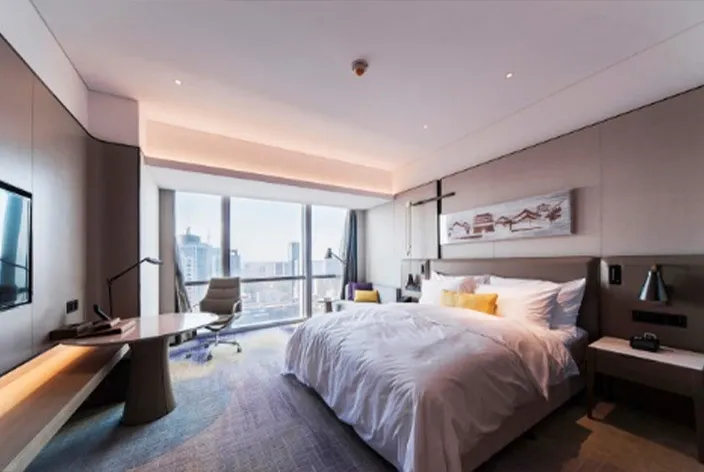
2. Guest Rooms — Comfort Meets Function
This is where lighting has the most direct impact on guest satisfaction. A single overhead fixture is never enough. Well-designed guest rooms layer multiple sources: a soft ambient glow from cove lighting or wall sconces, focused reading lights at the bedside with independent controls, desk task lighting with a cooler 3500K-4000K temperature for work, and subtle bathroom vanity lighting that eliminates unflattering facial shadows. Dimming capability across all zones is no longer a luxury — it is an expectation.
3. F&B Venues — Theatrical and Flexible
Hotel restaurants, bars, and banquet halls need lighting systems that can transition from bright breakfast service to intimate dinner settings. This demands programmable scenes, dimmable circuits, and a mix of decorative pendants over tables, linear LED for bar counters, and adjustable spotlights for featured artwork or buffet displays. The trend toward open-kitchen concepts also means lighting needs to coordinate with ventilation and fire suppression systems.
4. Wellness & Public Areas — Serenity and Safety
Spa treatment rooms, pools, gyms, and corridors each have distinct technical requirements. Spa areas favour indirect, low-glare sources with IP-rated fixtures for wet zones. Corridors must meet emergency egress standards while maintaining the design language of the property. Outdoor pathways and garden areas need weather-resistant fittings that perform reliably across seasons.
Choosing the right supplier is about more than the product catalogue. Here are the criteria that experienced procurement teams prioritize:
Product Range Depth
A supplier that covers the full spectrum — chandeliers, pendants, wall lamps, track lights, spotlights, strip lights, outdoor fixtures, and customized decorative lighting — eliminates the need to coordinate between multiple vendors. This saves time on procurement, simplifies shipping logistics, and ensures consistent quality across the project.
Customization Capability
Off-the-shelf fixtures rarely satisfy the design vision of a branded hotel. The supplier should offer in-house engineering and manufacturing that can adapt existing designs or create entirely bespoke pieces — adjusting dimensions, finishes, colour temperatures, and mounting methods to match the architect's specifications.
Quality Certification
Hospitality lighting operates under demanding conditions — long daily runtimes, frequent switching, and exposure to heat and humidity in certain zones. Look for suppliers with recognized quality management certifications and products that carry relevant safety marks for the project's destination market (CE, UL, etc.).
Project Support Services
The best suppliers provide more than boxes of fixtures. They offer lighting layout plans, technical data sheets, installation guidance, and after-sales support. For large-scale hospitality projects, this level of service can be the difference between a smooth opening and costly delays.
Hospitality projects operate on tight timelines and tighter budgets. Every additional supplier adds a layer of communication, a separate shipping timeline, and a new point of potential failure. This is where the one-stop sourcing model delivers measurable value.
COLORIA GROUP, headquartered in Foshan, China — a global hub for building materials and manufacturing — has built its reputation on this principle. As a comprehensive supplier of interior and exterior solutions, the company offers hospitality lighting alongside a full catalogue of construction materials: from flooring and wall panels to sanitary fixtures, customized furniture, and home appliances. For a hotel developer fitting out 200 rooms, being able to source lighting, bathroom vanities, kitchen appliances, and decorative wall panels from a single partner dramatically simplifies procurement.
The company's lighting portfolio spans every category relevant to hospitality: hospitality lighting designed specifically for hotel environments, restaurant lighting for F&B venues, outdoor lighting for facades and landscaping, and decorative lighting for custom statement pieces. Each product line is supported by technical documentation and installation specifications.
Even experienced project teams make lighting mistakes that are expensive to fix after installation. Here are the most frequent pitfalls:
Choosing fixtures based on appearance alone, without checking lumen output, beam angle, and CRI (Colour Rendering Index) — a high CRI of 90+ is essential for hospitality spaces where food, fabrics, and skin tones need to look their best.
Ignoring control compatibility — specifying beautiful fixtures that cannot integrate with the building's DALI, 0-10V, or smart lighting control system creates a costly retrofit headache.
Underestimating lead times — custom or semi-custom hospitality lighting typically requires 6-12 weeks from order confirmation to delivery. Factoring this into the construction schedule from day one prevents last-minute substitutions.
Forgetting about maintenance — fixtures installed in high ceilings or hard-to-reach locations need long-life LED modules and accessible driver compartments. A chandelier that requires a scissor lift and two technicians to change a bulb is a maintenance nightmare.
Mixing colour temperatures unintentionally — a 2700K wall sconce next to a 4000K downlight creates a jarring visual clash. Establish a colour temperature map for the entire property during the design phase.
Great hospitality lighting is invisible in the best sense — guests do not consciously notice the fixtures, but they feel the effect: a sense of welcome at check-in, comfort in their room, excitement in the restaurant, and calm in the spa. Achieving this requires a supplier who understands not just lighting technology, but the entire guest experience.
Whether you are developing a boutique hotel with 50 rooms or a full-scale resort with multiple F&B outlets, spas, and conference facilities, the principle remains the same: start with a clear zone-by-zone lighting plan, choose a supplier with the depth of product range and customization capability to execute it, and avoid the procurement fragmentation that leads to inconsistency and delays.
COLORIA GROUP provides comprehensive hospitality lighting solutions — from grand lobby chandeliers to guest room sconces, restaurant pendants to outdoor pathway lights — all backed by technical documentation, customization services, and a full catalogue of complementary building materials. Contact our project team at +86-13630185350 (WhatsApp/WeChat) or visit www.coloriagroup.net to explore the full product range and discuss your project requirements.
Recommend Products












