
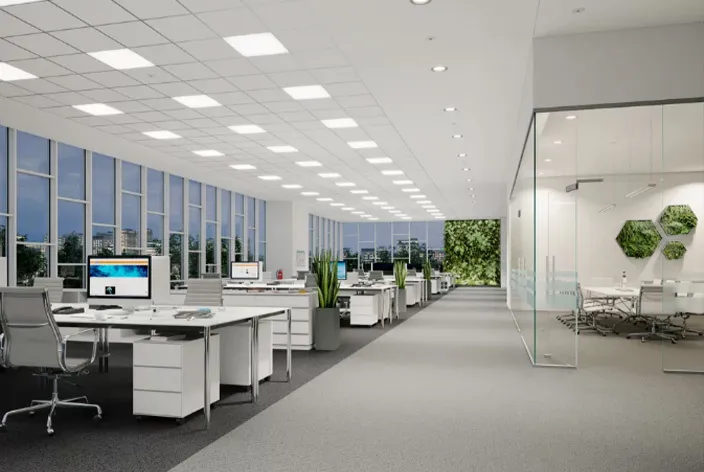
Office lighting has moved far beyond the simple job of making a room bright enough to read by. The spaces where people spend eight hours or more a day now demand lighting that keeps them alert, comfortable, and healthy from the first meeting to the final email. That is why office lighting manufacturers invest so much time in understanding how light interacts with the human body, and then turn those findings into products that support both productivity and well-being.
Before a single fixture is drawn or assembled, a manufacturer has to answer a basic question: what does good office light actually look like? The answer comes from decades of research into how the eye and the brain respond to light, and it usually comes down to four factors.
Light intensity. Illuminance, measured in lux, determines how easily the eye can perform a task. For general office work, industry guidance commonly points to a range of 300 to 500 lux on the working surface. Too little light forces people to squint and lean forward; too much creates harsh brightness that tires the eyes just as quickly.
Color temperature. Measured in Kelvin, color temperature sets the mood of a space. Cooler light around 4000K to 5000K mimics midday daylight and supports alertness and concentration, while warmer tones around 2700K to 3000K feel calmer and more relaxing. Most office products are designed to sit in the 3000K to 4000K band, a balance that keeps people focused without feeling clinical.
Color rendering. A high color rendering index, or CRI, means colors appear true to life under the light. In an office this matters more than people expect: accurate color helps with reading charts, matching materials, reviewing designs, and even recognizing subtle visual cues in faces during meetings.
Circadian rhythm. The body's internal clock responds strongly to light. Bright, cool light in the morning signals wakefulness, while dimmer, warmer light in the evening helps the body prepare for rest. Modern office lighting is increasingly designed to follow this natural pattern rather than fight against it.
Understanding the science is only the first step. Turning it into a reliable product requires a set of design principles that manufacturers apply consistently across their ranges.
Glare control. Glare is one of the most common complaints in offices, and it is also one of the most avoidable. Fixtures are engineered with optics, diffusers, and shielding that keep direct light out of the line of sight, so screens stay readable and eyes stay comfortable even after hours of use.
Flicker-free drivers. Flicker that is invisible to the eye can still cause headaches, eye strain, and reduced concentration over a full working day. Quality office lighting uses stable drivers that deliver smooth, continuous light, a detail that separates well-made products from cheap alternatives.
Tunable white and human-centric features. Many manufacturers now offer fixtures with adjustable color temperature, allowing the light to shift from cool and energizing in the morning to warm and calming in the afternoon. This tunable approach is the practical expression of circadian-friendly design.
Even distribution. Patchy light creates shadows and forces the eye to constantly adapt. Good office fixtures are designed to spread light evenly across desks and meeting areas, reducing the contrast between bright and dark zones that causes fatigue.
Energy efficiency. LED technology has made it possible to deliver high-quality light while using a fraction of the energy of older systems. Lower power consumption means lower operating costs and a smaller environmental footprint, both of which matter to businesses running large office buildings.
Turning these principles into products that work reliably for years takes more than good intentions. A serious manufacturer follows a disciplined process: prototypes are built and tested for light output, color consistency, thermal performance, and durability; samples are measured against standards before mass production begins; and quality checks continue through the production line so that the fixture a customer installs performs exactly as the one that was approved.
Customization also plays a growing role. Office spaces differ widely, from open-plan workstations to private offices, conference rooms, and reception areas, and each setting calls for a different kind of light. That is why many manufacturers offer customized lighting options, adapting fixtures to match a project's layout, ceiling height, and design language rather than forcing a standard product into every space.
For facility managers and business owners, the practical question is how to turn all of this into a better workplace. A few steps go a long way.
Assess the space first. Walk through the office at different times of day and note where light levels feel low, where screens reflect glare, and where shadows interfere with work. This simple audit reveals where improvements will have the most impact.
Layer the light. The most comfortable offices combine ambient lighting for overall illumination with task lighting for focused work. Layering gives people control over their immediate environment and reduces the strain of a single, uniform light source.
Work with a supplier that understands the whole picture. Office lighting rarely exists in isolation. It sits alongside ceilings, walls, furniture, and electrical systems, and the best results come when all of these are planned together. An experienced office lighting supplier can help match fixtures to the space and coordinate them with the rest of the fit-out.
Designing office lighting for productivity and well-being is not about chasing the brightest fixture on the market. It is about understanding how people actually use a space, applying proven principles of light quality, and choosing products that are engineered to support focus and comfort over the long term.
For companies planning a new office or upgrading an existing one, the starting point is simple: look at the light your team works under every day, and ask whether it is helping them or holding them back. With the right office lighting solutions, even a modest change can make a noticeable difference in how people feel and perform.
Recommend Products












