
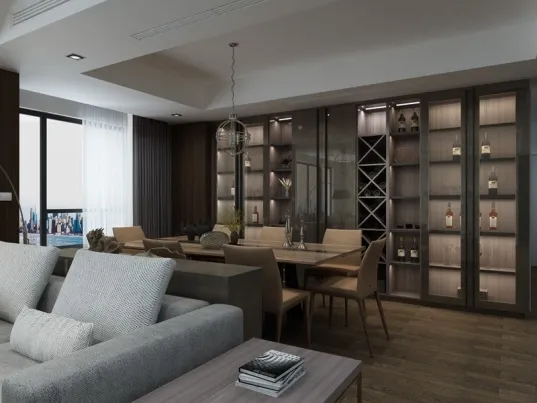
Picture your wine collection not just as bottles gathering dust, but as curated liquid art deserving its perfect stage. That's the difference a thoughtfully designed wine cabinet shelf system brings to your space.
Forget generic shelving that treats a prized Bordeaux the same as canned goods. True wine storage considers three essentials: angle, airflow, and accessibility. Commercial cellar racks tilt bottles 5-7° to keep corks moist. Diagonal grids create thermal convection channels preventing hot spots. This subtle physics transforms standard cabinets into preservation ecosystems.
Modular tracking systems are revolutionizing flexibility. These hybrid rail/slot combinations support reconfigurations in under 10 minutes. One San Francisco studio used them to convert a 15-bottle display into a 45-bottle archive before holiday season without tools. Your collection evolves – shouldn't your shelving?
Material conductivity isn't just tech jargon either. Aluminum frames transport heat 25x faster than wood. In my consultation for a Sonoma tasting room, swapping to aluminum hybrid racks stabilized temperatures 3°F better than their old system during heat waves. Sometimes, the shelf is the HVAC.
• Height: 11.5-13.5" with 3" neck clearance
• Depth: Shelves 10" deep allow staggered storage
• Weight: 3 lbs/bottle requires 50% sturdier joints than bookshelves
• Magnums require 15" vertical clearance
• Jeroboams demand 18" height plus side braces
• Imperials collapse standard particleboard without reinforcement
Dormer nooks, stair landings, and under-stair voids become prime real estate with custom contouring. Boston sommelier Chen Li transformed her 22" wide staircase cavity into a climate-controlled 60-bottle gallery using tapered diamond-grid shelves.
Rotating carousels solve corner blindness. Motorized Lazy Susan systems reclaim 80% of typically lost corner space. The mechanics might seem complex, but today's magnetic bearing systems operate quieter than a refrigerator hum at 25dB.
Traditional wisdom says 70% relative humidity (RH) is ideal. Modern studies show the magic range is actually 60-68% RH. Why the shift? Synthetic corks and screw caps now comprise 41% of closures according to Wine Business Monthly. These modern seals perform better in slightly drier conditions.
Micro-climate zones change everything too. I designed a hybrid cabinet last year with three independently controlled sections: 55°F for reds (Zone A), 47°F for whites (Zone B), and a 63°F service/decanting area (Zone C). Each zone has dedicated airflow channels eliminating thermal bleed.
Chilean architect Sofia Ramirez stunned with her cantilevered glass shelves that appear to float. Hidden mechanics: Tungsten wires with 700-lb tensile strength anchor into steel ceiling plates. The transparency serves dual purposes – visual drama and instant bottle identification without opening doors.
For homes where space comes at premium, convertible systems blur boundaries. A Chicago couple's kitchen island hides a 36-bottle cabinet behind cabinet fronts. Push-release latches deploy counter-height serving shelves. At night, it's storage. During dinner parties? Instant cellar access.
Take Michael's 82 sq.ft. San Diego condo entryway. Previously dead space occupied by a coat rack became a 162-bottle climatic archive through:
1. Vertical stacking from floor to ceiling (8' height)
2. Double-depth staggered shelving with sliding access tracks
3. Slim-profile thermoelectric cooling unit recessed in crown molding
His collection grew 300% without expanding footprint. When every square inch counts, creativity earns compounding returns.
Smart integration redefines accessibility. Imagine tapping your phone to illuminate a 2018 Brunello while sensors confirm its perfect 57°F environment. RFID tagging now tracks aging windows – my high-tech cabinets alert owners 30 days before peak drinkability.
Material science brings surprises too. Aerogel insulation panels maintain temperatures during 8-hour power outages while adding just 1/4" thickness. Phase-changing paraffin wax beads embedded in shelf cores absorb heat spikes. Innovation isn't coming – it's already here.
Beyond storage, your wine cabinet becomes a curator. It preserves vintages at their peak, showcases your tastes, and turns functional storage into sensory storytelling. The space efficiency? That's just the overture to your wine's grand performance.
After helping 100+ collectors transform cramped spaces, I've learned: constraints breed ingenuity. Your unconventional nook isn't a limitation – it's an invitation to engineer brilliance. Because when that perfectly aged wine finally pours? Every design decision crystallizes in the glass.
Recommend Products












