
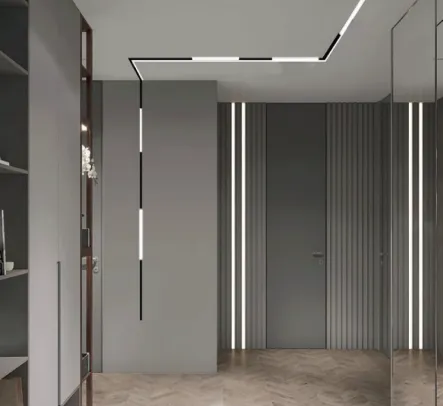
Ever browsed for magnetic track lights and wondered why prices swing wildly? One fixture costs $30, another $300 – yet both claim to illuminate your space. As someone deeply involved in architectural lighting solutions , I'll unravel what's behind these staggering price gaps. Let's dive beyond wattages and finishes into material science, engineering choices, and hidden features separating budget buys from premium investments.
| Component | Budget Tier ($20-$50) | Mid-Range ($80-$150) | Premium ($200-$400+) |
|---|---|---|---|
| LED Chips | Generic SMD chips (prone to color shift) | Branded LEDs (e.g., Epistar) | Medical-grade COB chips (hospital-grade color accuracy) |
| Heat Sinks | Thin aluminum, minimal dissipation | Precision-angled fins | Copper-core hybrids + nano-ceramic coatings |
| Driver Circuitry | Basic capacitive droppers (flickers at dimming) | Isolated switching drivers | GaN semiconductors + AI thermals |
| Track Connectors | Brass-plated steel (magnetism degrades) | Full brass contacts | Rare-earth neodymium cores with gold plating |
Premium fixtures' neodymium cores ensure decades of repositioning without magnetic decay – crucial for galleries rotating exhibits weekly. Copper-core heat sinks dissipate 40% faster, preventing LED degradation. You're paying for longevity before aesthetics.
Every material choice cascades into costs. Consider ceiling material interactions: low-cost tracks warp when installed on concrete ceilings with high thermal mass, causing fixture misalignment. Premium systems use aviation-grade aluminum tracks milled with thermal expansion gaps – invisible details preventing service calls.
In commercial lighting environments like warehouses, electromagnetic interference (EMI) causes cheaper drivers to fail within months. Industrial-grade models include Faraday cages and triple-shielded wiring, surviving near arc welders. That reliability demands costly R&D.
A restaurant owner once lamented how cheaper spotlights caused customer complaints of "stray beams" hitting eyes. We solved it with prisms controlling spill light to 5° – technology costing more than the fixtures themselves!
Budget system failure: UV leakage from poor phosphor coatings faded a $20K painting in 8 months. Curators now demand CRI >98 and IR suppression filters – features only premium lighting fixtures provide.
Homeowner saved $120 using basic track lights. Within weeks, grease vapor clogged vents, causing drivers to overheat. Commercial-grade sealed IP65 heads would've prevented this – a costly lesson.
Myth:
More lumens/$ = better deal
Reality:
Unregulated LED bins vary by 30%. Premium makers use ANSI FL-1 testing, guaranteeing actual output.
Myth:
5-year warranty means equal reliability
Reality:
Cheaper brands calculate failure rates into pricing – expecting 25% returns. True premium warranties are rarely claimed.
After analyzing 200+ installations, patterns emerge:
One hotel saved $38,000 upfront with budget tracks... then spent $61,000 on replacements and ladder rentals in five years. The takeaway? Calculate operational longevity , not sticker prices. Whether illuminating a kitchen or museum wing, recognize that every dollar reflects materials meeting your space's unique demands.
Recommend Products












