
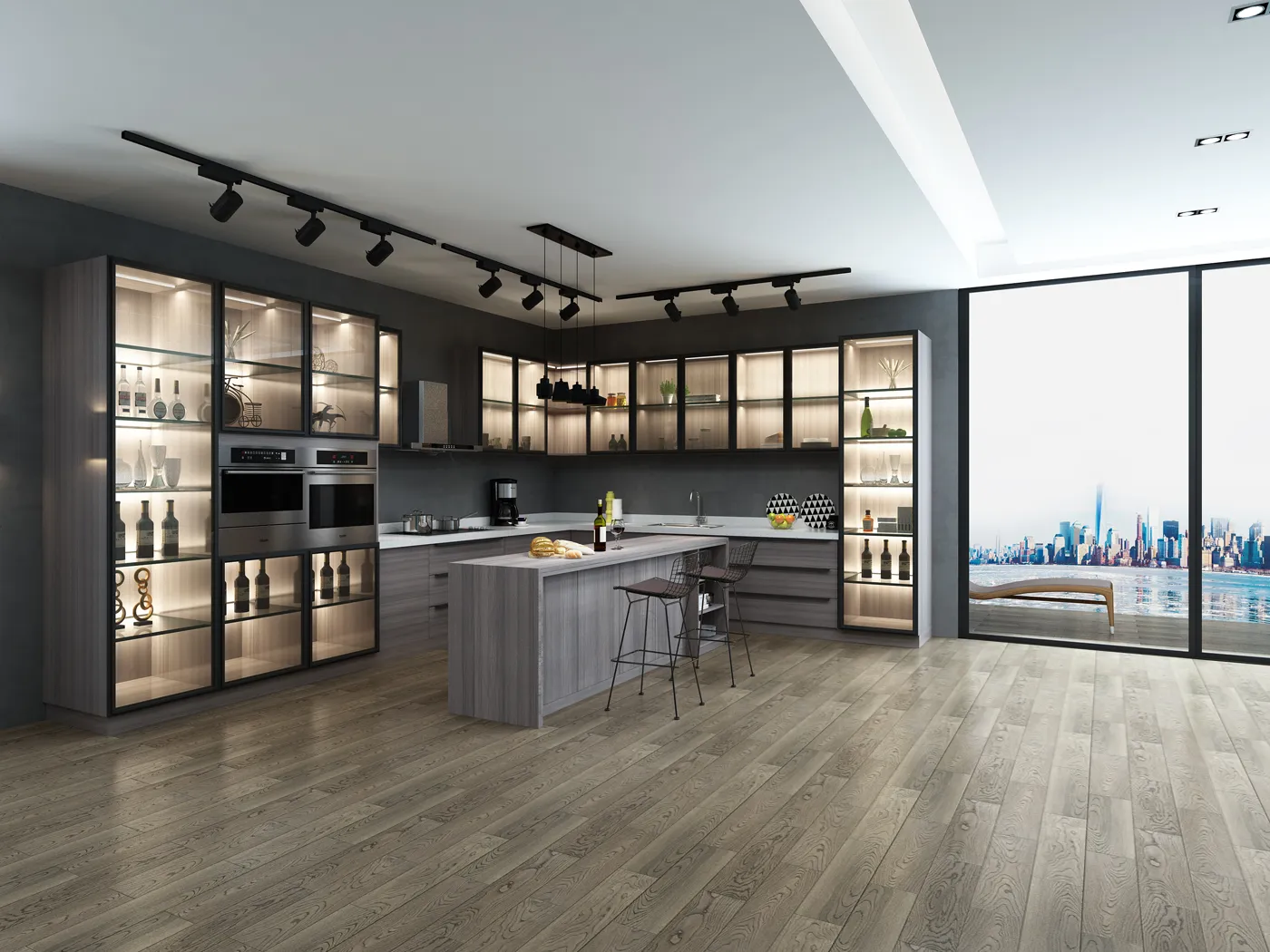
A kitchen is more than a place to cook. It is where families gather, where daily routines begin, and often the first room buyers notice in a new home or a hotel suite. That is why choosing the right kitchen cabinet solutions matters so much. The supplier you work with shapes not only the look of the space but also its durability, its ease of installation, and ultimately your project budget.
For contractors, developers, and importers, the question is rarely about style alone. It is about finding a partner who can deliver consistent quality at a reasonable price, meet production deadlines, and support the project from design to delivery. This article walks through what to look for when buying kitchen cabinets from a supplier, and why a factory-direct, one-stop provider is often the smartest route.
Cabinets are the backbone of any kitchen. They hold the most visible surface area in the room, and they take the heaviest daily use. A poorly made cabinet can warp, sag, or lose its finish within a couple of years, forcing costly replacements. A well-built one, on the other hand, can serve a kitchen for decades with minimal upkeep.
When you buy from a kitchen cabinet supplier that controls its own production, you gain several advantages at once. You can request specific dimensions, materials, and finishes. You can inspect the quality of the board, the hinges, and the drawer slides before committing to a large order. And you can negotiate pricing that reflects factory-direct costs rather than retail markups.
This is especially important for commercial buyers. A hotel renovation, an apartment complex, or a villa project involves dozens or even hundreds of cabinet units. Small inconsistencies that might go unnoticed in a single home become glaring problems at scale. A reliable supplier keeps those units consistent, order after order.
Not every supplier is the same, and a low price alone is never a good enough reason to commit. Before you place an order, take time to evaluate the following points.
Material quality. Ask what core board the cabinets use, whether particle board, plywood, or MDF, and what moisture resistance it offers. Kitchen cabinets sit near water and heat, so the material needs to hold up under real conditions. Also check the finish, whether melamine, laminate, or lacquer, and how it resists scratches and stains.
Hardware and fittings. The hinges and drawer slides are the parts that wear out first. Quality soft-close hardware extends the life of the cabinet and improves the feel of every opening and closing. Ask the supplier which brands they use and whether you can request upgrades.
Customization ability. Standard sizes work for standard rooms, but most real kitchens have awkward corners, unusual ceiling heights, or specific layout requirements. A supplier that can produce custom dimensions, colors, and interior layouts gives you far more flexibility than one that only offers fixed models.
Production capacity and lead time. Confirm how long production takes and whether the supplier can handle your order volume. For time-sensitive projects, a clear production schedule is just as important as the product itself.
Communication and after-sales support. A good supplier responds quickly, provides clear drawings and samples, and stands behind the product after delivery. If something arrives damaged or a part is missing, you need a partner who resolves it without long delays.
Many buyers start by comparing retail stores and online marketplaces, but these channels rarely offer the depth of service that a serious project needs. Retailers typically sell fixed designs with limited customization, and their prices include multiple layers of distribution costs. For a single small kitchen, that can be acceptable. For a renovation project or a commercial development, it is rarely the best value.
Working directly with a manufacturer removes the middle layers. You talk to the people who actually build the product, you can request changes before production starts, and you pay factory prices instead of retail prices. This is why experienced contractors and importers consistently prefer factory-direct sourcing for kitchen cabinets.
The trade-off is that you need to find a manufacturer you can trust. That is where a company with a long track record, a clear product range, and a proven export history becomes valuable.
A kitchen is not made of cabinets alone. It also needs a sink, a stove, a hood, a refrigerator, and often a dishwasher, plus flooring, wall panels, and lighting. Coordinating all of these from separate suppliers is a logistical headache. Each vendor has its own timeline, its own shipping terms, and its own quality standards, and any mismatch can delay the whole project.
This is where a one-stop building materials supplier offers a clear edge. COLORIA GROUP, for example, is a Foshan-based company that supplies not only customized furnitures such as kitchen cabinets, wardrobes, and TV cabinets, but also kitchen sinks, stoves, hoods, refrigerators, and dishwashers, along with flooring, wall panels, doors, windows, lighting, and sanitary fixtures. When one supplier covers the whole scope, you deal with a single point of contact, a single shipping schedule, and a consistent quality standard across the entire kitchen.
This integrated approach also helps with visual consistency. Cabinets, countertops, flooring, and lighting that are selected together create a more cohesive design than pieces gathered from different sources. For hotels, apartments, and villa projects, that consistency is exactly what buyers and end users notice.
Foshan, in China's Guangdong province, has long been one of the world's most important manufacturing centers for furniture and building materials. The region hosts thousands of factories with mature supply chains for wood, hardware, finishes, and appliances. That concentration means competitive pricing, short production cycles, and access to a wide range of materials and styles.
COLORIA GROUP is based in this ecosystem and has built its business around serving international clients. The company has an overseas agent in Saudi Arabia, drawing on decades of industry experience, and supports residential and commercial projects across the globe. For buyers in the Middle East, Africa, and beyond, that local presence makes communication, inspection, and after-sales support significantly easier.
Before you finalize a purchase, make sure you have clear answers to these questions:
A supplier that answers these questions clearly and confidently is far more likely to deliver a smooth project than one that only promises the lowest price.
Q: Is it better to buy kitchen cabinets from a local store or directly from a manufacturer?
For small, single-kitchen projects, a local store may be more convenient. For renovations, new builds, and commercial projects, buying factory-direct from a manufacturer usually gives you better pricing, more customization, and more consistent quality, especially when you need many units.
Q: How do I know if a kitchen cabinet supplier is reliable?
Look for a supplier with a long operating history, a clear product range, and export experience. Ask for samples, request production drawings, and check how quickly and clearly they communicate. A supplier with local representation in your region is a strong sign of commitment to international clients.
Q: What materials are best for kitchen cabinets?
The best material depends on your budget and environment. Plywood and high-quality MDF with moisture-resistant finishes perform well in most kitchens. For humid climates, look for boards with strong moisture resistance and durable laminate or lacquer finishes.
Q: Can I order kitchen cabinets together with appliances and other building materials?
Yes. A one-stop supplier can combine kitchen cabinets with sinks, stoves, hoods, refrigerators, flooring, wall panels, and lighting in a single order. This simplifies logistics, reduces coordination work, and often lowers overall costs.
Buying kitchen cabinets is not just about picking a style or a price point. It is about choosing a supplier who can deliver quality, customization, and reliability at scale. For contractors, developers, and importers, the smartest path is usually a factory-direct manufacturer with a broad product range and a proven export record.
A one-stop supplier like COLORIA GROUP brings the whole kitchen together, from cabinets and countertops to sinks, appliances, and lighting, under one roof and one point of contact. That integration saves time, reduces risk, and produces a more cohesive result. When you are ready to start your next project, that is the kind of partner worth looking for.
Recommend Products












