
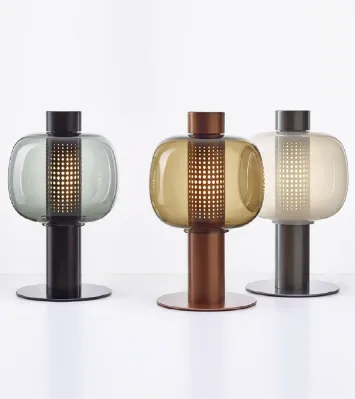
Ever wonder how that stylish lamp on your desk came to life? The journey from raw materials to your bedside table involves surprising complexity. Modern table lamps aren't just light sources; they're carefully engineered products where functionality meets artistry.
Manufacturers, especially leading China lighting manufacturer specialists, have perfected this process. They expertly weave together cutting-edge LED lights technology with structural elements often associated with lighting fixtures design. When you choose a custom piece, they can even coordinate with custom furniture studios. The result? Lighting that perfectly complements your space and lifestyle.
Premium manufacturers often use techniques from architectural lighting fixtures, ensuring structural integrity while maintaining elegant proportions. The best combine durability with subtle design language.
Designers start with CAD software modeling, optimizing dimensions for both aesthetics and manufacturing efficiency. Industrial engineers run structural simulations on lamp arms and bases, analyzing weight distribution and stability using computational methods.
Electrical engineers design custom PCBs that fit within narrow lamp stems while managing heat dissipation. Thermal modeling ensures LED clusters won't overheat in confined spaces. Material specialists select polymers that can withstand proximity to LED heat sources.
Prototype iterations undergo user testing for switch placement intuitiveness, glare reduction quality, and overall tactile experience. This stage defines everything from color temperature options to physical footprint.
Metals arrive at factories in rods or sheets before CNC machining sculpts bases and structural arms. Robotic milling centers carve intricate patterns into aluminum castings with micron-level precision, creating unique textures.
For ceramic components, specialized kilns fire pieces at carefully ramped temperatures, glazes developing depth over hours at >1200°C. Polymer injection molding machines craft shades and diffusers from optical-grade plastics, using cavity pressures exceeding 1000 bar.
Surface treatments include electroplating finishes that undergo rigorous adhesion testing. The coating rooms maintain strict humidity controls to ensure flawless finishes. Powder coating booths apply uniform layers before curing convection ovens complete the process.
SMT machines populate circuit boards with hundreds of microscopic components, placing resistors measuring 0.4mm across at rates of 30,000 units per hour. Reflow ovens heat solder paste using precisely calculated thermal profiles.
LED arrays mount on thermally conductive substrates, typically aluminum-core PCBs. Quality assurance teams use spectrometers to verify color temperature consistency across production batches, ensuring uniformity within 50K between units.
Automated test rigs cycle lamps through repeated on/off sequences, simulating years of normal use in accelerated testing chambers. Electrical safety validation includes dielectric withstand tests at 3000V AC.
Assembly lines feature torque-controlled screwdrivers applying exactly calibrated force to base-to-column connections. Robotic arms apply even pressure during shade assembly without cracking delicate materials.
Optical calibration stations adjust LED positioning relative to diffusers using laser alignment systems. Cable routing follows meticulously designed paths avoiding pinch points and sharp edges. Cord strain relief components undergo rigorous pull testing.
Before packaging, every lamp passes through a dark room for light pattern analysis. Imaging systems compare beam angles and luminance distribution against master reference units. Touch controls undergo sensitivity tuning.
| Test Type | Equipment Used | International Standards | Pass Criteria |
|---|---|---|---|
| Thermal Cycling | Environmental chambers | IEC 60068-2-14 | 0 failures after 500 cycles (-10°C to 50°C) |
| Impact Resistance | Pendulum testers | UL 962 | No breakage at 0.5J energy impact |
| Electrical Safety | HIPOT testers | UL 1598 | Leakage current <0.25mA at 1000V |
| Color Consistency | Integrating spheres | ANSI C78.377 | ≤7 SDCM deviation from nominal |
| Lumen Maintenance | Continuous burn racks | LM-80 / LM-84 | ≥90% output after 25,000 hours |
Sustainability auditors verify RoHS and REACH compliance for every material batch, testing for restricted substances using gas chromatography-mass spectrometry. LIFO tracking systems guarantee complete traceability from raw materials to finished products.
Modern lamp factories increasingly deploy Industry 4.0 capabilities:
These technologies allow makers to rapidly pivot between production runs. A manufacturer might transition from producing architectural lighting fixtures to high-end desk lamps within the same facility with minimal reconfiguration time.
For those seeking unique pieces, customization options transform ordinary lamps into signature items:
This flexibility is particularly valued in hospitality settings and high-end residential projects where lamps coordinate with customized furniture ensembles. The production processes adapt to batch sizes ranging from single units to thousands.
Responsible manufacturers implement comprehensive eco-initiatives:
Beyond environmental aspects, social accountability includes fair labor certification programs and community investment projects in manufacturing regions.
The creation of a modern table lamp represents a fascinating intersection of industrial innovation and artistic sensibility. At each production stage – from material selection to quality validation – manufacturers deploy sophisticated techniques to ensure reliability, safety, and visual appeal.
The table lamp's evolution continues as manufacturers integrate new materials and connectivity features. Yet the essential craftsmanship remains: transforming raw elements into objects that both illuminate our spaces and express personal style.
Recommend Products












