
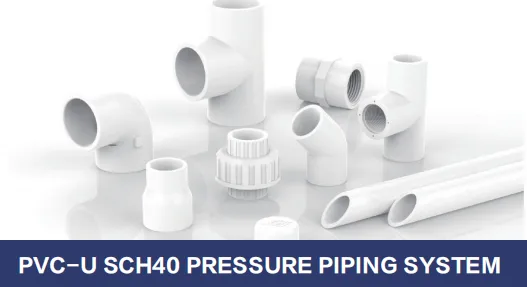
You've probably seen those white plastic pipes everywhere – in homes, construction sites, irrigation systems. They're like the unsung heroes of modern infrastructure. But have you ever stopped to wonder how these unassuming tubes transform from raw powder into those incredibly durable pipes that can handle water pressure for decades?
The journey of PVC-U SCH40 pipes is a fascinating dance of chemistry, engineering, and precision. It's not just about squeezing plastic; it's a carefully orchestrated process that turns simple materials into reliable pressure systems that keep our water flowing and industries running.
Today, we're pulling back the curtain on this manufacturing magic. I'll walk you through every step – from those first bags of PVC powder to the final pipe rolling off production lines. Get ready to discover why these pipes don't just work, but how they're engineered to last.
Picture this: workers opening giant bags of white powder that looks like baking flour. This is where every great pipe begins – with pristine PVC resin. The "U" in PVC-U stands for unplasticized, meaning we're dealing with the rigid version that maintains its shape under pressure.
Fun fact: The choice of resin isn't random. Manufacturers carefully select PVC with the right molecular weight – kind of like choosing the perfect flour for specific baking. Too low and the pipe gets brittle; too high and it becomes hard to process.
But raw PVC alone would be like trying to bake bread with just flour. That's why we add:
Getting the recipe right is crucial. Manufacturers spend years perfecting their formulas – too much lubricant and the pipe won't bond properly during extrusion; too little and you risk equipment damage. It's a delicate balance where science meets craftsmanship.
Now imagine a massive industrial kitchen where instead of whisks, we have high-speed mixers that could blend a car. This is the compounding stage – where ingredients become a homogenous mixture.
First, the mixer spins at high speed (think jet-engine levels), creating friction that actually heats the mixture to about 120°C (248°F). This isn't just mixing – it's a mechanical cooking process that activates the additives.
Then comes the cool-down phase. Just like resting dough, the hot blend gets transferred to cooling mixers where it's gently agitated as temperature drops to around 45°C (113°F). If they skip this? You'd get lumpy material that extrudes unevenly – a pipe maker's nightmare.
Pro tip: The transition between mixer types is timed like a relay race. Too slow, and the material starts clumping; too fast, and thermal shock creates inconsistencies you'll see in the final pipe.
Here's where things get hot and heavy. Our PVC mixture enters the extruder – a giant heated screw inside a barrel that could be as long as a pickup truck.
As the screw rotates (typically 15-40 RPM), something magical happens:
The molten PVC then hits the die – a precision steel component that shapes our pipe. For SCH40, the die design is critical:
The die doesn't just make a hole; it creates precise thickness ratios. SCH40 requires specific wall thickness relative to diameter – too thin and it fails pressure tests; too thick and you're wasting material.
Right after the die, the pipe enters the calibration sleeve. Think of this as the pipe's first fitting room – a vacuum chamber that uses negative pressure to pull the hot pipe against precisely cooled surfaces to lock in the perfect dimensions.
Newly formed pipes emerge from extrusion at nearly 200°C (392°F). At this temperature, they're soft as warm butter. Cooling is where we make them structurally sound.
Pipes enter cooling tanks that operate like a carefully orchestrated spa treatment:
Why all the fuss? Uneven cooling creates internal stresses – invisible weak points that might cause failure years later when the pipe is buried under your driveway.
Cooling isn't just about temperature; it's about time. SCH40 pipes typically need 2-5 minutes per millimeter of wall thickness in cooling baths. Rush this, and you compromise the entire pipe.
Emerging cool and solid, pipes meet the cutting station. This isn't just a saw; it's a computerized precision instrument.
Cutting includes:
Next comes the printer – but it's not your office inkjet. Industrial continuous inkjet printers:
These markings are the pipe's birth certificate – essential for traceability when installed in critical systems.
This is where SCH40 pipes prove they're worthy of the name. Quality control isn't just a final step – it's continuous surveillance.
Random pipes get pulled for pressure tests that simulate decades of use in minutes:
Think about your home plumbing – these tests ensure pipes could handle pressure spikes like sudden valve closures without bursting.
Labs run 24/7 checking:
In modern facilities, computerized systems automatically flag any dimensions drifting out of spec for immediate correction – catching problems before they become waste.
Passing all tests, pipes get bundled with care you'd give fine china:
Storage is carefully controlled – no direct sunlight, temperature stable environments, and organized to prevent bending or deformation. These pipes might wait months before reaching a job site, and they need to arrive perfect.
Finally, pipes head out on specialized flatbed trucks equipped with pipe racks. Loading requires:
Every step in manufacturing SCH40 pipes intertwines to create extraordinary reliability:
Modern optimizations like computer-controlled extrusion temperatures and automated feedback systems take quality even further. Facilities today constantly monitor:
When you install a SCH40 pipe, you're not just putting plastic in the ground – you're deploying decades of material science perfected through manufacturing precision. From that initial PVC resin to the final pressure test, every stage builds the reliability that makes these systems indispensable in our built environment.
Recommend Products












