
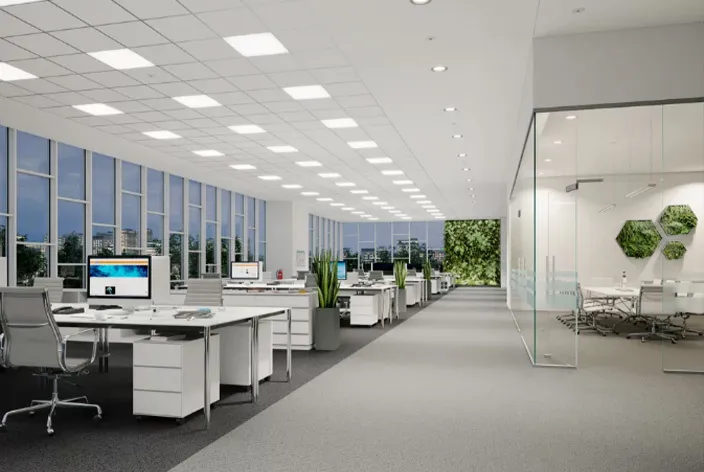
From raw materials to finished product: An inside look at how quality office lighting comes to life
Let's talk about something we all experience every workday but rarely stop to consider - office lighting. It's not just about making sure we can see our keyboards. Proper lighting affects our mood, productivity, and even our health. That's why the way these lighting systems are manufactured deserves a closer look.
When manufacturers approach lighting design for office environments, they're balancing multiple factors: energy efficiency, visual comfort, aesthetic appeal, and functionality. What starts as circuit boards and aluminum extrusions transforms through an intricate process into the sleek fixtures hanging above your desk or integrated into the ceiling panel systems.
Did you know? Studies consistently show that well-designed office lighting can boost productivity by 15-20% while reducing eye strain and fatigue. That's why commercial lighting manufacturers take their craft seriously.
So how do those LED lights actually get made? The process combines precision engineering with creative design:
| Stage | Process | Key Considerations |
|---|---|---|
| Design & Prototyping | Computer modeling, mockups, and testing | Light distribution, glare control, thermal management |
| Component Sourcing | Selecting quality LEDs, drivers, and materials | Color consistency, longevity, sustainability |
| Precision Manufacturing | Automated assembly of circuit boards and housings | Tolerance control, heat dissipation, electrical safety |
| Quality Assurance | Photometric testing and stress tests | Lumen output, color accuracy, flicker performance |
| Finishing & Packaging | Surface treatment and protective packaging | Aesthetics, durability during shipping |
What surprises most people is how much testing happens before a product ships. Manufacturers simulate years of continuous operation in special chambers where they measure performance under extreme conditions. This attention to detail is what separates quality commercial lighting from cheap alternatives.
Commercial lighting has needs that residential products just don't. Here's what manufacturers focus on:
Office lights are expected to work perfectly for years with minimal maintenance. That's why premium manufacturers use industrial-grade components rather than consumer-grade parts. We're talking about specialized drivers that maintain consistent output even as components age.
Imagine walking through an office where every light has a slightly different color temperature - it would drive you crazy! Manufacturers carefully bin LEDs to ensure color consistency across thousands of fixtures. This means testing and grouping LEDs by their precise color characteristics before assembly.
Premium office lighting solutions are designed to integrate with architectural elements like suspended ceilings or partition systems. The best products coordinate with manufacturers of other building components to ensure perfect compatibility - no awkward gaps or mismatched finishes.
Commercial-Grade Lighting:
Residential Lighting:
Here's something most people don't know - heat is the number one enemy of LED lights. Proper thermal management separates quality manufacturers from the rest:
The physics are simple: for every 10°C (18°F) increase in operating temperature above recommended levels, an LED's lifespan decreases by about 50%. That's why premium fixtures incorporate heat sinks that double as structural elements.
During manufacturing, thermal paste gets carefully applied between the LED board and aluminum housing using automated precision equipment. Too little paste and heat won't transfer properly; too much creates a mess without improving performance. It's a Goldilocks process where precision matters.
Pro Tip: When choosing office lighting, tap the fixture when it's been running for an hour. If it feels uncomfortably hot to the touch, that's a sign of poor thermal design. Quality lighting should feel warm but not hot.
Looking ahead, office lighting is transforming from simple illumination to smart building technology. The latest fixtures incorporate:
| Innovation | Manufacturing Implications | User Benefits |
|---|---|---|
| PoE (Power over Ethernet) | Integrated networking circuitry requiring FCC certification | Simplified wiring, data-enabled lighting control |
| Embedded Sensors | Miniaturized components with calibration requirements | Motion detection, occupancy tracking, daylight harvesting |
| Tunable White Spectrum | Dual-channel LED circuits with advanced drivers | Biologically-optimized lighting throughout the day |
| Modular Fixtures | Design for disassembly and component replacement | Easy upgrades without replacing entire fixtures |
Manufacturing these advanced systems requires collaboration between lighting specialists, electronics engineers, and software developers. It's no longer just about making metal housings and installing bulbs.
Interestingly, many leading manufacturers are now designing fixtures specifically for suspended ceiling systems. This integration allows for both functional and aesthetic harmony where lighting appears as an intentional architectural element rather than an afterthought.
While price often drives purchasing decisions, where something gets manufactured impacts more than just cost:
Factories that control more of their supply chain deliver better consistency. When a single facility handles everything from LED selection to final assembly, they eliminate variables that cause quality fluctuations.
Regions with stricter environmental standards limit hazardous substances in manufacturing. Quality manufacturers subject their products to third-party testing confirming they meet the latest RoHS (Restriction of Hazardous Substances) requirements.
Responsible manufacturers maintain transparent labor practices. When evaluating suppliers, ask about their factory certification programs - quality firms typically welcome this conversation.
Think about it this way - would you trust a discount brain surgeon? Of course not. Why then would we trust cheaply made lighting that affects eyesight and productivity? The manufacturing origin tells a story about what you're actually getting.
Understanding how office lighting gets manufactured empowers smarter decisions:
Quick Checklist When Evaluating Options:
Remember that the true cost of office lighting includes more than just the price tag. Factor in energy consumption, replacement frequency, and maintenance costs. Well-made lighting might cost more upfront but pays back over years of trouble-free operation.
Ultimately, quality office lighting manufacturing boils down to precision, expertise, and attention to detail. Each fixture represents hundreds of engineering decisions about materials, processes, and performance. And that investment shows itself every workday when employees enjoy comfortable, productive illumination.
Recommend Products












