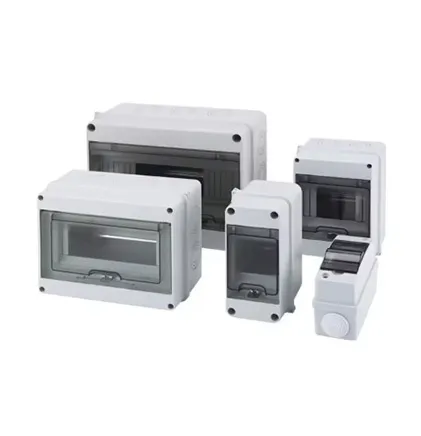
Ever wonder how that metal box controlling your building's power actually gets made? Distribution boxes – the unsung heroes tucked away in utility closets or basements – are more than just metal shells. They're sophisticated control centers managing electricity flow safely. Understanding how they're manufactured shows just how much precision goes into keeping the lights on safely. We'll peel back the cover and see how **electrical equipment** like this comes together from raw metal to finished system.
The Beating Heart: Inside the Distribution Box
Before diving into the assembly line, let's clarify what makes up a distribution box. At its core, it’s a protective enclosure housing crucial components:
-
Main Circuit Breaker:
The master switch controlling all power.
-
Branch Circuit Breakers:
Individual switches protecting specific circuits (like your kitchen sockets or lighting).
-
Busbars:
Thick metal bars (usually copper or aluminum) carrying the main power to the breakers.
-
Terminals:
Connection points for incoming power cables and outgoing circuit wires.
-
Neutral and Ground Bars:
Central points connecting neutral and grounding wires safely.
-
Enclosure:
The sturdy metal or plastic housing protecting everything inside.
The manufacturing process focuses on precisely assembling these elements into a safe, reliable, and long-lasting unit.
Starting Strong: Metalwork & Enclosure Fabrication
It all begins with raw materials. Most enclosures are made from sheet steel, galvanized steel (for corrosion resistance), or specially rated plastic composites.
-
Material Selection & Cutting:
Large coils or sheets of metal are fed into powerful cutting machines. Think giant laser or plasma cutters slicing the flat metal into precise shapes based on the box design. Imagine cookie cutters, but for thick, tough steel.
-
Bending & Forming:
The flat pieces now travel to hydraulic or CNC press brakes. Powerful machines bend the metal with extreme accuracy at specific angles to form the box's sides, back, and top. Computer control ensures every bend is perfectly aligned.
-
Punching & Drilling:
This is where the holes for components appear. Specialized punching machines create perfectly sized openings for circuit breakers, switches, cable entries, and mounting hardware. Accuracy here is non-negotiable; misaligned holes mean components won't fit or seals will leak.
-
Welding & Assembly (Enclosure):
Depending on the design, parts may be spot-welded together. For some larger boxes, frames are assembled using fasteners. Reinforcements are often added at key stress points.
-
Surface Finishing:
Raw metal needs protection! Enclosures typically undergo processes like phosphate coating or powder coating. Powder coating involves applying a dry electrostatically charged powder paint, baked on to form a tough, uniform, and often corrosion-resistant finish. The standard color? Safety Grey.
All this metalwork demands precision comparable to custom furniture solutions for high-end applications.
Building the Nervous System: Busbar & Component Prep
While the enclosure is being crafted, the internal components are also prepared:
-
Busbar Fabrication:
The "backbone" of power distribution is born. Copper or aluminum bars are precisely cut to length, shaped (often bent at specific angles), and have holes drilled or punched for attaching breakers. Contact surfaces might be silver-plated to improve conductivity and reduce oxidation.
-
Breaker Mounting:
The main breaker and individual branch breakers – manufactured elsewhere – are tested and staged for installation. The connections on their backs must perfectly match the busbar configuration.
-
Bar Assembly:
The neutral bar and grounding bar are assembled. These are usually pre-made subcomponents where incoming and outgoing neutral/ground wires will be securely terminated with screws.
-
Accessory Prep:
Mounting hardware, cable clamps, labeling tags, and terminal covers are prepped and sorted.
Bringing it All Together: The Assembly Line
This is where precision components meet the precision enclosure:
-
Busbar Installation:
The meticulously prepared busbar assembly is carefully mounted inside the enclosure onto insulating supports or brackets. This isolation is critical to prevent short circuits.
-
Main Breaker Mounting:
The main circuit breaker is secured, directly connecting to the incoming terminals of the busbar.
-
Branch Breaker Installation:
Branch breakers are "plugged" onto the busbar tabs. They must snap securely into place, ensuring a solid electrical connection. Manual force combined with guides ensures perfect seating.
-
Terminal Bars Mounting:
The neutral and ground bars are securely fixed inside the box at designated locations.
-
Wiring & Accessories:
Internal wiring (like factory jumpers, meter connections if applicable) is routed and terminated. Cable entry clamps are installed. Terminal shields and protective covers might be added.
-
Door & Hardware:
The enclosure door, often including a hinged panel for breaker access or a clear plastic cover for visibility, is fitted with hinges and a latch. Door interlocks (safety mechanisms preventing the door from opening when the main breaker is on) are installed and tested.
This stage requires skilled technicians following detailed diagrams – one wrong connection has serious consequences.
The Litmus Test: Rigorous Quality Control & Testing
You can't mess around with electricity. Every distribution box undergoes stringent checks:
Only after passing *all* relevant tests is the distribution box approved for packaging and shipping. It’s this QC that transforms assembled components into certified electrical equipment.
More Than Just Assembly: Design and Material Considerations
Manufacturing decisions start long before the metal is cut. Key factors influencing the process:
-
Material Choice:
-
Steel:
Robust, strong, excellent durability. Susceptible to rust (mitigated by galvanization/painting).
-
Stainless Steel:
Superior corrosion resistance (essential for harsh environments like chemical plants or coastal areas), but more expensive.
-
Plastic Composites:
Lightweight, corrosion-proof, good insulator. Strength and temperature limitations apply. Commonly used for smaller residential panels.
-
Busbar Material:
-
Copper:
Higher conductivity, better thermal properties, easier to solder/plate. More expensive.
-
Aluminum:
Lighter, less expensive. Lower conductivity requires larger cross-section. Needs special treatment to prevent oxidation at connections.
-
Environmental Rating:
Is it for a climate-controlled server room? A damp basement? A dusty factory? Requirements like IP (Ingress Protection - dust/water resistance) or NEMA Type ratings drive sealing techniques (gaskets, special glands, welded seams).
-
Arc Flash Protection:
Higher risk panels may incorporate features like arc venting channels to direct explosive energy away from personnel, influencing enclosure design and component placement.
-
Application Type:
Residential building materials focus on cost-effectiveness and ease of use. Commercial building materials demand higher capacity, durability, and often modularity for future expansion. Industrial boxes prioritize extreme robustness and specific hazard protections.
These choices impact the complexity, cost, and techniques used throughout manufacturing.
Robots in the Mix: Automation's Growing Role
Modern factories increasingly leverage automation for speed, consistency, and safety:
-
Laser/Plasma Cutting:
Highly automated for complex shapes.
-
CNC Bending:
Programmable presses ensure perfect bends every time.
-
Robotic Welding:
For consistent, high-strength welds on larger assemblies.
-
Automated Punching Lines:
Pre-programmed sequences for complex hole patterns.
-
Component Placement:
Robots can precisely position and seat circuit breakers, terminals, and other components onto busbars.
-
Automated Testing:
Robotic arms can probe test points for continuity, insulation resistance, and dielectric withstand, performing tests faster and with extreme consistency.
However, skilled human oversight remains crucial for complex assembly sequences, final inspections, troubleshooting anomalies, and managing customization. Automation handles the repetitive, precision tasks, freeing technicians for value-added work.
Final Thoughts: Complexity Behind the Simplicity
Opening the door to a distribution box reveals a meticulously organized panel of breakers. What lies unseen is the significant engineering and manufacturing journey behind it. From the initial metal shaping and precise punching, through the critical fabrication of the power-carrying busbar and careful mounting of breakers, to the exhaustive electrical testing confirming every safety feature works flawlessly – making one of these boxes is surprisingly complex.
Understanding the rigorous steps, material choices (balancing copper conductivity against aluminum cost), and intense QC measures reveals why these units reliably protect **residential and commercial building materials** for decades. It’s a blend of heavy metalwork, electrical precision, and unwavering quality standards. The next time you flip a breaker or see a panel humming quietly in a utility room, you'll appreciate the sophisticated manufacturing process that keeps everything running safely. This is the essence of quality **electrical equipment** production.