
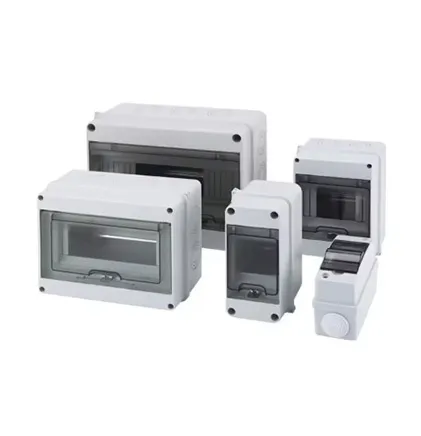
A power distribution box sits at the heart of every building's electrical system. It takes incoming power from the utility grid or a generator and distributes it safely to lighting circuits, HVAC equipment, machinery, and everyday outlets. When a distribution box fails because of poor manufacturing, the consequences are not limited to a tripped breaker — they can include equipment damage, production downtime, or even fire. That is why professional factories implement a structured set of quality control processes at every stage of production, from raw material inspection to final shipment testing.
Quality control does not start on the assembly line — it starts at the receiving dock. Factories that produce electrical power distribution box units must verify every incoming component before it enters the production floor. Steel sheets for enclosures are checked for thickness, flatness, and surface defects. Copper busbars are tested for conductivity and dimensional accuracy. Circuit breakers, contactors, and terminals from third-party suppliers are inspected against the purchase specifications and relevant certifications such as IEC or UL standards.
A well-run factory maintains batch traceability records for critical materials. If a copper supplier changes its alloy composition or a plastic supplier modifies its flame-retardant formulation, the factory must catch that change before it affects the final product. Spot-checking and statistical sampling methods, such as AQL (Acceptable Quality Level) inspection, are commonly applied to ensure that defective materials do not reach the production line.
The enclosure of a distribution box is more than a metal box — it is the first line of defense against physical impact, dust, moisture, and unauthorized access. During fabrication, quality inspectors monitor CNC laser cutting and bending operations to verify that panel dimensions and mounting hole positions stay within specified tolerances. Welding joints are inspected visually and, in critical applications, tested with dye penetrant or ultrasonic methods to confirm there are no hidden cracks or weak points.
Surface treatment is another key checkpoint. After shot blasting, the enclosure undergoes powder coating or wet painting. Inspectors measure coating thickness with a digital gauge, check adhesion with a cross-cut test, and evaluate uniformity under controlled lighting. A box that looks perfect when new but rusts after six months in a humid environment is a direct result of skipped surface treatment checks.
Assembly is where most hidden defects are introduced — and where effective in-process inspection pays off the most. For distribution box manufacturers, the assembly phase involves mounting busbars, installing circuit breakers and protective devices, routing and securing wiring, and fitting terminal blocks. Each step carries its own risk of error.
Torque control is one of the most critical — and most frequently overlooked — aspects of assembly. Loose electrical connections create resistance, which generates heat, which accelerates oxidation, which further increases resistance in a destructive cycle. Factories with strong QC programs use calibrated torque wrenches and require operators to record torque values for every bolted connection on busbars and main terminals. Some factories also apply torque-marking paint, which allows a supervisor to quickly verify that every joint has been tightened.
Wiring inspection follows a standardized checklist. Inspectors verify that wire colors and cross-sections match the electrical schematic, that cables are routed neatly without sharp bends or tension points, and that every wire is clearly labeled. Clearance and creepage distances between live parts of different phases and between live parts and the enclosure are measured with a gauge to confirm they meet the design requirements.
Once assembly is complete, every distribution box must pass a series of electrical tests before it can be considered ready for shipment. The exact test protocol depends on the product design and the standards it is certified to, but the following tests are common across the industry.
Dielectric strength testing (hi-pot test): A high voltage is applied between live parts and the enclosure, and between phases, to verify that the insulation can withstand voltage stress without breaking down. This test catches insulation damage, incorrect clearances, and assembly errors that could lead to arcing or shock hazards.
Insulation resistance measurement: Using a megohmmeter, inspectors measure the resistance of the insulation between conductors and between conductors and ground. A low reading indicates moisture ingress, contamination, or degraded insulation material.
Continuity and functional testing: Every circuit is energized and checked for correct operation. Breakers are switched on and off, indicators are verified, and interlocking mechanisms are tested. For distribution boxes with metering or control functions, the accuracy of meters and the logic of control circuits are validated against the functional specification.
Temperature rise testing (type test): While not performed on every unit, temperature rise tests are conducted on representative samples during the design certification phase and periodically for production audits. The box is run at full rated current under worst-case ambient conditions, and temperature sensors monitor busbars, terminals, and breaker contacts. The goal is to confirm that no part exceeds the temperature limits defined in the relevant standard.
Many distribution boxes are installed outdoors or in harsh industrial environments. A factory that takes quality seriously will verify the enclosure's IP (Ingress Protection) rating through physical testing. For an IP65-rated box, this means subjecting the enclosure to dust and water jet tests to confirm that no foreign particles or moisture can enter. Gasket fit, door seal compression, and cable gland installation are all checked as part of this process.
Flame retardancy is another non-negotiable requirement. Plastic components such as terminal blocks, busbar supports, and insulating barriers must be made from materials with verified flame-retardant ratings, typically UL94 V-0. Factories request material certificates from their suppliers and may conduct in-house burn tests on random samples to confirm compliance.
A disciplined factory maintains complete documentation for every unit produced. This includes the bill of materials, inspection records for incoming components, assembly checklists with torque values, electrical test results, and a final inspection sign-off. If a problem appears in the field months later, the factory can trace it back to the specific batch of materials and the specific operator who assembled the unit.
International certifications such as ISO 9001, IEC 61439, and UL 508A provide a framework for quality management. However, certification alone is not enough. The best factories treat these standards as a baseline, not a ceiling. They conduct regular internal audits, retrain operators on updated procedures, and invest in calibration of testing equipment. They also welcome third-party inspection from customers or independent agencies, because transparency is itself a quality control mechanism.
For project owners, contractors, and procurement managers, the quality control processes inside a distribution box factory directly affect the safety, reliability, and total cost of ownership of the products they purchase. A box that passes all QC checks may cost slightly more upfront than one from a factory that skips inspections, but the difference is recovered many times over through avoided downtime, fewer warranty claims, and lower risk of catastrophic failure.
When evaluating a supplier, ask to see their test reports, not just their certificates. Request a factory tour and observe whether workers use calibrated torque tools, whether wiring is neat and labeled, and whether testing stations are staffed and operational. These observations tell you more about real quality than any brochure can.
As a one-stop building materials provider, COLORIA GROUP supplies a wide range of electrical products including distribution boxes, switches and sockets, cables, and other electrical fixtures. Our commitment to quality runs through every product category, from walls and flooring to electrical systems and lighting. We work with certified manufacturing partners who follow the rigorous QC processes described above, ensuring that every product meets the expectations of contractors, developers, and project owners around the world.
For more information about our electrical products and quality standards, visit COLORIA GROUP or contact our sales team directly.
Recommend Products












