
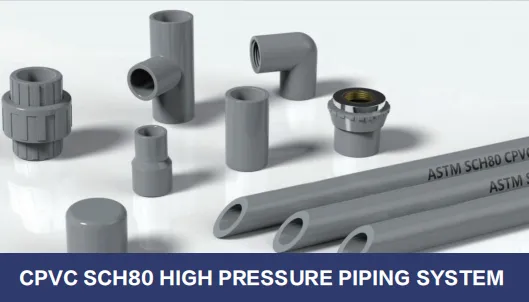
In the complex world of construction and infrastructure, every component plays a critical role in ensuring safety, durability, and performance. Among these, high-pressure piping systems stand as silent workhorses, carrying everything from water and chemicals to industrial fluids in settings ranging from commercial buildings to manufacturing plants. When it comes to high-pressure applications, CPVC SCH80 piping has emerged as a go-to solution, prized for its chemical resistance, temperature tolerance, and long-term reliability. But even the best materials are only as good as the supplier behind them. Choosing a reliable CPVC SCH80 high pressure piping system supplier is not just a procurement decision—it's an investment in the success of your project, the safety of its occupants, and the reputation of your business. So, what exactly separates a trustworthy supplier from the rest? Let's dive into the key qualities that define reliability in this critical industry.
At the heart of any reliable supplier lies an unwavering dedication to quality. CPVC SCH80 piping is designed to withstand extreme pressure (hence the "SCH80" classification, indicating a thicker wall for higher pressure ratings), and this performance hinges entirely on the quality of the materials and manufacturing processes involved. A trustworthy supplier doesn't cut corners here—they start by sourcing premium raw materials, often virgin CPVC resin that meets or exceeds industry standards like ASTM D2846. This resin is then processed using state-of-the-art extrusion techniques, with strict controls on temperature, pressure, and cooling to ensure uniform wall thickness, consistent dimensions, and freedom from defects like air bubbles or impurities.
But quality control doesn't stop at production. The best suppliers implement rigorous testing protocols at every stage: raw material testing to verify chemical composition and purity, in-line testing during manufacturing to monitor dimensions and structural integrity, and post-production testing to assess pressure resistance, impact strength, and chemical compatibility. For example, a reputable supplier might subject their CPVC SCH80 pipes to hydrostatic pressure testing—exposing samples to pressures far exceeding their rated capacity for extended periods—to ensure they can handle real-world stress without failure. They'll also conduct long-term aging tests to simulate decades of use, providing data on how the material holds up over time. When a supplier is transparent about these processes—readily sharing test reports, material certifications, and quality control documentation—you can trust that they stand behind their products.
High-pressure piping systems are rarely one-size-fits-all. Every project has unique requirements: varying pipe diameters, specific fittings, custom lengths, or specialized configurations to navigate tight spaces or complex layouts. A reliable CPVC SCH80 high pressure piping system supplier understands this diversity and goes beyond offering standard products—they provide comprehensive pipes fittings solutions that adapt to your project's needs. This means not only stocking a wide range of pipe sizes (from ½ inch to 12 inches or more) but also offering an extensive selection of fittings: elbows, tees, reducers, couplings, flanges, and valves designed to work seamlessly with their pipes. After all, a system is only as strong as its weakest link; mismatched or low-quality fittings can compromise the entire network's integrity.
Beyond off-the-shelf products, top suppliers excel at customization. Maybe your project requires extra-long pipe lengths to minimize joints, or unique fittings to connect to existing infrastructure. A reliable supplier will work with you to engineer these solutions, leveraging in-house design teams and manufacturing flexibility to create products that meet your exact specifications. For instance, if you're working on a chemical processing plant that requires corrosion-resistant piping with specialized end connections, they'll collaborate with you to develop a solution that adheres to both your technical needs and industry regulations. This ability to combine standard offerings with tailored solutions is a hallmark of a supplier that prioritizes customer success over cookie-cutter sales.
| Product Type | Key Features | Typical Applications |
|---|---|---|
| CPVC SCH80 Pipes (ASTM D2846) | Thick walls, pressure rating up to 200 psi at 73°F, chemical resistance | Industrial fluid transfer, water distribution, chemical processing |
| CPVC SCH80 Elbows & Tees | Socket fusion or threaded connections, 90°/45° angles, uniform wall thickness | System layout changes, branch connections in high-pressure lines |
| CPVC SCH80 Flanges | Raised face design, compatible with ANSI standards, leak-tight sealing | Connection points for pumps, valves, or large-diameter equipment |
| Custom-Made Fittings | Tailored dimensions, specialized materials, unique end connections | Retrofit projects, non-standard infrastructure, high-precision industrial systems |
Purchasing CPVC SCH80 piping is about more than buying a product; it's about ensuring that product is applied correctly. High-pressure systems are complex, and even small mistakes in design, installation, or maintenance can lead to catastrophic failures. This is where technical expertise becomes invaluable. A reliable supplier doesn't just sell pipes—they act as a knowledge partner, offering the support and guidance needed to make informed decisions at every stage of your project.
From the initial design phase, their team of engineers and technical specialists can help you select the right pipe size, pressure rating, and fittings based on your system's flow rate, fluid type, temperature, and operating pressure. They'll share insights on best practices for installation, such as proper solvent cementing techniques (critical for CPVC systems) or torque specifications for threaded connections. For example, they might provide detailed installation guides, video tutorials, or even on-site training for your crew to ensure the system is assembled correctly. Post-installation, they offer ongoing support: troubleshooting assistance if issues arise, guidance on maintenance schedules, and updates on industry advancements or regulatory changes that might affect your system.
This level of expertise is particularly crucial in specialized sectors. Consider, for instance, the strict standards required for healthcare or educational facilities, where safety and hygiene are paramount. A supplier that also offers class a fireproof cpl inorganic board for hospital and school solutions understands the importance of compliance with fire codes, antimicrobial properties, and low VOC emissions. While CPVC SCH80 piping and fireproof boards serve different functions, the commitment to technical precision and regulatory adherence is transferable. A supplier that excels in one area is likely to bring that same rigor to others, ensuring you're not just getting a product, but a partner who understands the nuances of your industry.
In construction and industrial applications, compliance with regulations isn't optional—it's a legal and ethical imperative. High-pressure piping systems are governed by a web of standards, including those set by ASTM International, ISO, NSF International, and local building codes. A reliable CPVC SCH80 high pressure piping system supplier doesn't just "meet" these standards—they embed compliance into their business model. This starts with certifications: look for suppliers whose products carry certifications like ASTM D2846 (for CPVC pipe and fittings), NSF/ANSI 61 (for drinking water applications), or ASME B31.3 (for process piping). These certifications are not easy to obtain; they require third-party testing, regular audits, and a commitment to maintaining strict quality control systems.
But compliance goes beyond product certifications. It also means staying ahead of evolving regulations. For example, as environmental concerns grow, many regions are updating codes to restrict lead content in piping systems or mandate higher efficiency standards. A proactive supplier will monitor these changes and adjust their products accordingly, ensuring you're never caught off guard by new requirements. They'll also provide the documentation you need to pass inspections, from material safety data sheets (MSDS) to compliance certificates, making the permitting process smoother and reducing the risk of costly delays. In industries like healthcare or education, where non-compliance can lead to fines, project shutdowns, or even legal liability, this attention to detail is priceless.
Even the highest-quality products are useless if they don't arrive on time. Construction schedules are tight, and delays in material delivery can have a domino effect, increasing labor costs, missing deadlines, and straining client relationships. A reliable supplier understands this and prioritizes supply chain resilience. This means maintaining adequate inventory levels to meet both standard and rush orders, investing in robust logistics networks, and having contingency plans for disruptions—whether due to raw material shortages, transportation issues, or global crises.
Look for suppliers with multiple manufacturing facilities or distribution centers, as this reduces the risk of regional bottlenecks. They should also offer transparent tracking and communication, keeping you informed about order status, shipment times, and potential delays. For example, if a storm disrupts a delivery route, a proactive supplier will immediately notify you, suggest alternative solutions (like expedited shipping from another warehouse), and work to minimize the impact on your schedule. Consistency in supply isn't just about delivering products—it's about delivering peace of mind, knowing that you can rely on your supplier to keep your project on track, no matter what challenges arise.
In an industry where technical details matter and projects are high-stakes, customer service can't be an afterthought. A reliable supplier views every client as a long-term partner, not just a one-time sale. This mindset manifests in several ways: responsive communication, where your calls and emails are returned promptly, and questions are answered thoroughly; personalized attention, where a dedicated account manager takes the time to understand your business, your projects, and your pain points; and a willingness to go the extra mile, whether that means expediting an order to meet a tight deadline or providing free samples for testing before you commit to a large purchase.
Post-sales support is another critical aspect. Even the best systems can encounter issues, and how a supplier responds to problems speaks volumes about their reliability. A trustworthy supplier will stand behind their products with a strong warranty, honor claims promptly, and work with you to resolve issues—whether through replacements, technical assistance, or on-site inspections. They won't blame-shift or make excuses; instead, they'll take ownership and strive to make things right. Over time, this level of service builds trust, turning a vendor relationship into a true partnership where both parties succeed.
Actions speak louder than words, and a supplier's reputation is built on the results they've delivered for other clients. Before choosing a CPVC SCH80 high pressure piping system supplier, take the time to research their track record. Look for case studies highlighting successful projects in your industry—whether it's a high-rise commercial building, a chemical plant, or a hospital. These case studies should detail the challenges the client faced, how the supplier's products and services addressed those challenges, and the outcomes achieved (e.g., reduced maintenance costs, improved system efficiency, on-time project completion).
Client testimonials are equally telling. Reach out to past or current customers to ask about their experiences: Was the supplier reliable? Did the products perform as promised? How was the customer service? A supplier with a long list of satisfied clients and repeat business is far more likely to deliver on their promises than one with little to no proven history. In the end, a track record of success isn't just a measure of past performance—it's a predictor of future reliability.
Choosing a reliable CPVC SCH80 high pressure piping system supplier is about more than comparing prices or product specs. It's about finding a partner who embodies quality, expertise, compliance, consistency, and customer focus—someone who understands that their success is tied to yours. From the raw materials they source to the support they provide long after the sale, every aspect of their business should reflect a commitment to excellence. In a world where projects are complex, deadlines are tight, and safety is non-negotiable, this kind of reliability isn't just a luxury—it's a necessity.
So, as you evaluate potential suppliers, ask the tough questions: What standards do they adhere to? How do they ensure product quality? Can they customize solutions to your needs? How do they handle supply chain disruptions? What do their clients say about them? The answers will reveal whether they're a vendor or a partner. And in the end, that partnership could be the difference between a project that meets expectations and one that exceeds them—delivering safety, durability, and success for years to come.
Recommend Products












