
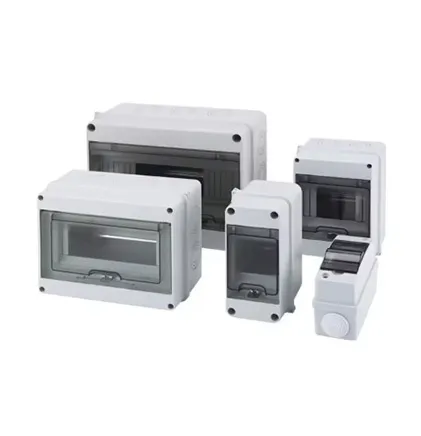
When planning a construction or industrial project, one of the most common questions procurement managers ask is: how long does it take to get a custom power distribution box from initial design to final delivery? The answer is not a single number — it depends on the complexity of your requirements, the manufacturer's production capacity, and the logistics involved. This article breaks down each stage of the process so you can plan your project timeline with confidence.
A custom power distribution box is an electrical enclosure engineered to meet specific project requirements rather than an off-the-shelf unit. Unlike standard catalog products, a custom distribution box is built around your unique load schedule, voltage level, circuit count, IP rating, and site conditions. It receives incoming power from a main supply and safely distributes it to multiple branch circuits, each protected by its own circuit breaker or protective device.
Customization can include everything from enclosure size and material to internal component brands, busbar configuration, metering options, and communication modules. For projects in regions with high ambient temperatures, dusty environments, or coastal humidity — such as across the Middle East, Africa, and Southeast Asia — a custom solution ensures the electrical distribution box performs reliably under site-specific conditions.
The first stage begins with a thorough requirement analysis. You provide the manufacturer with key specifications: the single-line diagram (SLD), total connected load in kVA or kW, number of circuits, fault level at the installation point, required IP rating, and any applicable compliance standards such as IEC 61439.
During this phase, the engineering team reviews your documentation and flags potential issues — such as a specified breaker that cannot achieve the required discrimination, or a cable entry configuration that conflicts with the enclosure IP rating. Resolving these conflicts early saves time and cost later. The design team then produces general arrangement (GA) drawings, schematic diagrams, and a bill of materials (BOM) for your review and approval. This stage typically takes one to two weeks, depending on the complexity of the project and the speed of your review cycle.
Once the design is approved, the manufacturer orders all required components. This includes the enclosure (steel or stainless steel), busbars (copper or aluminum), circuit breakers, residual current devices (RCDs), surge protective devices (SPDs), meters, and any communication modules specified in the BOM.
The duration of this stage depends heavily on component availability. Using well-known international brands such as ABB, Schneider Electric, Siemens, or Chint generally ensures predictable delivery timelines. Specialty components or custom-manufactured parts may extend lead times. Material procurement typically takes two to four weeks. A manufacturer with established supply chain relationships can often compress this timeline by maintaining stock of commonly used components.
With all materials on hand, the manufacturing phase begins. Sheet metal is cut, bent, and welded to form the enclosure. Powder coating is applied for corrosion resistance — an especially important step for installations in coastal or humid environments. Busbars are fabricated and mounted, and components are installed according to the approved GA drawing.
Wiring follows the approved schematic diagrams, with every wire ferruled and labeled for easy identification during site installation and future maintenance. For complex distribution boxes that include PLC control, metering, or communication modules, the wiring phase requires additional care to segregate power wiring from control signal cables. This stage generally takes three to five weeks, though larger or more complex units may require additional time.
Before the distribution box leaves the factory, it undergoes a factory acceptance test (FAT). This is a critical quality gate that verifies the unit meets all design specifications and safety standards. A comprehensive FAT typically includes dielectric strength testing, insulation resistance measurement, functional operation verification of all breakers and protective devices, and confirmation of protection relay settings.
For projects that require IEC 61439 compliance — which is increasingly mandatory for World Bank and African Development Bank funded projects — the FAT documentation serves as evidence of conformity. Many manufacturers also offer remote FAT witnessing via video call, allowing you or your representative to observe the testing process without traveling to the factory. This stage typically takes about one week.
After passing the FAT, the distribution box is packed for shipment. For international orders, export-grade wooden crates or steel frames are used to protect the unit during transit. All documentation — test reports, certificates, as-built drawings, and spare parts lists — is included either inside the crate or sent digitally.
Delivery time varies significantly based on the shipping method and destination. Sea freight to the Middle East or Africa can take two to four weeks, while air freight can reduce this to under one week at a higher cost. For remote sites with limited access, manufacturers may offer knock-down delivery — the distribution box ships partially disassembled with assembly drawings, reducing shipping volume by 30 to 50 percent and making transport to difficult locations feasible.
Bringing all stages together, the typical lead time for a custom power distribution box from design approval to factory dispatch is 7 to 12 weeks. Adding international shipping brings the total door-to-door timeline to approximately 9 to 16 weeks, depending on the destination.
| Stage | Activity | Typical Duration |
|---|---|---|
| 1 | Requirement Analysis & Design | 1–2 weeks |
| 2 | Material Procurement | 2–4 weeks |
| 3 | Manufacturing & Assembly | 3–5 weeks |
| 4 | Testing & Quality Assurance | 1 week |
| 5 | Packaging & Delivery (Sea Freight) | 2–4 weeks |
| Total Door-to-Door Timeline | 9–16 weeks |
Several factors can compress or extend the baseline timeline. Understanding these helps you manage expectations and plan accordingly:
There are several practical steps you can take to reduce the overall timeline:
The supplier you choose has a direct impact on both lead time and product quality. Look for a manufacturer with proven experience in delivering to your region. Key indicators of a reliable supplier include ISO 9001 certification, third-party type test certificates, the use of first-tier component brands, and a track record of on-time delivery to projects similar to yours.
As a one-stop building materials solution provider, COLORIA GROUP offers a comprehensive range of electrical fixtures and cables, including custom distribution boxes designed to meet the specific requirements of residential, commercial, and industrial projects. With headquarters in Foshan, China — a global manufacturing hub — and an overseas agent in Saudi Arabia, COLORIA GROUP combines efficient production with reliable international logistics to serve clients across the Middle East, Africa, and beyond.
Whether you are outfitting a new commercial building, upgrading a factory's electrical infrastructure, or sourcing for a large-scale development project, planning your distribution box procurement around a realistic lead time helps keep your entire project on schedule. Contact COLORIA GROUP today to discuss your custom power distribution box requirements and receive a detailed timeline tailored to your specific needs.
Recommend Products












