
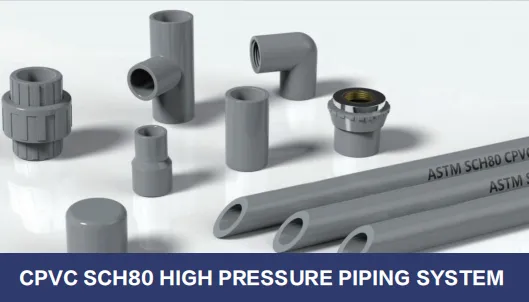
In the world of infrastructure and construction, the backbone of any functional space lies in its unseen systems—piping networks that carry water, chemicals, and gases reliably, even under extreme conditions. For high-pressure applications, where failure is not an option, choosing the right piping material can mean the difference between seamless operations and costly, dangerous leaks. Enter the CPVC SCH80 High Pressure Piping System: a solution engineered to withstand the toughest demands while offering durability, versatility, and peace of mind. Whether you're managing an industrial plant, constructing a commercial building, or upgrading a municipal water system, understanding what CPVC SCH80 brings to the table is key to making informed decisions. In this guide, we'll unpack everything from its composition and core properties to its real-world applications, benefits, and how it stacks up against other piping materials. We'll also explore why partnering with a trusted cpvc sch80 high pressure piping system supplier is critical to accessing tailored cpvc sch80 high pressure piping system solutions that meet your project's unique needs.
At its core, CPVC SCH80 is a specialized type of piping material designed to handle high-pressure and high-temperature environments. Let's break down its components and what makes it stand out:
CPVC, or Chlorinated Polyvinyl Chloride, is a thermoplastic polymer derived from PVC (Polyvinyl Chloride) through a chlorination process. This process involves introducing chlorine molecules into the PVC structure, which enhances its thermal stability, chemical resistance, and mechanical strength. Unlike standard PVC, which is ideal for low-pressure, cold-water applications, CPVC's chlorination makes it capable of withstanding higher temperatures and pressures, making it a go-to for more demanding scenarios.
The "SCH80" in its name refers to the pipe's "schedule," a standard used to denote wall thickness and pressure-bearing capacity. In piping terminology, Schedule 80 pipes have thicker walls compared to their Schedule 40 counterparts (e.g., pvc-u sch40 pressure piping system supplier products). This added thickness directly translates to higher pressure ratings: while SCH40 pipes are suitable for moderate pressures, SCH80 is engineered for systems where fluid or gas pressures are significantly higher. For example, a 2-inch CPVC SCH80 pipe can typically handle pressures up to 200 psi at 73°F (23°C), far exceeding the capacity of many other plastic piping materials.
The production of CPVC SCH80 involves extruding the chlorinated resin into pipes with strict adherence to dimensional standards. Manufacturers use high-quality raw materials and advanced extrusion techniques to ensure uniform wall thickness, consistent diameter, and smooth inner surfaces—critical for minimizing flow resistance and preventing pressure buildup. Reputable suppliers often subject their CPVC SCH80 products to rigorous testing, including hydrostatic pressure tests, chemical resistance trials, and temperature cycling, to certify compliance with industry standards like ASTM D2846 (a key specification for CPVC piping systems).
CPVC SCH80's popularity in high-pressure applications stems from a unique blend of properties that address the limitations of other materials like metal, standard PVC, or even newer options like PPR or PEX. Let's explore its most notable characteristics:
CPVC SCH80's thick walls and chlorinated structure allow it to operate under both high pressure and elevated temperatures. It can reliably handle continuous service temperatures up to 200°F (93°C) and intermittent peaks of 210°F (99°C), making it suitable for hot water distribution, HVAC systems, and industrial processes involving heated fluids. This sets it apart from PEX, for instance, which typically maxes out around 180°F (82°C) in standard applications, or PPR, which may struggle with prolonged exposure to temperatures above 180°F. For projects requiring both high pressure and heat resistance, CPVC SCH80 is often the safer bet.
In industrial settings, pipes frequently come into contact with corrosive substances like acids, alkalis, and solvents. CPVC SCH80's chlorinated composition creates a barrier against chemical attack, making it resistant to most acids (e.g., sulfuric acid, hydrochloric acid), bases, and organic compounds. This resistance is far superior to metal pipes, which are prone to rust and corrosion, and even to standard PVC, which may degrade when exposed to certain chemicals. For chemical processing plants, water treatment facilities, or laboratories, this property is invaluable in reducing maintenance costs and extending system lifespan.
Unlike metal pipes (steel, copper), which are heavy and require specialized tools for cutting and joining, CPVC SCH80 is lightweight and easy to handle. Its installation typically involves simple solvent cementing—a process where a chemical adhesive (solvent cement) is applied to the pipe and fitting, creating a strong, leak-proof bond as the cement melts and fuses the materials. This method is faster and more cost-effective than welding metal pipes or using compression fittings for PEX or ppr pipe and fitting supplier products. For contractors, this translates to reduced labor time, lower installation costs, and fewer on-site delays.
CPVC SCH80 is inherently resistant to corrosion, rust, and scaling, which are common issues with metal pipes. It does not support bacterial growth (unlike some metal alloys), making it ideal for potable water systems or medical facilities where hygiene is critical. When properly installed and maintained, CPVC SCH80 systems can last 50 years or more, outperforming many traditional materials and reducing the need for frequent replacements.
To truly appreciate CPVC SCH80's value, it helps to compare it with other popular piping options. Below is a detailed comparison table highlighting key differences in pressure rating, temperature range, and applications:
Comparison of CPVC SCH80 with Common Piping Materials
| Material | Max Pressure (2" Pipe at 73°F) | Max Temperature | Chemical Resistance | Typical Applications |
|---|---|---|---|---|
| CPVC SCH80 | ~200 psi | 200°F (continuous) | Excellent (resists acids, alkalis, solvents) | Industrial processing, chemical transport, hot water distribution, HVAC |
| PVC-U SCH40 | ~140 psi | 140°F (continuous) | Good (limited to mild chemicals) | Cold water supply, drainage, irrigation |
| PPR (Polypropylene Random Copolymer) | ~100 psi | 180°F (continuous) | Good (resists some acids, alkalis) | Residential plumbing, hot/cold water systems |
| PEX (Cross-Linked Polyethylene) | ~160 psi | 180°F (continuous) | Fair (vulnerable to strong chemicals) | Residential plumbing, radiant heating |
| Copper (Type L) | ~400 psi | 250°F (continuous) | Fair (prone to corrosion in acidic water) | High-pressure water systems, gas lines |
As the table shows, CPVC SCH80 outperforms PVC-U SCH40 and PPR in pressure and temperature tolerance, while offering better chemical resistance than PEX or copper. While copper has a higher pressure rating, it is significantly more expensive, heavier, and prone to corrosion—making CPVC SCH80 a more cost-effective and durable alternative for many high-pressure applications.
CPVC SCH80's versatility makes it a staple in a wide range of industries. Here are some of its most common uses:
In factories and manufacturing plants, CPVC SCH80 is used to transport corrosive chemicals, acids, and solvents. Its chemical resistance ensures that pipes remain intact even when exposed to harsh substances like sulfuric acid or sodium hydroxide. Industries such as pharmaceuticals, food processing, and electronics manufacturing rely on CPVC SCH80 for process piping, where purity and reliability are non-negotiable.
Commercial spaces like hospitals, schools, and office complexes often use CPVC SCH80 for hot water distribution and HVAC systems. Its ability to handle high temperatures and pressures ensures consistent performance in large-scale heating and cooling networks. In hospitals, for example, CPVC SCH80's smooth interior and resistance to bacterial growth make it suitable for transporting clean water to operating rooms and patient areas.
Municipal water treatment plants use CPVC SCH80 for handling treated water, wastewater, and chemical dosing systems. Its corrosion resistance prevents contamination, while its high-pressure rating ensures efficient water transport over long distances. It is also used in desalination plants, where pipes must withstand the corrosive effects of saltwater.
In upstream and midstream oil and gas operations, CPVC SCH80 is used for secondary containment, chemical injection lines, and produced water transport. Its lightweight design and resistance to hydrocarbons make it a safer, more cost-effective alternative to steel in non-critical, high-pressure applications.
While CPVC SCH80 is relatively easy to install, proper techniques are essential to maximize its lifespan. Here's a step-by-step overview of best practices:
1. Preparation: Ensure all pipes and fittings are clean and free of debris. Check for cracks, dents, or other damage before installation. Use a pipe cutter or saw with a fine-tooth blade to cut pipes squarely—rough edges can weaken joints.
2. Solvent Cementing: CPVC SCH80 is typically joined using solvent cement, which chemically bonds the pipe and fitting. Apply a generous coat of cement to both the pipe end and fitting socket, then insert the pipe fully into the fitting and hold for 30-60 seconds to allow initial set. Wipe away excess cement immediately to prevent weak spots.
3. Cure Time: Allow joints to cure fully before pressurizing the system. Cure times vary by temperature and humidity (e.g., 24 hours at 70°F for 2-inch pipes). Refer to the cement manufacturer's instructions for specific guidelines.
4. Support and Alignment: Use pipe hangers or straps to support pipes every 3-5 feet (horizontal runs) or 6-8 feet (vertical runs) to prevent sagging. Ensure pipes are aligned straight to avoid stress on joints.
CPVC SCH80 requires minimal maintenance, but regular inspections can prevent issues:
-
Visual Checks:
Look for signs of leaks, discoloration (indicative of chemical exposure), or deformation (a sign of overheating or excessive pressure).
-
Pressure Testing:
After installation, test the system at 1.5 times the working pressure for 30 minutes to identify leaks.
-
Cleaning:
For systems prone to scaling (e.g., hard water), use mild, non-abrasive cleaners. Avoid harsh chemicals like acetone, which can damage the pipe surface.
-
Repairs:
Small leaks can often be fixed with solvent cement and repair couplings. For larger damage, replace the affected section of pipe.
The performance of your CPVC SCH80 system depends heavily on the quality of the materials and support from your supplier. When selecting a cpvc sch80 high pressure piping system supplier , consider the following:
Reputable suppliers will have certifications like ASTM D2846 compliance, ISO 9001 quality management, and NSF/ANSI 61 certification (for potable water applications). These certifications ensure the product meets strict safety and performance standards.
Look for suppliers that offer technical support, including help with system design, pressure calculations, and installation guidance. This is especially valuable for complex projects where custom cpvc sch80 high pressure piping system solutions may be needed.
A reliable supplier should offer a full range of CPVC SCH80 pipes, fittings, valves, and accessories (e.g., elbows, tees, reducers) to minimize the need for multiple vendors. Some may also provide complementary products like tools for solvent cementing or pipe support systems.
Check online reviews, case studies, or references from past clients to gauge the supplier's reliability, delivery times, and post-sales service. A supplier with a proven track record in industrial or commercial projects is more likely to understand your specific needs.
In high-pressure piping applications, where safety, durability, and efficiency are paramount, CPVC SCH80 stands out as a versatile, cost-effective, and reliable choice. Its unique combination of pressure tolerance, chemical resistance, and ease of installation makes it ideal for industries ranging from manufacturing and healthcare to water treatment and oil and gas. By partnering with a reputable cpvc sch80 high pressure piping system supplier , you can access tailored solutions that meet your project's requirements and ensure long-term performance. Whether you're upgrading an existing system or designing a new one, CPVC SCH80 offers the peace of mind that comes with knowing your piping network is built to last.
So, if you're ready to invest in a high-pressure piping system that delivers on both performance and value, consider CPVC SCH80. With the right supplier and proper installation, it's a decision that will pay off for decades to come.
Recommend Products












