
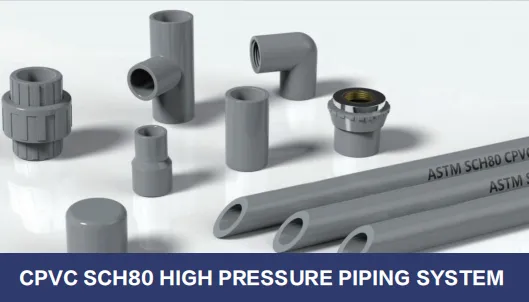
When it comes to building or upgrading a piping system—whether for a bustling factory, a high-rise apartment, or a busy hospital—one question always looms large: "Will this system hold up when the pressure's on?" High-pressure environments demand reliability, durability, and peace of mind. That's where the CPVC SCH80 high pressure piping system steps in. If you've ever wondered what makes this system a go-to choice for engineers, contractors, and facility managers, you're in the right place. Let's dive into everything you need to know—from what it is and how it works, to why partnering with a trusted CPVC SCH80 high pressure piping system supplier matters.
Let's start with the basics. CPVC stands for Chlorinated Polyvinyl Chloride—a tough, versatile plastic material that's been a staple in plumbing and industrial systems for decades. But what sets "SCH80" apart? In the world of piping, "schedule" refers to the wall thickness of the pipe. SCH80 (or Schedule 80) means the pipe has a thicker wall compared to its SCH40 counterpart, making it built to handle higher pressure. Think of it like choosing between a standard water bottle and a heavy-duty thermos—both hold liquid, but one's designed to take more stress.
CPVC SCH80 is created by treating regular PVC with chlorine, which boosts its heat resistance and strength. This process transforms it from a material best suited for cold water lines into one that can handle high-pressure, high-temperature applications without breaking a sweat. And when we talk about "high pressure," we're not kidding—depending on the pipe size, SCH80 CPVC can withstand pressures up to 300 PSI (pounds per square inch) at room temperature, and still perform reliably even when temperatures climb to 200°F (93°C). That's a level of toughness that makes it a favorite in settings where failure isn't an option.
What makes this piping system a top pick for high-pressure needs? Let's break down its standout features in plain language:
Thanks to its thick SCH80 walls, this pipe laughs in the face of high pressure. Whether it's pumping water through a skyscraper, moving chemicals in a factory, or supporting a commercial HVAC system, it maintains structural integrity where thinner pipes might crack or burst.
Unlike standard PVC, which can warp or weaken with hot water, CPVC SCH80 handles temperatures up to 200°F. That makes it ideal for hot water lines in hospitals, schools, and industrial facilities—places where consistent, reliable hot water is non-negotiable.
Metals like steel or copper can rust or corrode when exposed to chemicals, saltwater, or harsh cleaning agents. CPVC SCH80? It's impervious to most acids, alkalis, and corrosive substances. This is a game-changer for labs, water treatment plants, and chemical processing facilities where pipes come into contact with tough fluids.
Let's be real—no one wants to haul heavy metal pipes around a job site. CPVC SCH80 is lightweight, which cuts down on labor costs and makes installation a breeze. It also connects with solvent cement (a special glue) instead of welding, so you don't need specialized equipment or hours of training to get the job done right.
When installed properly, a CPVC SCH80 system can last 50 years or more. That's decades of worry-free performance, which translates to lower replacement costs and less downtime for repairs. For building owners and facility managers, that's a huge win for long-term budgeting.
This system isn't a one-trick pony—it's versatile enough to excel in a wide range of settings. Here are some of the most common places you'll find it hard at work:
Factories, refineries, and manufacturing plants rely on CPVC SCH80 to transport everything from coolants and lubricants to industrial chemicals. Its chemical resistance and high pressure rating make it a safe, reliable choice for keeping production lines running smoothly.
Hospitals, schools, hotels, and office towers need piping systems that can handle heavy usage. CPVC SCH80 is perfect for hot water distribution, fire sprinkler systems, and HVAC lines. In hospitals, for example, it ensures sterile, consistent water flow to operating rooms and patient areas—critical for patient safety.
Tall apartment buildings have unique challenges: water needs to be pumped to upper floors, which means higher pressure. CPVC SCH80's strength ensures water reaches every unit without drops in pressure or leaks, even in 30+ story buildings.
Municipal water treatment plants use CPVC SCH80 to move treated and untreated water, as well as chemicals like chlorine used in purification. Its corrosion resistance prevents contamination and extends the life of the system.
Plants that process food or beverages need pipes that are easy to clean and resistant to bacteria. CPVC SCH80's smooth interior surface prevents buildup, and it stands up to frequent sanitization with hot water and cleaning agents.
You might be thinking, "Why not just use PPR pipes or regular PVC?" Great question! Let's put CPVC SCH80 head-to-head with other common materials to see why it's often the better choice for high-pressure needs:
| Material | Max Pressure (PSI at 73°F) | Max Temperature | Best For | Key Limitation |
|---|---|---|---|---|
| CPVC SCH80 | 200-300 (varies by size) | 200°F (93°C) | High-pressure industrial, commercial hot water, chemical transport | Slightly higher cost than SCH40 PVC |
| PPR (Polypropylene Random Copolymer) | 100-150 (varies by size) | 180°F (82°C) | Residential hot/cold water, low-pressure HVAC | Lower pressure rating; not ideal for industrial use |
| PVC-U SCH40 | 140-180 (varies by size) | 140°F (60°C) | Cold water lines, drainage, low-pressure applications | Cannot handle high heat or pressure; prone to cracking under stress |
| Copper | 400-500 (varies by size) | 250°F (121°C) | Residential plumbing, gas lines | Expensive; heavy; corrodes in acidic water; requires welding |
As you can see, CPVC SCH80 strikes a balance between strength, versatility, and cost that's hard to beat. It outperforms PPR and PVC in high-pressure scenarios and offers similar durability to copper at a fraction of the price and weight.
Even the best piping system won't perform well if it's installed poorly. Here's a step-by-step guide to installing CPVC SCH80 like a pro—no fancy engineering degree required:
You'll need a fine-tooth saw (hacksaw or pipe cutter), a deburring tool, CPVC primer, CPVC solvent cement, a tape measure, and a level. Avoid using tools meant for metal pipes—they can damage the plastic.
Mark the pipe where you need to cut, then use a straight edge to ensure a clean, perpendicular cut. A jagged cut can lead to leaks, so take your time here.
After cutting, use the deburring tool to smooth the inside and outside edges of the pipe. Sharp edges can tear the cement or create weak spots in the joint.
Wipe the pipe and fitting with a clean cloth to remove dirt or oil. Then, apply a layer of CPVC primer to both the pipe end and the inside of the fitting—this softens the plastic and helps the cement bond.
Apply a thin, even layer of solvent cement to both surfaces (a little goes a long way!). Push the pipe into the fitting with a slight twist, and hold it for 30 seconds to set. Wipe away any excess cement immediately.
Curing time depends on temperature and humidity, but plan for at least 24 hours before turning on the water. Rushing this step is the #1 cause of leaks—patience pays off!
Pro Tip: Always follow the manufacturer's instructions for primer and cement. Using non-CPVC-specific products can weaken the joint and lead to failure. A trusted CPVC SCH80 high pressure piping system supplier will often provide installation guides and even training to ensure you get it right.
One of the best things about CPVC SCH80 is that it's low-maintenance. But a little care goes a long way in extending its life. Here's what you need to do:
Check pipes and fittings every 6-12 months for signs of damage: cracks, discoloration, or loose joints. Pay extra attention to areas near heat sources or where the pipe bends—these are common stress points.
While CPVC is chemical-resistant, some solvents (like acetone or methyl ethyl ketone) can damage it. Always check if a chemical is compatible before using it in the system.
Small leaks can often be fixed with a CPVC repair clamp. For larger issues, replace the damaged section—don't try to patch it with tape or non-CPVC cement, as this is a temporary fix at best.
Use pipe hangers or brackets to support long runs of pipe. Unsupported pipes can sag over time, leading to stress on joints and leaks.
You could buy CPVC SCH80 from just about any pipes fittings supplier, but not all suppliers are created equal. Here's why choosing a top-tier supplier matters:
Reputable suppliers source CPVC SCH80 that meets strict industry standards, like ASTM D2846 (the gold standard for CPVC pipe). This ensures the pipe is consistent in thickness, pressure rating, and chemical resistance—no cutting corners or "seconds" that could fail under pressure.
Top suppliers don't just sell products—they offer solutions. Need help choosing the right pipe size for your project? Confused about installation? They'll provide engineers or product specialists to guide you, saving you time and avoiding costly mistakes.
A great supplier stocks everything you need: elbows, tees, couplings, valves, and even tools. This means you can get all your materials from one place, ensuring compatibility and reducing logistical headaches.
Construction projects can't afford delays. Top suppliers have robust inventory and efficient shipping networks, so you get your pipes when you need them—no waiting around for backorders.
The best suppliers view you as a partner, not just a customer. They'll follow up after installation to ensure everything's working, and they'll be there if you need replacement parts or support down the line. It's the kind of relationship that makes future projects smoother, too.
If your project involves high pressure, high temperatures, or exposure to chemicals, CPVC SCH80 high pressure piping system is likely the smart choice. It's strong, durable, easy to install, and versatile enough to handle everything from industrial facilities to luxury high-rises. And when paired with a top CPVC SCH80 high pressure piping system supplier, you're not just buying pipes—you're investing in peace of mind.
Whether you're a contractor starting a new build, a facility manager upgrading an old system, or a homeowner planning a major renovation, take the time to explore CPVC SCH80. It might just be the solution that keeps your project running smoothly for decades to come.
Recommend Products












