
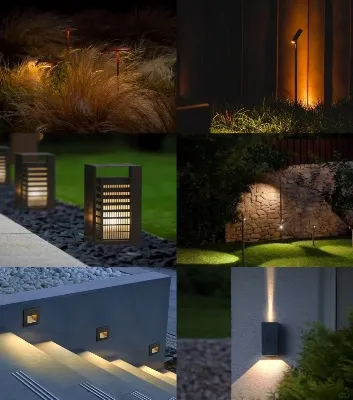
When you buy garden lights for a villa, a hotel garden, or a public park, the fixture itself is only half the story. The other half is whether it is safe to run outdoors. A garden light that looks great in a showroom can still fail in the rain if it was never tested against the right standards. That is why the certifications held by your garden light supplier matter just as much as the product's design and price.
Certifications are not paperwork for its own sake. They are the result of real testing: a fixture is checked for electrical insulation, heat resistance, moisture ingress, and impact strength before it can carry a recognized mark. When a supplier can show you these certificates, you know the product has been built to a standard that protects people and property.
Indoor lights live in a controlled environment. Garden lights do not. They are mounted low to the ground, exposed to sprinklers and storms, buried in soil, and sometimes knocked by lawn equipment. Moisture is the biggest enemy. Water that finds its way into a poorly sealed housing can cause short circuits, corrosion, and in the worst case, electric shock or fire. Add temperature swings and UV radiation, and the demands on a garden light are far higher than on an indoor lamp.
This is why most markets require outdoor luminaires to pass stricter tests than indoor ones. A supplier that only makes indoor fixtures may not have the testing infrastructure or experience to build safe garden lights.
For the EU market, garden lights must comply with the Low Voltage Directive and the Electromagnetic Compatibility Directive. The relevant product standards are EN 60598 for the safety of luminaires and EN 55015 for electromagnetic compatibility of lighting equipment. CE is a self-declaration, so it is worth asking for the underlying test report rather than accepting the mark at face value.
For North America, look for UL 1598 for luminaires or UL 8750 for LED equipment, plus FCC Part 15 for electromagnetic compatibility. UL certification is verified by a third-party testing laboratory, which gives it more weight than a self-declared mark.
The Ingress Protection code tells you how well a fixture resists dust and water. For garden lights, IP65 (dust-tight and protected against water jets) is the common baseline, while IP66 adds protection against powerful water jets. A fixture with a low IP rating is a red flag for outdoor use, no matter how good it looks.
The IK code measures impact resistance. IK08 means the housing can withstand a 5-joule impact, and IK10 means 20 joules. If a garden light will be installed in a public area or anywhere it can be hit, a good IK rating is essential.
The Restriction of Hazardous Substances directive limits lead, mercury, cadmium, and other substances in electrical products. RoHS compliance matters for the EU market and for buyers who want to avoid environmental liability.
The IECEE CB scheme is an international mutual recognition system for electrical equipment. A CB test report from an accredited laboratory can be converted into national certifications in many countries, which is useful when you ship to several markets from one supplier.
ISO 9001 certifies the supplier's quality management system rather than a specific product. It tells you the factory runs consistent processes for design, production, and inspection. It is a good sign of a serious manufacturer, but it does not replace product-level certifications.
A certificate is only useful if it is real and covers the product you are buying. Here is a practical checklist:
Certification is easier to manage when your supplier handles more than one product line. An outdoor lighting supplier that also provides garden lights and solar panels can keep the whole project consistent: one set of compliance documents, one quality standard, and one point of contact for the entire site.
This is the approach taken by COLORIA GROUP, a one-stop building materials supplier based in Foshan, China, with an overseas agent in Saudi Arabia. Its product range covers interior and exterior solutions, including garden lights, outdoor lighting, and solar panels, so a single partner can cover the lighting needs of a residential or commercial project from one source. Whether you need a garden light supplier for a hotel landscape or a solar panel supplier for a villa rooftop, the same quality and compliance standards apply across the whole order. When you work with a supplier that also understands the wider building materials picture, you spend less time coordinating and more time building.
Outdoor electrical safety is not negotiable for garden lights. The certifications a supplier holds, such as CE, UL, IP, IK, RoHS, and ISO 9001, are the evidence that its products have been tested to withstand the conditions they will face. Before you place an order, ask to see the certificates, check that they cover the exact product, and confirm the test reports come from an accredited laboratory. A few minutes of verification now can save you from customs delays, safety incidents, and costly rework later.
Recommend Products












