
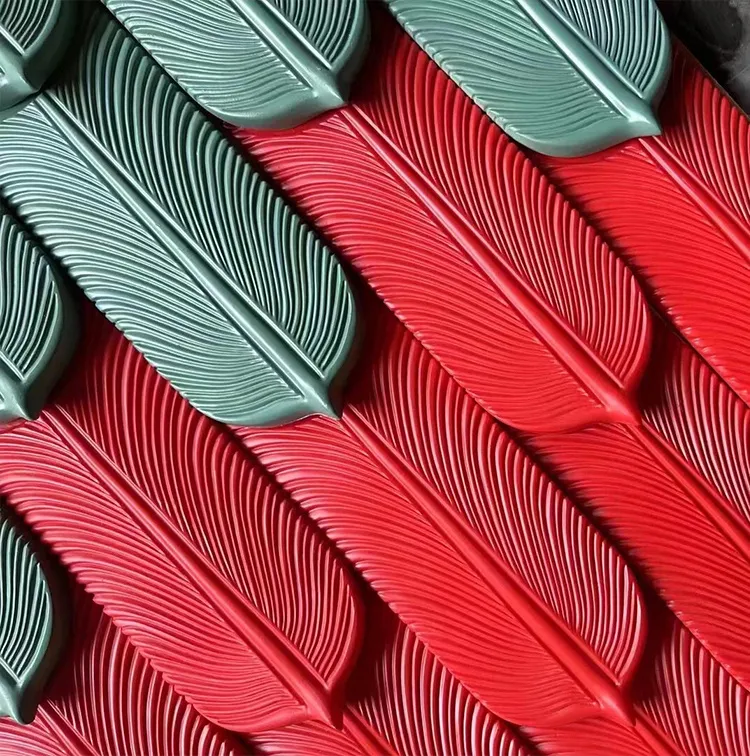
Picture this: you're standing in a gallery where light flows over organic stone curves that look like solidified wind. That's feather stone whispering its secrets. This ancient art form bridges natural forces and human craftsmanship in ways that make skyscrapers blush.
Stone speaks the world's oldest language. Before cement mixers roared, before CAD designs lit up screens, feather-and-wedge splitting birthed the foundations of civilization. Think of Jericho's 9000 BC walls whispering secrets to the Acropolis. This method traveled through Egyptian quarry workers, Chinese masonry guilds, and Roman engineers—the ultimate architectural influencer.
Modern tools can't replicate feather stone's magic. Diamonds bite indiscriminately, tearing stone cells like paper. But wedges? They flow with the stone's conversation—foliation plans, quartz veins, crystalline memories trapped since the Precambrian. Every split reveals a geological story.
Splitting stone isn't domination; it's partnership. Expert masons read stone like poets: Is it talkative Blue Mist granite whose cleavage sings like wind chimes? Or stoic Rosswell Grey that whispers its preferences only at dawn's humidity?
Hand-drilling guide holes feels like taking the stone's pulse—too shallow and your wedges stutter; too deep and you crack its soul. Ideal holes breathe at 80% depth, like respecting boundaries.
Trow & Holden wedges aren't brute force. Steel feathers embrace the wedge like caring hands—gradually increasing pressure at 1,800 PSI. Unlike the screaming grind of carbide blades, stone parts with a satisfying "thoomp," sounding like sealed cave air escaping.
Enter Steven Holl's Nanjing Sifang Art Museum—the feather stone manifesto. Its floating corridors seem carved by glacial winds. The split-face granite walls glow amber at sunset as if capturing time itself. At 1111 Lincoln Road in Miami, Herzog & de Meuron transformed feather stone into vertical poetry. As one building material supplier remarked, their cantilevered staircases appear petrified waterfalls.
Modern architects rediscover what Inca masons knew: split stone breathes with humidity and plays with light like faceted jewels. That tactile vibration when you touch fractured stone? That's the stone's living signature, forever distinct from sterile polished slabs.
Feather stone creates environmental magic too. Consider carbon footprints: diamond sawing granite emits 16kg CO2 per square meter; feather-and-wedge is 0.8kg. Why? No fossil-fueled blades, no cooling agents seeping into aquifers. Modern stone cutting uses water volumes comparable to drought-stricken villages' annual supply.
Weathered techniques also preserve heritage. When restoring York Minster's ruins, feather stone saved carvings that power tools would have obliterated. This gentle approach lets stone fragments find afterlife as landscape poetry—meandering paths, water features, or sculpture gardens.
Urban designers increasingly choose feather stone not just for its ecological charm but because it resonates emotionally—we inherently trust split stone's tactile honesty more than laser-perfect composites. It whispers permanence.
Learning this craft feels like entering a stone whispering society. Brian Post of The Stone Trust teaches apprentices to listen with their palms. You gauge when tension climbs to the breaking point—a tactile memory no hydraulic splitter can teach. Workshop rituals transform into meditations: the percussion of hand hammers, the faint tang of steel on quartz, sunlight warming stone dust.
Stone splitting workshops near ancient quarries become time portals where participants touch the same rock faces medieval builders touched. That thread through time? That's true heritage preservation.
Feather stone's elegance now graces spaces we inhabit daily: textured accent walls that invite touch in boutique hotels, landscape boulders split into natural benches for public parks. Artisans sculpt kinetic pieces where stones balance on fracture points that look impossible.
Forward-looking designers partner with quarries to custom-split stones according to crystal patterns. Imagine bespoke marble countertops where calcite rivers flow across your kitchen surface, each one unique as a fingerprint.
Emerging tech embraces feather stone's spirit. Robotic masonry arms guided by AI cleavage prediction models, parametric designs using algorithm-generated fracture patterns. Even lunar architecture concepts apply wedge physics to regolith splitting.
Feather stone represents the beautiful conversation between human ingenuity and Earth's patience. It transforms quarry rock into heritage—not just physically but emotionally. Every split stone carries geological memory; every precisely fractured surface becomes a timestamp in human craft.
So next time you trace your finger along a weathered stone wall, remember: that surface emerged from ancient geological forces and someone patiently listening to stone whispers. That's the true magic—where art meets earth.
This stone speaks for civilizations past and futures imagined. We're merely translators of its ancient song.
Recommend Products












