
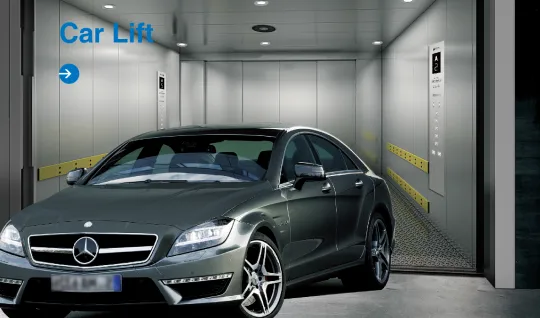
As urban spaces become increasingly dense and the demand for efficient parking solutions grows, automated parking systems equipped with car lifts have emerged as a game-changing technology for residential, commercial, and mixed-use developments. But one question consistently arises among property developers, building managers, and vehicle owners: what safety mechanisms are built into these systems to protect both vehicles and people? This article explores the multi-layered safety architecture that makes modern car lift solutions among the most reliable parking technologies available today.
The most fundamental safety mechanism in any car lift system is the mechanical locking assembly. Contrary to a common misconception, vehicles are not held in place solely by hydraulic pressure or wire rope tension. Once a lift platform reaches its designated position, heavy-duty mechanical safety latches automatically engage, anchoring the platform directly into the structural steel frame. This means that even in the event of a complete hydraulic failure or power loss, the vehicle remains securely locked in place with zero risk of downward movement.
Modern car elevators typically employ spring-applied, electrically-released (SAER) braking systems. In their default state, these brakes are engaged and holding the load. They require a continuous electrical signal to release, meaning that any power interruption instantly triggers brake engagement — a true fail-safe design. The holding torque of these braking systems is typically rated for 200% to 300% of the maximum rated load, providing an ample safety margin.
Key takeaway: Mechanical locks are passive safety devices that work without any external power, ensuring that a parked vehicle cannot fall regardless of system failures.
High-quality automated parking lifts are equipped with a dense network of sensors that continuously monitor every aspect of the lifting operation. These sensors form a redundant detection system that can identify potential hazards before they become dangerous.
Load sensors mounted on the platform constantly measure the weight of the vehicle. If the detected weight exceeds the lift's rated capacity, the control system immediately prevents operation. These sensors also monitor weight distribution to ensure the load is balanced, preventing dangerous tilting or uneven stress on the lifting mechanism.
Optical encoders and laser-based sensors track the exact position of the platform with millimeter-level accuracy throughout every movement cycle. If the platform deviates from its expected position — even by a few millimeters — the system triggers an emergency stop. Proximity sensors scan the surrounding area continuously, detecting any unexpected objects or personnel in the movement zone and halting operation instantly.
Infrared safety light curtains create invisible detection grids across entry and exit points. If any object or person breaks the beam during operation, the system halts immediately. Passive infrared (PIR) motion detectors add an additional layer of protection by scanning for any movement within the bay area before initiating any lift sequence.
Beyond physical mechanisms, the electronic control architecture of automated parking lifts provides sophisticated software-level safety. Dual-channel safety PLCs (Programmable Logic Controllers) run identical safety logic on two independent processors. The outputs are continuously compared, and any mismatch between the two channels triggers an immediate safe-state shutdown.
The control system enforces multiple safety interlocks, including movement sequencing that prevents conflicting commands — for example, the system cannot lift and lower simultaneously. Speed limiting functions ensure gradual acceleration and deceleration, preventing jerking movements that could destabilize the load. Watchdog timers monitor the health of the PLC itself, and if the controller fails to send a periodic "heartbeat" signal, the system automatically enters a safe state.
Many leading elevator manufacturers in China and globally now incorporate advanced diagnostic capabilities into their control systems, allowing for remote monitoring and predictive maintenance that catches potential issues before they escalate into safety concerns.
No discussion of safety mechanisms would be complete without addressing emergency scenarios. Modern car lift systems are designed with multiple layers of emergency response capability:
Even the most sophisticated safety systems require regular inspection and maintenance to perform reliably over the long term. Industry best practice recommends annual comprehensive inspections by qualified technicians, during which the structural integrity of the lift frame is assessed, locking mechanisms are tested under load, sensors are calibrated, and wear components are examined for signs of fatigue or corrosion.
A well-maintained car lift system with documented service history not only provides greater safety assurance but also extends the operational lifespan of the equipment and maintains compliance with relevant safety standards and certifications.
Conclusion
The safety mechanisms in modern car lift solutions for automated parking are comprehensive, redundant, and engineered to the highest standards. From fail-safe mechanical locks and multi-sensor detection networks to dual-channel control systems and robust emergency protocols, every layer works together to create a parking solution that is statistically far safer than traditional self-parking. For property developers, facility managers, and end users alike, understanding these safety features provides confidence that automated parking technology is not just a space-saving convenience, but a genuinely safer way to park.
Recommend Products












