
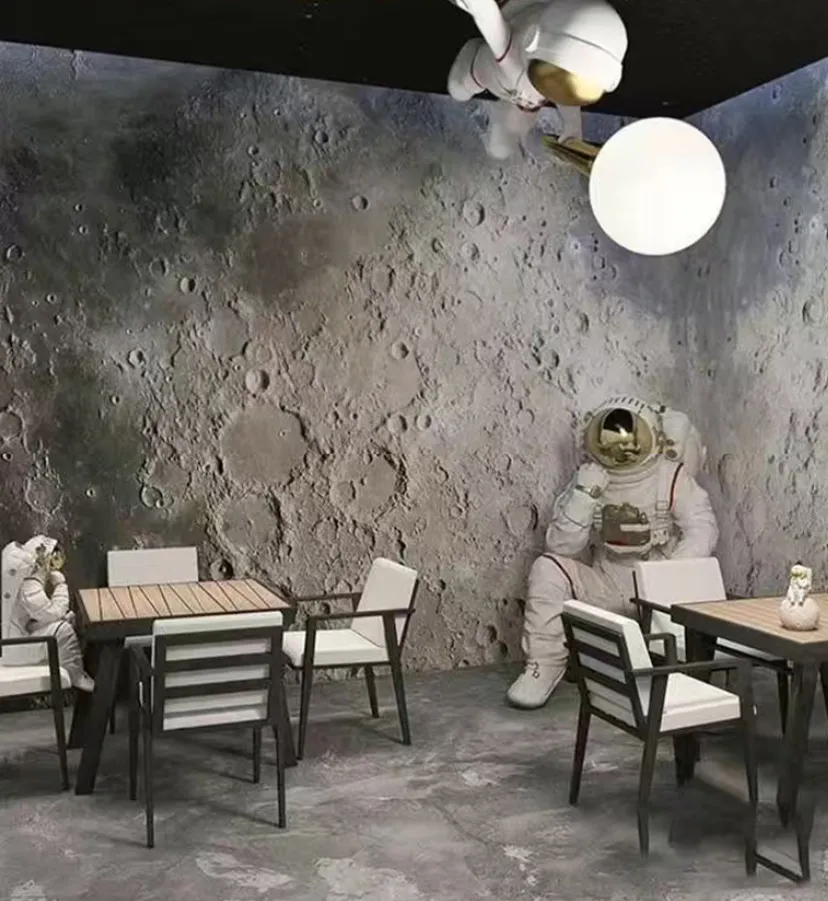
If you have spent any time browsing architectural material catalogues lately, you have probably noticed a growing number of panels that look like they were pulled straight off the lunar surface. They are sold under names like moon rock, lunar stone, or crater texture panels, and they have become a favourite of designers who want something that feels less like a flat wall and more like a landscape.
But what exactly are moon rock solutions, and how do they manage to copy the texture of a place most of us will never visit? This article explains the idea behind them, the way they are made, and why they have earned a permanent spot in modern interior and exterior design.
Moon rock solutions are decorative wall and surface panels that reproduce the cratered, uneven appearance of the moon's surface. They belong to the wider family of decorative profiles and textured cladding, a category built around giving ordinary walls the depth and character of natural materials.
Unlike flat printed wallpaper that simply shows a picture of craters, moon rock panels are genuinely three-dimensional. Each depression is a real recess in the surface, and each raised edge casts a real shadow as light moves across the room. That physical depth is the whole point, and it is also the main reason these panels have moved beyond novelty into mainstream specification.
Most moon rock panels are made from high-density polyurethane foam with a protective coating. The material is light enough to be handled by one person, yet rigid enough to keep its shape for years. Some versions are produced as flexible cladding that can follow curved walls, while others are rigid boards intended for flat surfaces.
Recreating the moon's surface is not a matter of painting a few grey circles. It takes several steps that work together to produce a convincing result.
Manufacturers do not guess what the moon looks like. They start from high-resolution scans and photographic reference of the lunar surface, then translate that data into moulds. Some moulds are carved by CNC machines, which allows the crater layout, depth, and edge profile to be controlled precisely. Others are cast from natural rock or meteorite textures to keep the irregularity that makes real stone convincing.
The key difference between moon rock panels and imitation stone wallpaper is depth. The raised crater rims and recessed crater floors create a relief that can be several millimetres deep. When light hits the surface at an angle, the shadows change continuously through the day, which is exactly what makes a wall feel alive rather than decorated.
Most people picture the moon as a single flat grey, but real lunar regolith contains subtle mineral variation, with hints of blue, beige, brown, and charcoal. Good moon rock panels reproduce this range instead of settling for one uniform tone. A matte finish is used to scatter light naturally, avoiding the plastic sheen that ruins so many faux stone products.
Because the texture is raised, the surface needs to survive daily wear. Most panels carry a clear protective topcoat that resists scratching, light chemical contact, and UV exposure. In practice this means a moon rock feature wall can be wiped down with a damp cloth and will not fade noticeably in a sunlit room.
Natural stone delivers an unmatched texture, but it also brings weight, cost, and installation complexity. Moon rock panels were designed to close that gap:
The texture is striking enough that it works best as a deliberate feature rather than an all-over finish. Common placements include:
Installation follows the same pattern as most lightweight cladding. The wall should be clean, dry, and reasonably flat. Adhesive is applied to the back of the panel in dots or a snake pattern, the panel is pressed into place, and a rubber mallet is used to seat it evenly. Panels are cut with a utility knife or jigsaw, and a small gap can be left between boards and filled with neutral silicone for a seamless look.
Day-to-day care is simple: a damp cloth handles dust and marks, and there is no need for the sealing or polishing that natural stone demands. For large areas or ceiling work, a second pair of hands or a temporary prop is worth having while the adhesive cures.
COLORIA GROUP is a one-stop building materials supplier based in Foshan, China, covering everything from walls solutions and flooring to sanitary fixtures, lighting, and solar panels. That breadth matters for contractors and distributors because it means moon rock panels can be ordered alongside the rest of a project's materials, with a single contact point and consistent quality control.
The company's decorative profiles range includes moon rock, lunar peak, starmoon stone, and a long list of other textured finishes, so matching a lunar feature wall to the surrounding design is straightforward. With an agent in Saudi Arabia and decades of industry experience behind the team, COLORIA GROUP also understands the documentation, packaging, and delivery requirements of export projects, which removes a layer of uncertainty for overseas buyers.
Are moon rock panels suitable for outdoor use? Some versions are made with weather-resistant coatings and can be used on exterior facades. It is always worth confirming the outdoor rating of the specific product before ordering.
Can the panels be cut to fit around corners and outlets? Yes. They cut cleanly with a utility knife or jigsaw, and the edges can be finished with silicone or trim profiles.
How do moon rock panels compare with printed 3D wallpaper? Printed wallpaper only simulates texture with shading. Moon rock panels have real relief, so the light and shadow behaviour is genuine and the surface can be touched and cleaned like a solid material.
Are custom colours and crater layouts available? Most manufacturers, including COLORIA GROUP, can tailor colour, size, and texture density to suit a specific project. Custom orders usually require a minimum quantity and a slightly longer lead time.
Moon rock solutions are essentially a clever marriage of material science and design. They take the cratered, mineral-rich look of the lunar surface and reproduce it as lightweight, fire-rated, easy-to-install panels that cost a fraction of natural stone. The realism comes from genuine three-dimensional relief, moulds based on real lunar reference data, and a colour palette that goes beyond plain grey.
For architects, interior designers, and contractors who want a feature wall that people actually stop to look at, moon rock panels are a practical way to get the drama of natural texture without the structural headaches. And when they are sourced from a supplier that can deliver the rest of the building package alongside them, the whole process becomes a good deal simpler.
Recommend Products












