
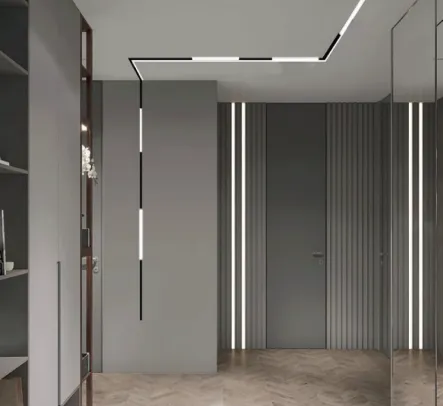
You know that moment when you walk into a room and the lighting just feels... off? Maybe your kitchen counters are shadowy when you're chopping veggies, or your art collection looks dull instead of dazzling. This is where magnetic track lights come to the rescue – they're like LEGOs for your ceiling. Let me break down why everyone from homeowners to commercial designers are flipping for these flexible systems.
Imagine a sleek track mounted to your ceiling that holds multiple lights, but with zero screws or complicated wiring for each fixture. That's the core idea. Magnets embedded in both the track and light fixtures create a secure snap-on connection that's surprisingly strong. You can reposition spotlight heads, swing pendants sideways, or swap out modules in seconds – no electrician needed.
Why this beats traditional setups: Remember struggling with recessed lighting that required cutting holes in drywall? Or those bulky track lights with visible connectors? Magnetic systems ditch all that hassle. The tracks are slim (often under 1" tall), and fixtures click into place with satisfying precision.
| Feature | Magnetic Track Lights | Recessed Lighting | Traditional Track Lights |
|---|---|---|---|
| Installation Time (10 lights) | 1-2 hours | 4-6 hours | 2-3 hours |
| Repositioning Fixtures | Seconds, no tools | Impossible without drywall repair | Requires screwdriver/rewiring |
| Max Fixture Spacing Flexibility | Anywhere along track | Fixed during installation | Limited to pre-set connection points |
| Upgradeability | Swap modules anytime | Entire fixture replacement | Compatible fixtures only |
| Ceiling Visual Impact | Ultra-slim tracks | Visible bezels/cans | Bulky tracks with connectors |
Homes: Kitchens crave adjustable task lighting over islands. Living rooms benefit from accent spots that highlight bookshelves or art. Even bathrooms use moisture-resistant modules for vanity lighting without glare.
Retail & Galleries (Commercial Lighting Pros): Magnetic tracks excel here. Highlight new arrivals with spotlights, use wide-beam modules for wall washing, and reposition everything during seasonal displays without scaffolding. Museums love them for artifact illumination that avoids damaging ceilings.
Offices: Combine ambient linear lights with task modules over desks. Need a layout change? Just slide fixtures instead of rewiring entire grids.
Track Voltage: Low-voltage (24V/48V) systems dominate for safety and slim profiles. Line-voltage (120V) exists for high-output needs but needs deeper tracks.
Fixture Types: Mix spotlights (15°-30° beams for drama), floodlights (wide wall washing), pendants (over islands), linear battens (general light), and even decorative shapes.
Smart Features: Many integrate with Alexa/Google Home. Choose tunable white lights (warm to cool) or full-color RGB modules for mood lighting. Look for dimmable drivers.
Finish Harmony: Match tracks and fixtures to your décor. Black offers contrast, white disappears, brushed nickel fits transitional spaces.
While recessed lighting still has its place in minimalist schemes, magnetic tracks offer unbeatably flexible, future-focused illumination. They solve the "I wish I could move that light..." frustration forever. As LED tech advances, upgrading will mean swapping modules – not your entire ceiling.
Whether you're revamping a kitchen, designing a boutique, or just crave adaptable ambiance, magnetic track lights bridge the gap between functionality and aesthetics. They’re proof that in modern architectural lighting solutions , flexibility is the ultimate luxury.
Recommend Products












