


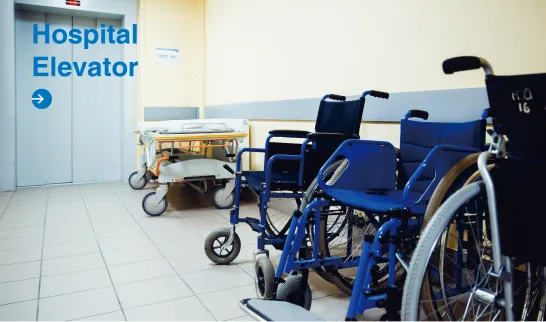
Picture a busy hospital: doctors rushing to surgeries, nurses pushing medication carts, patients being transported between floors. At the heart of this organized chaos are unsung heroes quietly making it all possible – hospital elevators. These aren't your average office-building lifts; they're specialized engineering marvels designed to handle life-or-death situations with seamless precision. Today, we're pulling back the curtain on these vital machines to understand exactly why they're engineered differently, how they function in critical healthcare settings, and why they deserve our attention.
Beyond Basic Transport: The Life-Saving Role of Hospital Elevators
Hospital elevators serve as the circulatory system of healthcare facilities, powering three essential flows:
Patient Mobility: Gentle & Efficient
These elevators cradle fragile human cargo with precision engineering. We're talking ICU patients on ventilators, trauma victims bleeding out, elderly with mobility challenges. Specialized stretcher and bed elevators feature:
- Ultra-smooth acceleration/deceleration – no jerky stops!
- Extra-wide cabins fitting critical care equipment
- Gentle alignment systems eliminating dangerous gaps
A hospital elevator doesn't just move bodies; it safeguards precious seconds during stroke interventions, codes, and emergency C-sections.
Medical Equipment & Supply Chain
Consider how sterilized surgical kits travel from the basement to ORs or how radioactive isotopes journey to oncology units. Service elevators handle these critical transfers with:
- Heavy-duty load capacities (often 1600kg-3000kg)
- Shock-resistant interiors protecting sensitive MRI components
- Express zoning technology bypassing non-critical floors
Without this logistical backbone, the complex machinery keeping modern medicine alive simply wouldn't function.
The Human Network: Staff & Visitors
Passenger elevators keep the heartbeat of healthcare professionals steady. Doctors changing shifts, families visiting ICU, technicians troubleshooting equipment. These specialized lifts include:
- Voice announcement systems for visually impaired visitors
- Emergency communication buttons connecting directly to security
- Self-sanitizing UV light systems fighting infection spread
They're social spaces where hope and anxiety mingle quietly between floors.
Built For Healthcare: How Hospital Elevators Are Engineered Differently
Hospital-Grade Safety Protocols
Unlike commercial elevators, healthcare lifts have tiered safety protocols:
- Fireproof construction materials rated for 120+ minutes
- Backup power systems ensuring functionality during outages
- Seismic stabilization protecting earthquake-prone regions
- Emergency stop overrides accessible to medical teams
Infection Control Warfare
This is where you'll notice antibacterial surfaces and specialized airflow:
- Seamless stainless steel interiors with antimicrobial coatings
- Hands-free controls (voice/gesture/mobile app activated)
- HEPA filtration systems cycling air every 90 seconds
- Non-porous materials resisting pathogen colonization
Every surface fights against hospital-acquired infections.
Engineering for Vulnerable Moments
Features designed for physical limitations:
- Low-zone Braille and voice controls (ADA compliance)
- Non-slip grooved flooring needing no visual cues
- Seating nooks for patients awaiting transport
- Gentle warning tones avoiding panic triggers
Meeting Specific Needs: Types of Hospital Elevators
Bed Elevators: The Heavy Lifters
Engineered around standard hospital bed dimensions. Key specs:
- Cabin size (min): 150cm × 270cm × 230cm
- Weight capacity: 2000kg+
- Smooth hydraulic drives preventing IV pole disturbance
- Common sizes: 180cm × 270cm cabins
Stretcher & Emergency Responders
Slightly narrower than bed elevators for rapid trauma transport:
- Priority call buttons flashing hall indicators
- Retractable rails securing gurneys during motion
- Intercom systems coordinating with ER teams
Service & Logistics Elevators
The "freight trains" of hospitals handling:
- Bulk food delivery to kitchens
- Sterile supply transport
- Waste management systems
Features heavy-duty surfaces and drainage options.
Integrated Hybrid Systems
The latest trend – modular designs adapting between roles:
- Morning: Transporting breakfast carts
- Midday: Shifting outpatient clinic supplies
- Night: Emergency ICU transfers
All achieved with convertible interiors and dynamic zoning.
Choosing The Right System: A Hospital Administrator's Guide
Matching Capacity to Workflow
Critical considerations:
- Number of daily patient transports per department
- Peak hour volume mapping
- Future expansion planning
Hospitals often need multiple specialized units rather than one oversized elevator.
Infection Control Hierarchy
Elevator placement matters:
- Separate units for sterile vs. contaminated paths
- OR-specific elevators with positive airflow
- Isolation unit elevators with decontamination cycles
Designated "dirty routes" prevent cross-contamination.
Maintenance & Longevity
Evaluating long-term value:
- Sealed lubrication systems reducing servicing frequency
- Modular component design simplifying repairs
- Remote diagnostic monitoring for predictive maintenance
Future Horizons: Smart Hospital Elevators
AI Coordination Systems
Emerging predictive algorithms:
- Integrating with surgery schedules to pre-position elevators
- Analyzing historical patterns optimizing resource deployment
- Prioritizing emergency requests in real-time
Health Monitoring Integration
Elevators becoming diagnostic tools:
- Non-contact vital sign scanning during transport
- Automated emergency alerts if readings deteriorate
- Integrated defibrillator units in code blue models
Transforming transport corridors into responsive care environments.
Elevating Healthcare: Why These Systems Matter
As we've explored, hospital elevators operate at the critical intersection of logistics, safety protocols, and human care. They're engineered with precision unmatched in other vertical transport systems because lives literally depend on their flawless operation. Every design choice – from antimicrobial surfaces to specialized fireproof construction materials – addresses healthcare's unique pressures.
Whether it's enabling rapid stroke interventions by cutting transport times, maintaining sterile pathways between critical departments, or simply providing dignified mobility to vulnerable patients, these systems form the unacknowledged backbone of modern medicine. Next time you visit a hospital and enter an elevator, notice the extra width, the seamless surfaces, the careful engineering. What might seem ordinary is actually a remarkable life-support system carrying humanity through its most fragile moments.










