
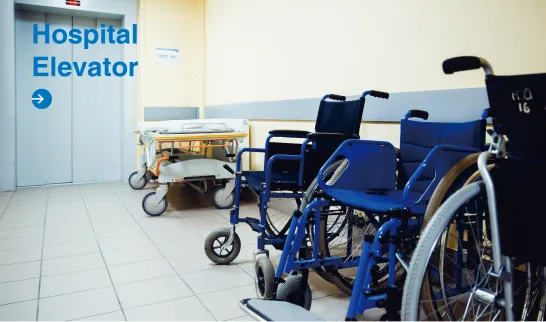
When a hospital grows beyond a single floor, the elevator stops being a convenience and becomes part of the medical infrastructure. Stretchers need to move between the emergency department and the operating theatre, medication carts roll between wards, and visitors stream in and out during visiting hours. A machine that handles this much traffic, under this much pressure, has to be built differently from a standard office lift. That is why hospital elevators manufacturers design dedicated product lines around the specific demands of healthcare buildings rather than adapting a generic elevator and hoping for the best.
The core difference is not the motor or the cables, but the way the whole system is engineered around patient safety and continuous operation. A hospital elevator has to start and stop gently, because a sudden jolt can be painful for a patient on a stretcher or dangerous for someone carrying a tray of samples. It has to be spacious enough to fit a hospital bed, an IV stand, and two or three attendants at the same time. And it has to keep running around the clock, because emergencies do not follow a nine-to-five schedule.
Beyond the basics, healthcare facilities also look for features that keep the environment clean and controlled. Antibacterial interior finishes, hands-free or touchless call buttons, and smooth, sealed surfaces that are easy to wipe down all matter in a setting where hygiene is a daily priority. These details are exactly what a serious hospital elevator supplier builds into its products from the start.
A good manufacturer does not offer a single hospital elevator; it offers a family of machines that covers every vertical transport task in a medical campus. The most common types include:
Many manufacturers also supply complementary vertical transport equipment for the wider building, such as home lifts for staff housing or outpatient facilities, freight lifts for logistics, and even escalators and moving walks for large hospital lobbies and connecting wings. When one supplier covers the whole range, the hospital gets consistent quality, simpler maintenance contracts, and a single point of contact for spares.
Safety in elevators in hospitals is not a single feature but a stack of systems working together. Overspeed governors and safety brakes stop the car if it moves faster than it should. Emergency communication systems connect passengers to help immediately. Backup power keeps at least one car running during an outage, which is critical when a patient is mid-transfer between departments. Access control, using smart cards or keypads, restricts certain floors to staff only, protecting operating theatres, pharmacies, and storage areas.
Energy efficiency matters too, because a hospital elevator runs far more cycles per day than a residential lift. Regenerative drives capture energy during descent and feed it back into the building grid, while LED lighting and standby modes cut idle consumption. These features lower the running cost of the elevator over its service life, which for a busy hospital adds up to a meaningful saving.
Start by listing the actual traffic your building will generate: how many beds, how many floors, which departments need dedicated cars, and whether you need stretcher capacity on every floor or only on certain routes. That list becomes the specification you take to shortlisted manufacturers. Then compare them on four things: proven experience in healthcare projects, the ability to customize car sizes and finishes, the quality of installation and after-sales support, and how quickly spares can reach your site.
It is also worth considering a manufacturer that supplies the rest of the building as well. A hospital is not just elevators; it needs walls, flooring, sanitary fixtures, doors, lighting, and electrical systems. Working with a one-stop building materials supplier means the elevator specification can be coordinated with the rest of the fit-out, deliveries arrive through the same channel, and the project team deals with fewer vendors overall.
COLORIA GROUP is a one-stop building materials supplier based in Foshan, China, with an agent in Saudi Arabia and decades of combined industry experience. Its elevator range includes hospital elevators, home lifts, freight lifts, car lifts, commercial escalators, and moving walks, so a healthcare project can source all its vertical transport needs from a single supplier. Beyond elevators, the company covers thirteen product categories, from walls and flooring to sanitary fixtures, customized furniture, doors and windows, lighting, and solar panels, which makes it easier to coordinate the whole building package in one place.
The company's slogan, "Together we Build the Future," reflects its approach: understanding the project first, then matching the right products to it. For procurement teams and contractors planning a hospital or clinic, that means a supplier who can answer questions about the elevator, the bathroom fixtures, and the lighting in the same conversation, and who can back every product with reliable delivery and support.
Hospital elevators are a specialized product category, and the manufacturers who do them well treat them that way. The right machine combines gentle motion, generous capacity, round-the-clock reliability, and the safety and hygiene features a medical environment demands. And the right supplier brings experience, customization, and after-sales support to the table, ideally alongside the rest of the building materials you need. If you are planning a healthcare project, start with a clear specification, shortlist manufacturers who specialize in medical vertical transport, and look for a partner who can deliver the whole picture, not just one piece of it.
Recommend Products












