
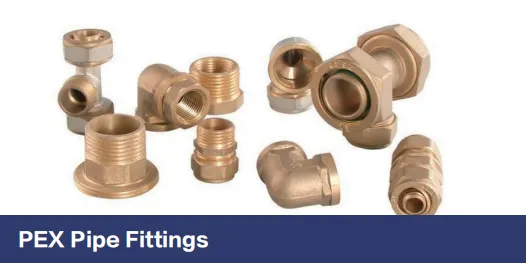
If you have ever looked behind a kitchen sink, under a washbasin, or inside a utility closet, you have probably met the 1/2 PEX pipe fitting without knowing its name. PEX has quietly taken over residential and light-commercial plumbing because it is flexible, lightweight, and far easier to install than copper or steel. This guide explains what a 1/2-inch PEX fitting is, how the different types seal, when to use them, and what to look for so that your joints stay watertight for years.
A 1/2 PEX pipe fitting is a connector designed to work with 1/2-inch PEX tubing, the most common diameter used for lavatory, kitchen, and washing-machine supply lines. The "1/2 inch" refers to the inside diameter of the pipe, not the wall thickness. In practical terms, it means the fitting has a PEX connection sized for half-inch tubing on at least one end, while the other end may be a barb, a threaded adapter, or simply another PEX socket.
PEX fittings come in several materials. Brass and lead-free brass remain the most common because they are strong, corrosion-resistant, and form a reliable compression seat. PEX pipe and fitting systems are also available in engineered plastics such as PPSU, which are lightweight and do not corrode at all. Whether a home renovation or a full new build, a solid set of 1/2 PEX fittings paired with good tubing forms the backbone of a modern water-distribution network.
Before connecting anything, understand that PEX comes in three manufacturing types: PEX-A, PEX-B, and PEX-C. They share the same outside and inside dimensions, so a 1/2-inch crimp fitting fits all three. The differences lie in how the tubing is cross-linked and how it behaves during installation and connection. PEX-A is the most flexible and is preferred for expansion-ring connections; PEX-B is slightly stiffer but generally more affordable. The fitting you choose must match the connection method you plan to use, not just the diameter.
The real genius of PEX is that it does not need solder, glue, or threading. Instead, each fitting mates the pipe wall to the fitting body with a mechanical grip. There are four common methods, and the most familiar one is the crimp fitting.
Crimp (copper ring). Slide a copper crimp ring over the pipe, push the pipe onto the barbed end of the fitting until it stops, then squeeze the ring with a crimp tool. The compressed ring bites into the tubing and locks it to the barb. This is the classic, dependable method used in most homes.
Clamp (stainless steel cinch). Instead of a copper ring, a stainless-steel clamp is tightened with a cinch tool. The clamp holds the pipe against the barb and can be removed and adjusted more easily than a crimp ring, which makes it a favorite for repairs.
Expansion (PEX-A only). The pipe is stretched open with an expansion tool, slipped over a larger fitting, and allowed to shrink back for a tight grip. This method gives a full-bore flow and the strongest, most permanent connection, typical of modern manifold systems.
Push-to-connect. Simply push the 1/2-inch pipe into the fitting and a stainless-steel grab ring plus a rubber O-ring do the work. No tools at all, which makes push-to-connect ideal for tight spaces and quick repairs, though it costs a little more per joint.
Regardless of brand, a careful installation follows the same routine. First, cut the pipe square and clean — a square cut gives the ring a uniform surface to grip. Second, slide the crimp ring onto the pipe. Third, push the pipe fully onto the barb so it seats against the fitting shoulder. Fourth, position the ring just past the barb and compress it with the matching crimp tool. Finally, use a go/no-go gauge to check that the ring was compressed to the correct diameter; this accuracy check is what keeps the connection from leaking silently behind a wall.
Half-inch supply lines feed the fixtures you use every day: bathroom faucets, toilet supplies, dishwasher and washing-machine connections, and refrigerator ice-makers. Because PEX bends around corners without many joints, a 1/2-inch line can run from a central manifold to a fixture in a single, continuous length. The same fittings work for hot and cold water and even for hydronic heating loops, so the same fitting box covers most of a home or a small hotel renovation.
Not all fittings are built to the same standard, and the difference shows up years later. Look for lead-free brass bodies, which are safe for potable water, and for EPDM O-rings that hold up to hot water without drying out. Check that the fitting matches the intended standard — for crimp connections that means a proper barb profile and a ring seat that accepts a standard ASTM F1807 ring. When buying in volume for a project or for resale, sourcing from a supplier that can guarantee batch consistency matters more than shaving a few cents per unit.
COLORIA GROUP supplies complete pipes fittings for water, drainage, and pressure systems. Within its piping range you will find PEX pipe and fitting sets built for hot and cold water, as well as dedicated PEX pipe fittings. Because the company covers walls, flooring, sanitary fixtures, and appliances as well, a contractor can consolidate an entire project, including plumbing, from a single one-stop building-materials partner.
Most PEX leaks come from installation errors rather than from the fitting itself. The four that appear again and again are: not pushing the pipe fully onto the barb, positioning the ring in the wrong spot before compressing, using mismatched ring and crimp sizes, and skipping the go/no-go gauge check. If the ring is compressed too little, the grip is weak; if the head of the fitting cracks from excessive force or a wrong-size ring, water finds an easy path out. Re-checking every joint before closing the wall is the cheapest insurance there is.
The 1/2 PEX pipe fitting is a small part that carries a big responsibility: every drop of water in your plumbing passes through one. Understanding the difference between crimp, clamp, expansion, and push-to-connect systems, choosing lead-free quality fittings, and installing them with a clean square cut and a verified ring compression will give you durable, leak-free connections for decades. Whether you are repairing a single sink line or equipping a whole building, starting with reliable fittings is the simplest way to ensure the job is done right the first time.
Recommend Products












