


Why Consistency Matters More Than You Think
The Unsung Hero: Why Wall Thickness Isn't Just a Number
Picture this: You're installing irrigation lines for a community garden. The sun's beating down, you’re halfway through the project, and suddenly— snap —a pipe bursts. Turns out, that one weak spot where the wall was thinner than it should’ve been couldn't handle the pressure. Sound familiar? This everyday scenario shows why wall thickness uniformity isn't just factory jargon—it's what stands between reliability and costly failures.
Bottom line first: Consistent wall thickness in PVC pipe fittings is like having balanced tires on your car. You won’t notice it when it’s right, but when it’s off? Everything vibrates, wears out faster, and eventually fails. This isn’t about chasing perfection—it’s about avoiding disasters.
Manufacturers face a daily tightrope walk. Make walls too thin? The pipe collapses under pressure. Too thick? You’re wasting resin and hiking costs for everyone. For transparent PVC pipes—where flaws are embarrassingly visible—uniformity becomes non-negotiable. Think aquarium installations or lab setups where a leak could ruin sensitive equipment.
How We Measure What You Can’t See (Without Cutting Anything Apart)
The "gold standard" for checking wall thickness? Ultrasonic testing. Imagine a tiny, high-pitched speaker pressed against the pipe surface. It sends sound waves through the material, which bounce back like echoes in a canyon. By timing these echoes, devices like the Olympus 45MG or 39DL PLUS gauges calculate wall thickness down to the millimeter.
Why this beats cutting pipes open:
- Speed: Results in seconds, not hours
- Non-destructive: Test installed pipes without dismantling systems
- Pinpoint accuracy: Detect variations human eyes miss
Pro tip for engineers: Using the right probe matters as much as the gauge itself. For most clear PVC pipes (thickness under 25mm), the M112 transducer is your workhorse. Thicker than an inch? Switch to the M1036. Small diameters under 3mm? That’s a job for the specialized 72DL PLUS.
| Pipe Scenario | Recommended Tool | Use Case Tips |
|---|---|---|
| Standard PVC pipes (0.5-25mm) | M112 Transducer | Ideal for irrigation/drainage systems |
| Thick-walled pipes (>25mm) | M1036 Transducer | Industrial pressure applications |
| Micro-diameter tubing (<3mm) | 72DL PLUS Gauge | Medical/lab equipment lines |
When Uniformity Saves More Than Money
Consider the lifecycle of a typical PVC pipe fitting:
Problem: Uneven walls concentrate stress like folded paper—eventually tearing. This becomes critical in scenarios like:
- Chemical transport where leaks create hazards
- HVAC systems with thermal cycling stresses
- Underground installations where repair costs soar
Solution: Consistent thickness distributes pressure evenly. This isn't just theory—facilities managing 5,000+ pipe segments report 70% fewer failures after implementing regular ultrasonic checks.
A manufacturer shared this insight: "Before prioritizing wall checks, we wasted 3% of resin on over-engineered sections. Now? That's down to 0.8% without compromising safety. For a facility moving a million pounds of PVC annually, that’s a $200,000 savings."
Beyond Ultrasonic: Other Detection Techniques Compared
Laser Micrometry : Uses lasers to map surface profiles. Great for lab settings but struggles with on-site inspections. One technician joked, "It’s like bringing a microscope to a construction site—accurate but impractical."
X-ray Imaging : Reveals internal flaws but requires safety protocols that slow workflow. Best saved for failure analysis, not daily QC.
The verdict: Ultrasonic remains king for field reliability and cost-effectiveness. As one plant manager noted: "We tried fancier systems, but what works at 3 AM during an emergency repair isn’t the lab’s darling—it’s the gauge that fits in your tool belt."
Why PVC Deserves Extra Attention (Hint: It’s See-Through)
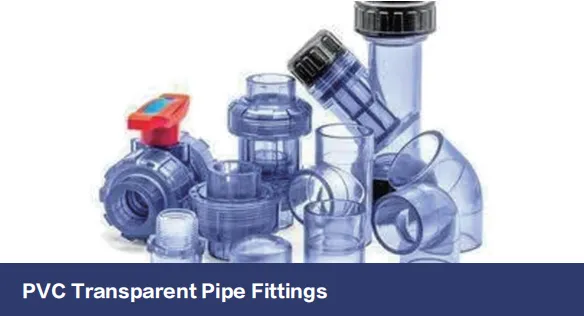
Transparent **pvc pipe** fittings suffer uniquely from thickness flaws:
- Visual imperfections frustrate architects in high-design spaces
- Light refraction magnifies wall inconsistencies
- Installers avoid using them in visible areas due to cosmetic risks
One aquarium designer lamented: "I stopped using clear PVC for exhibits because inconsistent walls created funhouse-mirror distortions. Only when a supplier guaranteed ±0.1mm uniformity did we return to it."
Future-Proofing: Where Detection Tech is Headed
The next generation goes beyond manual spot-checks:
AI-Powered Systems : Like quality control "co-pilots" using cameras to scan full pipe lengths during extrusion, flagging variations in real-time.
Blockchain Traceability : Imagine scanning a QR code on any pipe fitting to see its wall thickness map from production—already piloted in pharmaceutical supply chains.
As one tech CEO observed: "In five years, measuring thickness will be like checking battery life on your phone—automated, predictive, and something you rarely think about until it warns you."
Wrapping Up: The Thin Line Between Success and Failure
Wall thickness uniformity isn’t just about avoiding bursts—it determines how long systems last, how much they cost to run, and whether professionals trust a material. That clear PVC pipe fitting? It’s more than tubing; it’s a promise of reliability sealed by precision.
Final takeaway: Prioritizing uniformity transforms PVC from a commodity into a precision component. As infrastructure ages globally, this invisible quality will decide which systems outlive their warranties—and which become tomorrow’s emergency repair stories.










