
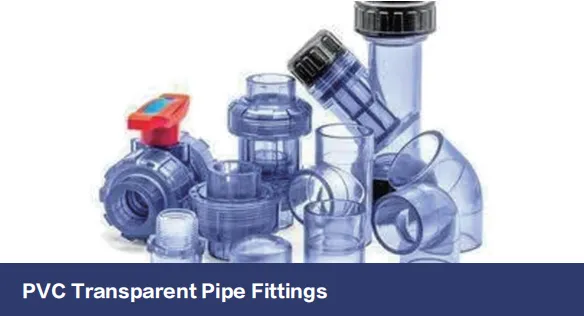
Picture this: You're staring at a complex industrial piping system, trying to troubleshoot a flow issue. With traditional opaque pipes, you're essentially working blind - guessing at flow rates, potential blockages, or contamination. Now imagine instead you're looking through crystal-clear conduits where you can actually see the liquid moving through the system. That's not sci-fi - it's the reality of transparent PVC pipe fittings that are changing how we interact with fluid systems forever.
Transparency isn't just about aesthetics - it's about putting control and visibility directly into the hands of technicians, engineers, and maintenance crews. When you can visually verify what's happening inside your pipes, you move from reactive troubleshooting to proactive system management.
The plumbing and industrial piping world has been dominated by opaque materials for decades. We've had copper's reliability concerns, galvanized steel's corrosion issues, and standard PVC's "black box" mystery. But transparent PVC changes the game completely. It's like going from dial-up internet to fiber optic - once you experience the difference, there's simply no going back to guessing games with your fluid systems.
Let's get real about why transparent PVC fittings outperform their opaque cousins in nearly every application:
1. The Eyes Have It: You know that moment when you're troubleshooting a system issue and wish you had x-ray vision? Transparent fittings give you exactly that capability. Being able to spot flow issues, sediment buildup, or color changes immediately is invaluable. Maintenance teams at chemical plants have reported reducing diagnostic time by 60% simply by seeing rather than guessing at problems.
2. Safety Isn't Invisible: When dealing with hazardous materials, visual confirmation equals safety. I've spoken with plant managers who swear transparent fittings prevented serious incidents when operators spotted contamination or leaks developing early. The psychological comfort alone of knowing what's flowing through your pipes changes how workers interact with systems.
3. More Than Just Pretty Pipes: Modern industrial design has embraced transparent piping as both functional and visually striking. Architects are incorporating clear PVC into open-concept spaces where pipes become design elements rather than eyesores. One brewery I visited uses transparent pipes as part of their customer tour - watching the golden ale flow becomes part of the experience!
Not all clear PVC is created equal - understanding the difference between SCH40 and SCH80 can save you headaches down the line:
SCH40 is your everyday workhorse - perfect for most residential and light industrial applications where pressures stay moderate. SCH80 steps up when you need muscle - its thicker walls handle higher pressure and offer enhanced chemical resistance that chemists in lab settings appreciate.
I recently helped a microbrewery overhaul their system and we chose SCH80 for the hot wort transfer lines. The thicker walls handled the temperature fluctuations beautifully while letting them spot any particle contamination during transfer. It's decisions like this where clear pvc fittings prove their worth beyond their aesthetic appeal.
Don't just grab whatever's on the shelf though - factor in your operating temperature range and chemical compatibility. Some acids can cloud standard transparent PVC over time, but specially formulated clear blends maintain visibility even in harsh environments. This transparency resilience matters when your system's visibility is mission-critical.
This isn't plumbing as usual - transparent fittings are solving real-world problems across sectors:
The Lab Life: Research facilities are early adopters. One biotech engineer described how transparent pipes helped them spot a critical phase separation in real-time that would've ruined a week-long experiment with standard pipes. The "eureka moment" came visually when researchers saw the unexpected reaction unfolding.
Aquatic Applications: Aquariums large and small benefit tremendously. Marine biologists monitoring delicate ecosystems appreciate being able to visually confirm flow rates and spot blockages before they become life-threatening to species. Public aquariums now feature viewing windows with clear pipes where visitors can watch water circulation systems in action.
Food & Beverage Revolution: Food safety inspectors love transparent systems. During a recent visit to a juice bottling plant, the quality manager showed me how they spot pulp accumulation before it causes flow issues. "We literally see quality flowing through our plant now," she remarked - something impossible with opaque systems.
The educational value alone makes transparent piping worthwhile. Teaching fluid dynamics becomes dramatically more effective when students can visualize laminar versus turbulent flow rather than just imagining it. One university professor redesigned their entire fluid mechanics lab around transparent systems with measurable improvement in comprehension.
What's next for transparent PVC? We're already seeing exciting developments:
Smart Integration: Pairing transparent pipes with IoT sensors creates incredibly intelligent systems. Imagine a chemical plant where flow sensors attach directly to clear pipes - operators get real-time visual verification backed by sensor data. This hybrid approach prevents false alarms while catching actual issues faster.
Material Breakthroughs: New formulations are emerging that offer enhanced UV resistance for outdoor applications. One manufacturer showed me prototype clear pipes maintaining perfect transparency after a year in desert sunlight - crucial for solar thermal and agricultural applications.
Circular Economy: Sustainability initiatives now include clear PVC recycling streams. Closed-loop systems recover manufacturing cutoffs to create new fittings, reducing waste dramatically. As environmental manager at one plant told me, "Seeing our waste reduction literally flow through clear recycled pipes is incredibly satisfying."
The adoption curve keeps accelerating as more industries realize that opaque piping is essentially operating with blindfolds on. When your infrastructure's visibility becomes a core functionality rather than just a feature, transparent PVC fittings move from being alternatives to becoming the obvious choice.
Recommend Products












