
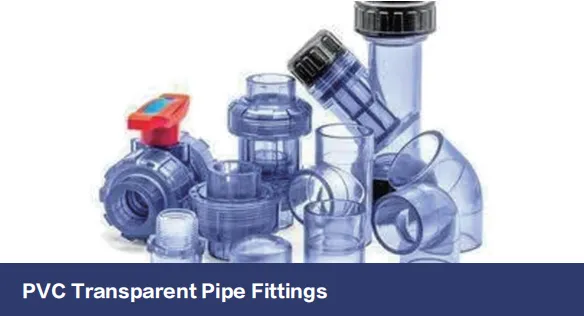
Picture this: you're troubleshooting a lab vacuum system when you spot an ominous bubble forming in a pipeline. In any other setup, it might go unnoticed until catastrophe strikes. But with PVC transparent pipes, you've just caught a disaster in the making. This superpower of visibility isn't just convenient—it's revolutionizing how engineers approach vacuum systems where pressure differentials make or break operations.
Transparent PVC pipe systems (especially clear PVC fittings) transform the invisible into the observable. Unlike opaque alternatives, these see-through conduits provide real-time diagnostics by revealing contaminants, flow irregularities, or material degradation before these hidden issues cascade into system failures. This crystal-clear advantage makes them indispensable for critical vacuum applications in labs, pharmaceutical facilities, and chemical processing plants where negative pressure demands absolute reliability.
Negative pressure systems are unforgiving environments where mistakes show up in collapsed pipes and contamination. That's where PVC-U transparent piping flexes its muscles:
The magic starts with Type I, Grade I Polyvinyl Chloride meeting ASTM D1784 standards. This material laughs in the face of -28 PSI vacuum conditions while resisting chemical corrosion like a seasoned gladiator.
These pipes boast Schedule 40 thickness with reinforced walls specifically engineered to handle dramatic pressure differentials. Their molecular structure maintains integrity when lesser materials would buckle—literally.
Cloudy fluid? Particles accumulating at joints? Flow inconsistencies? With transparent PVC, you're not guessing – you're seeing exactly what's happening from pipe-in to pipe-out.
The real-world difference appears when considering traditional systems. One pharmaceutical manufacturer reported eliminating 93% of unplanned maintenance when they switched to transparent PVC after constant negative pressure collapses. Seeing is preventing.
Not all "clear" pipes are vacuum-ready. Here's what separates show ponies from workhorses:
A silicon wafer plant learned this painfully when cheaper imports clouded after three months of vacuum cycles, shutting down $2M production lines for a month. For vacuum systems, meeting DIN 8062 or ASTM D1785 isn't enough—it's the baseline for discussion.
Even superhero materials fail with poor implementation. Avoid these vacuum installation traps:
"Solvent welding seems straightforward until your fittings start weeping under vacuum," warns Lars Heinrich, a Munich-based vacuum systems specialist. His golden rule? Sand all mating surfaces before applying cement and hold joints perfectly aligned for 45 seconds—no compromises.
Creating smooth turns without collapsing pipe walls demands precision. For 1" pipes: 350°F for exactly 45 seconds achieves optimal pliability. Too hot? Material crystallizes. Not hot enough? Bends collapse under vacuum.
Consider the German chemical plant that doubled service intervals simply by switching to DIN-certified PVC-U pipes with thermal cycling validation. Their secret? Partnering with manufacturers that provide pressure/temperature curves for specific pipe diameters.
With vacuum tech advancing, material scientists point to emerging innovations:
Nanoparticle-infused PVC layers that signal stress through optical color shifts before failure
Smart fittings with integrated microsensors monitoring wall integrity under pressure
Self-healing polymer matrices that seal micro-fractures during pressure fluctuations
Leading this charge? German manufacturers pioneering molecular stabilization techniques that maintain optical clarity after 10,000 pressure cycles. Because seeing problems shouldn't mean compromising longevity.
In vacuum systems, ignorance isn't bliss—it's expensive downtime. PVC transparent pipes provide the rare trifecta: uncompromised structural integrity under negative pressure, real-time diagnostic visibility, and adherence to exacting pharmaceutical-grade standards. When specifying your next negative pressure system, remember what separates adequate from exceptional lies in what you can—and can't—see.
It's not just about pipes. It's about operational visibility and avoiding catastrophic failure. For installations where collapse isn't an option, transparency through certified PVC isn't a luxury—it's a necessity.
Recommend Products












