
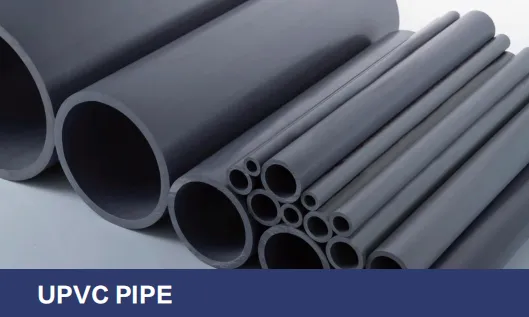
Picture this: It's a sweltering summer morning on a residential construction site. A team of workers is gathered around a stack of heavy steel pipes, their brows sweating as they heave one into place. The pipe slips, scraping against the concrete floor, and a frustrated groan escapes the foreman's lips. "We're already two hours behind schedule," he mutters. "If these pipes were any lighter, we could've finished the first floor by now." Sound familiar? For anyone in construction, plumbing, or infrastructure, the battle against bulky, cumbersome materials is all too real. But what if there was a solution that didn't just lighten the load—literally—but also turned installation from a headache into a highlight of the day? Enter UPVC pipe solutions: the unsung hero of modern piping systems, where lightweight design meets effortless installation.
In this article, we're diving deep into why UPVC (Unplasticized Polyvinyl Chloride) has become the go-to choice for contractors, engineers, and project managers worldwide. We'll explore how its featherlight construction eases physical strain, speeds up timelines, and cuts costs. We'll talk about the joy of watching a crew install an entire plumbing system in half the time it used to take with metal pipes. And we'll shine a light on the suppliers who make it all possible—because even the best product is only as good as the team behind it. Whether you're a seasoned builder or a homeowner planning a renovation, this is the story of how UPVC is reshaping the way we build, one lightweight pipe at a time.
Let's start with the obvious: heavy pipes are a pain. But their impact goes far beyond sore muscles. Think about the logistics: transporting steel or copper pipes requires larger trucks, more fuel, and extra hands to unload. On-site, maneuvering them through tight spaces—like between floor joists or up narrow stairwells—often means bringing in cranes or specialized equipment, adding thousands to project costs. And let's not forget safety: every time a worker strains to lift a 50-pound pipe, the risk of back injuries, slips, or falls increases. It's a domino effect: heavier materials lead to slower work, higher labor costs, and more downtime. So when we talk about UPVC's "lightweight design," we're not just talking about convenience—we're talking about transforming the entire rhythm of a project.
Take Maria, a site engineer with 15 years of experience, who recently switched to UPVC for a mid-rise apartment complex. "Before, we'd have a crew of four spending half a day just moving pipes to the third floor," she recalls. "With UPVC, two workers can carry a bundle of 20-foot pipes up a ladder—no crane, no hassle. We shaved three days off the plumbing phase alone." That's the power of lightweight: it turns a bottleneck into a breeze. UPVC pipes weigh roughly 1/5th of steel pipes and half as much as copper, making them easy to handle even in tight corners. For renovation projects, where access is often limited, this is a game-changer. Imagine replacing old, corroded pipes in a historic building without having to tear down walls to fit heavy materials through—UPVC makes that possible.
But lightweight doesn't mean flimsy. One common misconception is that "light" equals "weak," but UPVC defies that stereotype. Its rigid structure, reinforced by additives like impact modifiers, gives it the strength to withstand high water pressure (up to 16 bar for SCH40 pipes) while staying easy to carry. It's the kind of material that makes you think, "How did we ever work without this?"
If lightweight design is UPVC's superpower, installation ease is its sidekick. Let's walk through a typical scenario: You're installing a new plumbing line in a commercial kitchen. With metal pipes, you'd need to measure, cut with a hacksaw, deburr the edges, and then weld or thread the joints—a process that requires skilled labor and specialized tools. A single mistake, like a misaligned weld, can lead to leaks down the line. With UPVC? It's a different story. Grab a handsaw or pipe cutter (no power tools needed), apply solvent cement to the fittings, and twist the pipe into place. The cement sets in minutes, and you're ready to move on to the next section. It's so simple that even apprentices can master it with minimal training.
What makes installation so smooth? Solvent welding, the process used to join UPVC pipes and fittings, creates a bond that's stronger than the pipe itself. Unlike threaded metal connections, which can loosen over time, UPVC joints are permanent and leak-proof when done right. And because the pipes are lightweight, there's no need to build elaborate support structures—simple brackets spaced at regular intervals are enough. For projects with tight deadlines, like hospital expansions or school renovations, this speed is invaluable. When every day counts, UPVC lets you keep pace without cutting corners.
Another hidden benefit? Flexibility in design. UPVC pipes come in a range of sizes (from 16mm to 630mm in diameter) and can be easily bent or shaped using heat—though most installations stick to straight runs and standard fittings. This adaptability means they work just as well in a minimalist home's sleek plumbing as they do in a factory's complex drainage system. It's the kind of versatility that makes contractors smile.
Lightweight and easy to install are great, but what happens after the pipes are in the ground? That's where UPVC truly shines. Let's talk durability. Unlike metal pipes, which rust, corrode, or scale over time, UPVC is resistant to almost everything: chemicals, saltwater, bacteria, and even UV rays. In coastal areas, where salt air eats away at steel, UPVC pipes last for decades without a single spot of rust. In industrial settings, where acidic or alkaline fluids are common, they stand strong where metal would fail. It's the kind of longevity that gives homeowners and facility managers peace of mind. "I installed UPVC pipes in my house 15 years ago," says Sarah, a homeowner in Jeddah. "I haven't had a single leak or repair. When my neighbor had to replace his copper pipes last year because of corrosion, I just shook my head and thanked my lucky stars I went with UPVC."
Maintenance is another area where UPVC excels. No need for regular painting, coating, or inspections. Because the inner surface is smooth, there's minimal buildup of sediment or limescale, which means better water flow and lower energy bills (no more fighting clogs or replacing water heaters prematurely). For busy property managers, this translates to fewer callbacks, happier tenants, and lower operational costs. It's not just a pipe—it's a low-maintenance partner in building management.
And let's not overlook cost. While UPVC pipes might have a slightly higher upfront cost than low-quality PVC, they're significantly cheaper than copper or stainless steel. When you factor in installation speed (less labor), maintenance savings, and longevity, the total cost of ownership is unbeatable. It's an investment that pays off from day one.
Curious how UPVC measures up against other common piping materials? Let's take a look at the numbers. The table below compares UPVC with traditional metal pipes (steel/copper) and PPR (Polypropylene Random Copolymer) pipes, a popular alternative in some regions.
| Feature | UPVC | Metal (Steel/Copper) | PPR |
|---|---|---|---|
| Weight (per meter, 50mm diameter) | 0.8 kg | 4.5 kg (steel) / 3.2 kg (copper) | 1.2 kg |
| Installation Time (10m run) | 30 minutes | 2+ hours (welding/threading) | 45 minutes (heat fusion) |
| Corrosion Resistance | Excellent (no rust, chemical-resistant) | Poor (steel rusts; copper corrodes in acidic environments) | Good (chemical-resistant but sensitive to UV light) |
| Maintenance Required | None (no painting/coating) | Regular (painting, anti-corrosion treatments) | Minimal (but UV protection needed for outdoor use) |
| Estimated Lifespan | 50+ years | 20-30 years (steel) / 40-50 years (copper, with corrosion risks) | 40-50 years (indoor use) |
| Cost (per meter, 50mm diameter) | Moderate ($8-12) | High ($15-30 for steel; $25-40 for copper) | Moderate-High ($10-15) |
As you can see, UPVC leads the pack in weight, installation speed, and corrosion resistance—key factors for any project. While PPR is a solid alternative, its higher weight and longer installation time (due to heat fusion) make UPVC the better choice for most applications, especially where speed and ease are priorities.
Great products are only as good as the suppliers who deliver them. When it comes to UPVC pipe solutions, choosing the right upvc pipe supplier can make or break your project. A reputable supplier doesn't just sell pipes—they offer expertise, reliability, and peace of mind. So what should you look for? First, quality control. The best suppliers test every batch of pipes for strength, pressure resistance, and compliance with international standards (like ASTM or DIN). They'll provide certificates and technical data sheets without hesitation, so you know you're getting a product that meets safety and performance benchmarks.
Range is another key factor. A top-notch upvc pipe supplier will also be a pipes fittings supplier, offering a full line of elbows, tees, couplings, and valves to match their pipes. This ensures compatibility and eliminates the hassle of sourcing parts from multiple vendors. Imagine needing a specific fitting at 3 p.m. on a Friday—wouldn't it be better to get it from the same supplier who provided your pipes? That's the convenience of a one-stop shop.
And let's not forget plastic valve system suppliers. Valves are the unsung heroes of any piping system, controlling flow and ensuring safety. A supplier that offers high-quality plastic valves (compatible with UPVC pipes, of course) saves you time and reduces the risk of leaks from mismatched components. It's all about integration—pipes, fittings, valves working together seamlessly to create a system you can trust.
Technical support is another hallmark of a great supplier. Whether you need help calculating pipe sizes for a complex system or troubleshooting an installation issue, a knowledgeable team can save you hours of frustration. Some suppliers even offer on-site training for installers, ensuring your crew knows the best practices for working with UPVC. It's this level of care that turns a transaction into a long-term relationship.
Let's take a step back and look at real-world applications. UPVC isn't just for residential plumbing—it's making waves in commercial, industrial, and institutional projects too. Consider a recent hospital expansion in Dammam. The project required a plumbing system that was not only fast to install (to minimize disruption to patient care) but also resistant to bacteria and easy to clean (critical for infection control). UPVC pipes, with their smooth inner surfaces and corrosion resistance, were the perfect fit. The installation team finished the entire system in two weeks, half the time estimated for metal pipes, and the hospital was able to open its new wing ahead of schedule. "Every day we saved meant more beds for patients," says Dr. Khalid, the hospital administrator. "UPVC didn't just help us build—it helped us heal."
In the hospitality industry, UPVC is a favorite for resorts and hotels. Imagine a beachfront property in Jeddah, where saltwater and humidity are constant challenges. Metal pipes would corrode within years, leading to costly replacements. UPVC? It stands up to the elements, keeping plumbing systems running smoothly for decades. And because it's lightweight, installing pipes in high-rise hotels is a breeze, even on upper floors with limited access.
Industrial facilities are another area where UPVC shines. A chemical plant in Jubail uses UPVC pipes to transport corrosive solvents between production lines. "We used to replace steel pipes every 5-7 years because of corrosion," says the plant engineer. "With UPVC, we're approaching 12 years and counting. The savings in replacement costs and downtime have been enormous."
Sustainability is no longer a buzzword—it's a necessity. And UPVC is stepping up to the plate. Let's start with production: UPVC requires less energy to manufacture than metal pipes, reducing its carbon footprint from the start. Many suppliers now use recycled materials in their production processes, further minimizing environmental impact. And because UPVC pipes last for 50+ years, they reduce the need for frequent replacements, cutting down on waste.
Water conservation is another area where UPVC contributes. Its smooth inner surface reduces friction, allowing water to flow more efficiently. This means pumps use less energy to move water through the system, lowering greenhouse gas emissions. In regions where water scarcity is a concern, every drop saved counts—and UPVC helps make that happen.
And when the time finally comes to replace UPVC pipes (decades from now), they're recyclable. Many suppliers offer take-back programs, ensuring old pipes are ground up and used to make new products. It's a circular economy in action, turning waste into resources.
Green building certifications, like LEED or Estidama, often reward projects that use sustainable materials. By choosing UPVC, you're not just building for today—you're building for a greener tomorrow. It's a small choice with a big impact.
We started with a story of frustration—workers struggling with heavy pipes, deadlines slipping, costs mounting. But as we've explored, UPVC pipe solutions offer a different narrative: one of ease, efficiency, and empowerment. Lightweight design that turns backbreaking work into manageable tasks. Installation ease that cuts timelines in half and puts smiles on installers' faces. Durability that stands the test of time, saving money and stress for years to come. And suppliers who don't just sell products but partner with you to ensure success.
Whether you're building a home, a hospital, or a skyscraper, the choice of piping material matters. It affects your budget, your timeline, and the long-term health of your project. UPVC isn't just a pipe—it's a solution that respects your crew's hard work, your clients' deadlines, and the planet we all share. It's the kind of innovation that makes you wonder how we ever managed without it.
So the next time you're planning a project, think about Maria and her crew, Juan and his satisfied clients, Sarah and her 15-year-old leak-free pipes. Think about the difference lightweight, easy-to-install UPVC could make. And when you're ready to take the leap, remember: the right upvc pipe supplier, pipes fittings supplier, and plastic valve system supplier are your allies in building something great. Here's to lighter loads, faster installs, and projects that exceed every expectation. The future of piping is here—and it's looking bright (and lightweight).
Recommend Products












