


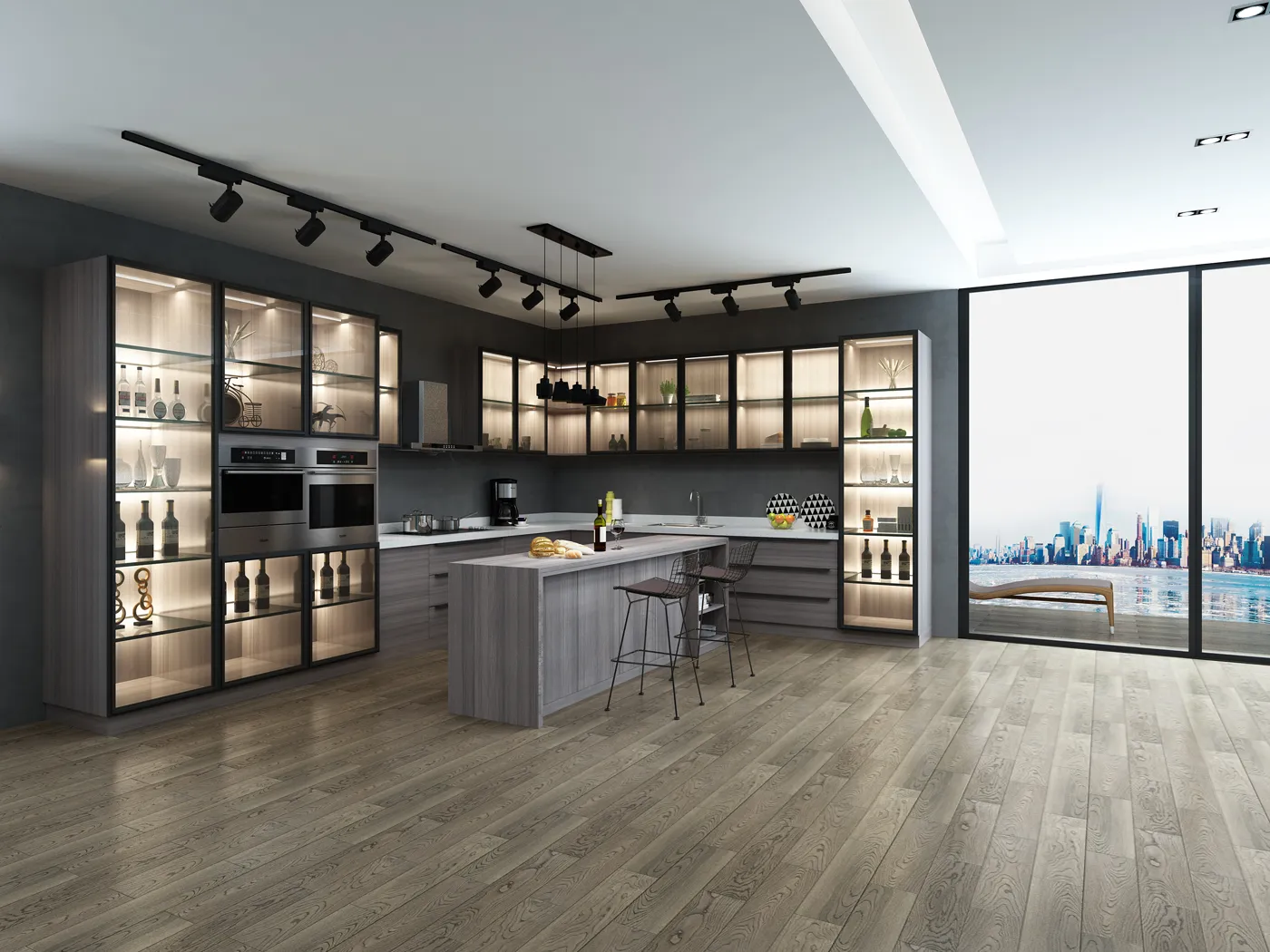
An insider's guide to the craftsmanship, materials, and techniques that define luxury cabinetry
The Art of Lacquered Cabinetry
When we talk about kitchen transformations, there's something almost magical about lacquered finishes. That glass-like surface that catches the light just so? That depth of color that seems to go on forever? That's not just paint – it's a masterful application of science and artistry. It's what separates ordinary cabinetry from showstopping kitchen installations that become the heart of a home.
I've seen countless homeowners walk into a kitchen with lacquered cabinets and do that little gasp. There's an immediate emotional response to that flawless, luminous finish. You run your hand across it expecting texture, but it's smooth as glass. That tactile experience is intentional, crafted through multiple stages of precision work. The lacquer doesn't just sit on the surface – it becomes one with the material beneath it in a way that transforms ordinary wood into something that feels almost alive.
"The true magic of lacquering happens in that quiet space between chemistry and craftsmanship – where temperature-controlled environments meet the steady hands of artisans who've perfected their technique over decades. That perfect orange-peel-free surface doesn't happen by accident."
Surface Preparation: Where the Magic Begins
Wood Selection & Initial Treatment
Everything starts with the canvas. Premium cabinet makers don't just grab whatever wood is handy – they're picky. Really picky. We're talking slow-growth hardwoods like maple or cherry that have tight, even grain patterns. Why? Because lacquer magnifies everything. A tiny imperfection you wouldn't notice on a matte finish becomes a glaring flaw under that high-gloss surface. It's like putting a spotlight on the wood's personality.
The wood gets conditioned in a humidity-controlled room for at least a week before any work begins. This isn't just some quaint tradition – it's science. Wood moves, breathes, and expands with moisture. If you skip this step, you'll end up with cracks in your finish six months down the line. Ask any professional painter – they've seen the heartbreak of skipped conditioning. The wood gets sanded to perfection, not with power tools that can create heat marks, but with hand-sanding in multiple directions to ensure every microscopic pit is gone.
The Priming Process
Here's where many DIYers go wrong – they think primer is just white paint. In high-end cabinetry, the primer is a carefully calibrated cocktail that does three critical jobs: seals the wood, creates a uniform base, and provides a bonding layer for the lacquer. We're talking about sandable polyester resins or catalyzed primers that cure to an incredibly hard surface. Unlike regular primers that just sit there, these actually interlock with the wood fibers at a molecular level.
Application is everything. Too thick and it will sag; too thin and it won't seal. The sweet spot? Multiple ultra-thin coats applied with precision spray equipment in a dust-free environment. Between each coat comes the waiting game – we're talking proper curing times, not just drying to the touch. Then it's sanded again with progressively finer grits. By the end, that primer surface feels smoother than marble. When you knock on it? It sounds solid, not hollow. That's your foundation telling you it's ready.
The Lacquer Application: Precision in Motion
Spray Technology & Environment
Forget what you know about paint spraying. Lacquer application in premium cabinet shops looks more like a laboratory than a workshop. Picture this: climate-controlled rooms kept at precisely 72°F with 50% humidity. Why? Because lacquer behaves differently when the air's too dry (it flashes off too quickly) or too humid (it gets cloudy). The spray guns aren't your hardware-store variety either – they're high-transfer efficiency (HTE) guns that atomize the lacquer to an almost fog-like consistency.
The spray techs move with a rhythm that's almost meditative. Each pass overlaps the previous one by exactly 50%. Too much overlap? You get runs. Not enough? You'll see stripes. The distance from gun to surface is religiously maintained at 6-8 inches. Get too close and it pools; too far and it dries before hitting the surface. It requires not just skill but body awareness. I've seen veterans who've been doing this 20 years who could spray perfectly with their eyes closed – they know the rhythm in their muscles.
The Catalyzed Difference
When we talk about truly high-end lacquer, we're discussing catalyzed systems. Unlike simple nitrocellulose lacquers (which are essentially time capsules of 1950s technology), catalyzed lacquers contain hardeners that create permanent cross-links between molecules. Think of it as turning the lacquer from a plastic coating into something more like ceramic. The difference becomes obvious when you test it – catalyzed finishes laugh at ethanol spills, fingernails, and cleaning chemicals that would destroy lesser finishes.
The chemistry is precise. Once the catalyst is mixed with the lacquer, you have a strict window to apply it – typically 4-8 hours depending on the formula. This is where factory finishes have an advantage over site-applied. In a controlled environment, they can maintain this chemical timing perfectly. The curing process is equally scientific: heated rooms at 100°F speed the chemical reaction but must be ramped up slowly to prevent solvent popping (tiny pinholes that look like goosebumps on the surface).
Quality Standards: The Benchmark of Excellence
Visual & Tactile Tests
High-end cabinet manufacturers don't just glance at their work under fluorescent lights. They employ lighting rigs that would make a film crew jealous. Daylight-balanced LEDs at multiple angles reveal what normal lighting misses. But it's not just about looking – feeling is equally important. Inspectors wear cotton gloves and run their hands over every surface, back and forth, cross-grain, diagonal. They're feeling for orange peel texture (should be virtually undetectable), dust nibs, or dry spray.
Then come the tools. Digital gloss meters measure reflectivity at 60° and 85° angles to ensure consistency across pieces. Adhesion tests? They're brutal. Cross-hatch cuts made with surgical precision, then covered with specialized tape that's ripped off. When high-quality lacquered cabinets are built using
high-quality building materials
, they can withstand these harsh inspections. Any lifting at the cuts indicates inadequate bonding – instant rejection. Impact testing involves dropping weighted balls onto surfaces to simulate years of cupboard-door-slamming stress in a single moment. The finish shouldn't just survive; it shouldn't even show a mark.
Durability Testing
Real-world simulation tests are where the rubber meets the road. UV exposure chambers replicate years of sunlight in weeks, checking for yellowing or fading. Humidity cabinets cycle between tropical steam-room conditions and desert dryness, seeing how the wood expands and contracts underneath. Chemical resistance isn't just about common cleaners – it includes splashes of red wine, olive oil, coffee, even artificial perspiration. The surface should wipe clean without etching or staining.
Thermal shock testing subjects panels to oven-like heat followed by refrigerator-like cold within minutes, repeated hundreds of times. Inferior finishes will crack like ice on a pond. High-quality lacquer remains monolithic. Scratch testing uses calibrated weighted needles dragged across surfaces. A good lacquer shouldn't just resist scratches – when you buff it lightly with a microfiber cloth, microscopic scratches should actually self-heal as the lacquer surface reflows.
Maintaining the Masterpiece
Okay, so you've invested in these beautiful high-gloss cabinets. Now what? Contrary to popular myth, they're not museum pieces requiring white-glove treatment. But there are right ways and wrong ways to care for them. First rule: microfiber is your friend. Cheap terrycloth towels or paper towels can introduce micro-scratches over time. A good quality microfiber picks up dust without scratching. For cleaning, warm water usually suffices. If needed, a tiny bit of pH-neutral cleaner diluted way more than the bottle says.
Avoid anything abrasive or acidic. Those handy countertop sprays with bleach or ammonia? Keep them far away from your lacquer. The same goes for any "all-purpose" cleaner. Why? Because lacquer has a faint porosity you can't see. Over time, harsh chemicals can infiltrate and cause what we call "blushing" – a permanent white haze beneath the surface. Instead, use cleaners specifically formulated for high-gloss finishes. And that promise about being fingerprint-resistant? It's true when installed correctly – a simple microfiber dusting returns them to perfect clarity.
The Future of Lacquered Finishes
Where is this craft heading? We're already seeing fascinating innovations in nanotechnology lacquers. These formulations incorporate microscopic ceramic particles that increase scratch resistance exponentially while maintaining that deep, liquid appearance. Another frontier: eco-friendly formulations. Premium manufacturers are pioneering lacquers with dramatically reduced VOCs that cure without the strong chemical smell of older generations – better for your home's air quality and the environment.
Digital color matching has become mind-bendingly precise. I've seen shops that can scan a fabric swatch or paint chip and match it exactly in lacquer – incorporating that exact undertone and light-play that gives colors dimension. Texture innovation is coming too – subtly matted finishes that offer the stain resistance of lacquer without the high gloss for those who prefer something softer. The heart of the craft remains the same though: understanding materials deeply, respecting chemistry, and executing with precision that borders on obsession.
Ultimately, what separates high-end lacquered cabinetry isn't just what you see on the surface. It's the invisible standards, the hours of preparation, the precise environmental control, the chemical mastery, and the uncompromising inspections that happen long before those cabinets ever reach your kitchen. When done to these standards, lacquered cabinets don't just look beautiful – they become a functional art piece you interact with daily. That flawless surface reflecting light isn't just a finish – it's a testament to the care invested at every step.










