
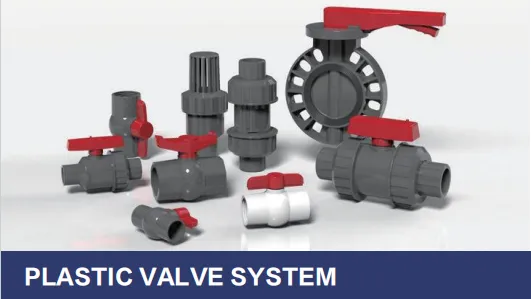
Picture this: It's 2025 and industries worldwide are quietly revolutionizing their fluid control systems. What's driving this change? Plastic valves. These aren't your grandparents' industrial components – today's plastic valves are corrosion-resistant champions, lightweight powerhouses, and eco-warriors all rolled into one. They've come a long way from being just "cheaper alternatives" to becoming serious contenders that outperform traditional metal valves in countless applications.
Let me walk you through why facilities managers and engineers are increasingly choosing plastic valves:
The global market tells the story clearly: valued at around $3.17 billion in 2025, it's growing at a healthy 5.7% annual clip. That's not just numbers – that's thousands of facilities switching to plastic solutions daily. And this isn't temporary; it's a fundamental shift in how industries approach fluid control.
Not all plastic valves are created equal – each type has its own personality, strengths, and ideal applications. Think of them as specialized tools in a mechanic's toolbox. Here's the breakdown:
Ah, the ball valve – probably what comes to mind when you picture a valve. That simple quarter-turn operation makes it a favorite where quick shut-off matters. Inside, there's a ball with a hole through it; line up the hole with the pipe and fluid flows, turn it 90 degrees and you've got instant shutoff. Their simplicity is their genius.
Where they shine: Water treatment plants love them, chemical processors rely on them, and HVAC systems wouldn't be the same without them. They're like the Swiss Army knives of valves.
Imagine a disc rotating on a rod – that's essentially a butterfly valve. Their slim profile makes them ideal for tight spaces where other valves just won't fit. The quarter-turn operation means quick response, and the full-port versions offer minimal flow resistance.
Where they shine: Large pipe diameters in water distribution systems, ventilation ducts in industrial buildings, slurry handling in mining operations. If space is tight and flow needs controlling, butterflies often win.
Gate valves are all about precision control. That sliding gate moves perpendicular to the flow, allowing you to throttle flow with surprising accuracy. They're not for quick-action scenarios but excel where fine-tuning matters.
Where they shine: Oil refineries, power generation facilities, anywhere with high-pressure steam systems. They're the choice when you need exact flow regulation rather than just on-off control.
Check valves work automatically – they let flow move in one direction only. When backflow tries to sneak in, they slam shut faster than you can say "reversed flow." It's their protective instinct that makes them essential.
Where they shine: Pump outlets to prevent water hammer, heating systems to maintain directional flow, sewer systems to stop backflow nightmares. Any place where reverse flow could spell disaster.
Of course, these are just the headliners – specialized valves like diaphragm valves and needle valves have their own niche roles. The beauty is that advancements in material science keep expanding possibilities for these plastic performers.
Let's move beyond theory and see where plastic valves transform real-world operations:
This sector is the heavyweight champion of plastic valve usage – responsible for over 35% of industrial consumption. Why? Plastic doesn't bat an eye at corrosive acids and harsh solvents that would destroy metal valves in months.
PPR pipe fittings and specialized valves handle everything from sulfuric acid to caustic soda. Chemical engineers sleep better knowing PVDF and PTFE valves stand guard.
Hygiene reigns supreme here. Plastic valves win with smooth interiors that resist bacteria buildup and FDA-approved materials that prevent contamination. CIP (Clean-in-Place) systems love how plastic handles hot sanitizers without corroding.
You'll find them in dairy processing, breweries, and bottling plants – anywhere food safety is non-negotiable.
Municipal plants battling chlorination? Plastic valves don't flinch. From intake screens to final distribution, their corrosion resistance extends infrastructure life exponentially while maintaining water purity.
New reverse osmosis facilities especially favor them – no metallic ions sneaking into purified water.
Validation and contamination control aren't just nice-to-haves here – they're regulatory mandates. Valves with ultra-smooth finishes and USP Class VI certified materials prevent hotspots where microbes might hide.
In aseptic processing areas, you'll find plastic valves keeping vital medicines pure from production to packaging.
Why does one butterfly valve cost $250 while another tops $1,000? It's not random – specific factors create these price points:
Pro tip: High prices don't always mean better quality – it's about matching specifications to actual needs. Chemical plants happily pay premium for PFA-lined valves while water plants save with standard PVC.
Plastic valve use isn't spreading evenly – regional industrial bases and environmental policies create fascinating patterns:
Led by US chemical giants and Canadian water initiatives, this region commands 38% of global demand. Strict EPA regulations actually boost plastic valve adoption as companies replace corroding metal systems. Smart valve integration for remote monitoring is particularly advanced here.
EU environmental directives make plastic valves a natural choice. Germany's chemical sector pairs them with solar heating systems while Nordic countries leverage them in geothermal applications. Eastern European nations show the fastest regional growth as infrastructure modernizes.
China builds dozens of water treatment plants monthly, with plastic valves central to construction. India's pharmaceutical boom drives specialty valve demand. Vietnam and Thailand attract chemical manufacturers needing cost-effective corrosion solutions. This region shows 7.2% CAGR – nearly double North America's growth.
As we look beyond 2025, the plastic valve evolution continues exciting trajectories:
The bottom line? What started as simple, low-cost alternatives have matured into sophisticated flow control solutions. The trajectory points upward as material science advances unlock new potentials and sustainability requirements favor plastic's eco-advantages. Industrial fluid management will keep flowing plastic's direction for decades ahead.
Recommend Products












