
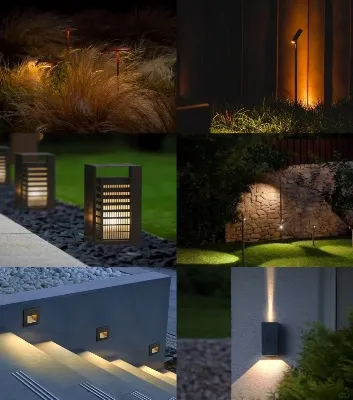
A well-lit garden is more than just a visual upgrade — it is an extension of your living space, a security layer, and a statement of design intent. Whether you are a homeowner looking to create a warm evening atmosphere or a contractor sourcing materials for a large-scale development, choosing the right garden light solutions can redefine how outdoor areas are experienced after sunset.
Today's market offers a dizzying array of options: solar-powered stake lights, hardwired LED spotlights, bollard path lights, and decorative string lighting, to name just a few. The challenge is not finding a product — it is finding products that combine durability, energy efficiency, and design coherence, all while fitting within a realistic budget. This guide walks through the key considerations for selecting garden lighting that delivers long-term value.
Garden lighting falls into several functional categories, and most well-designed outdoor spaces use a combination of them:
Path and Area Lights — These fixtures illuminate walkways, driveways, and perimeters. They improve safety by reducing trip hazards and define the boundaries of a space without overpowering it. Bollard-style and low-profile stake lights are common choices here.
Accent and Spotlighting — Used to highlight architectural features, specimen trees, water features, or sculptures, spotlights and well lights draw the eye to focal points. Adjustable beam angles give designers flexibility to create layered lighting effects that evolve as plants grow.
Decorative and Ambient Lighting — String lights, lanterns, and decorative post lights add warmth and character. These are often the "mood setters" — less about illumination levels and more about atmosphere. In commercial hospitality settings, they define the guest experience.
Wall and Step Lights — Mounted on retaining walls, stair risers, or exterior walls, these fixtures provide functional illumination for elevation changes and building perimeters. They blend safety with subtle design integration.
Flood and Security Lights — High-output fixtures designed to cover large areas with bright, even light. While often associated with utilitarian purposes, modern designs allow these to be integrated tastefully into landscape plans.
Not all garden lights are created equal, and the difference between a fixture that lasts two seasons and one that lasts a decade often comes down to a few critical specifications:
Material and Build Quality — Outdoor fixtures face constant exposure to UV radiation, rain, temperature swings, and in coastal areas, salt spray. Look for housings made from die-cast aluminum, stainless steel (grade 304 or 316 for coastal environments), or heavy-duty UV-stabilized polycarbonate. Powder-coated finishes add an extra layer of corrosion resistance.
Ingress Protection (IP) Rating — The IP rating tells you how well a fixture resists dust and water. For garden lights, aim for a minimum of IP65 — this means the fixture is fully dust-tight and protected against water jets from any direction. Fixtures installed in ground-level or flood-prone areas should ideally carry an IP67 or IP68 rating.
Light Source Technology — LED has become the standard for outdoor lighting, and for good reason. Quality LED modules offer 30,000 to 50,000 hours of rated life, consume a fraction of the energy of halogen equivalents, and are available in a wide range of color temperatures. For garden applications, warm white (2700K–3000K) is generally preferred for residential settings, while neutral white (3500K–4000K) works well for commercial landscapes.
Power Source — Low-voltage (12V/24V) wired systems remain the most reliable option for permanent installations, offering consistent output and easy integration with timers and smart controls. Solar-powered garden lights have improved significantly in recent years, with monocrystalline panels and lithium battery storage making them viable for areas with good sun exposure. Hybrid systems that combine solar charging with a grid-tied backup are an emerging option for projects that prioritize both sustainability and reliability.
One mistake that project managers and homeowners alike often make is treating garden lighting as an isolated purchase rather than as part of a broader outdoor design strategy. When garden lights, pathway materials, wall cladding, and outdoor furniture are sourced from different suppliers, inconsistencies in finish, color temperature, and delivery timelines can quickly derail a project.
Working with a comprehensive building material supplier simplifies procurement by consolidating multiple product categories under a single point of contact. For instance, a contractor renovating a villa exterior might need garden lights, outdoor lighting for the terrace and entryway, porcelain slab tiles for the patio, decorative wall panels for the facade, and customized outdoor furniture. When these items are coordinated through one supplier, specifications can be cross-checked for compatibility before orders are placed, and consolidated shipping reduces both cost and carbon footprint.
COLORIA GROUP, headquartered in Foshan, China — one of the world's most concentrated building materials manufacturing hubs — exemplifies this approach. As a one-stop architectural solution provider, the company maintains a product catalog spanning 13 major categories and over 560 individual products, covering everything from wall panels and flooring to sanitary ware, elevators, and, of course, lighting solutions.
The company's garden light range is part of a larger lighting division that includes 18 categories — shop lighting, hospitality lighting, industrial lighting, office lighting, residential lighting, restaurant lighting, magnetic track lights, spotlights, chandeliers, wall lamps, table lamps, light letters, neon lights, strip lights, and more. This breadth means that the same design language can flow from the garden into interior spaces, creating visual continuity across an entire property.
Even the highest-quality garden light will underperform if installed incorrectly. A few practical guidelines:
Cable Depth and Protection — For wired low-voltage systems, bury cables at a minimum depth of 6 inches (15 cm) and use conduit in areas with high foot traffic or where gardening tools might reach. Direct-burial rated cable is mandatory; standard indoor wiring will degrade rapidly underground.
Fixture Placement and Glare Control — The goal of garden lighting is to illuminate objects and surfaces, not to shine directly into people's eyes. Position fixtures so that the light source itself is concealed or shielded. Accessories like glare guards, honeycomb louvers, and frosted lenses can make a dramatic difference in perceived quality.
Transformer Sizing — Low-voltage systems require a transformer to step down line voltage. A common pitfall is undersizing the transformer. As a rule of thumb, total the wattage of all connected fixtures and select a transformer rated for at least 125% of that total to allow for future expansion and to avoid running the unit at full capacity continuously.
Seasonal Adjustments — Gardens change with the seasons. A spotlight aimed at a deciduous tree in winter may need repositioning when foliage fills in during summer. Build adjustability into the design from the start — choose fixtures with articulating heads and plan for easy access to junction points.
Effective garden lighting is the result of thoughtful product selection, coherent design, and proper installation — not simply buying the brightest fixture available. For project owners and contractors, the procurement experience matters as much as the product itself. Working with a supplier that understands the broader context of architectural and landscape design ensures that garden lights are not an afterthought, but an integrated element of the built environment.
COLORIA GROUP supports clients across residential and commercial sectors with tailored procurement solutions, drawing on its extensive supply chain in China's Pearl River Delta and its overseas agent network in Saudi Arabia. Whether you are outfitting a single-family garden or specifying lighting for a multi-building resort, consolidating your material sourcing with one knowledgeable partner can save time, reduce logistical complexity, and improve the final result.
For more information on garden light solutions and the full range of building materials available, visit the COLORIA GROUP website or reach out directly to discuss your project requirements.
Recommend Products












