
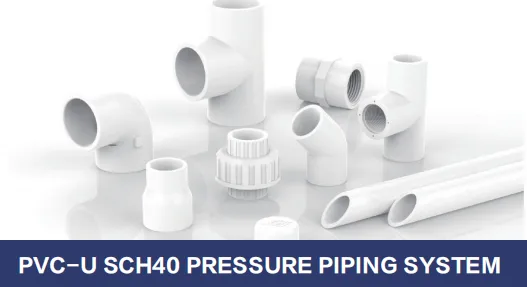
You've probably walked past PVC-U pipes a thousand times without noticing. That's the beauty of Schedule 40 systems - they work silently behind the scenes, bringing clean water to your taps and safely carrying wastewater away. But beneath that unassuming grey exterior lies an engineering marvel that's transforming the UK's water infrastructure.
Let me tell you a story about PVC-U SCH40. Picture this: It's 3 AM on a freezing February morning. An engineer is responding to a burst pipe emergency in Manchester. She could be wrestling with rusty, corroded metal pipes, cursing in the cold... but instead, she's calmly joining lightweight sections with solvent cement, knowing these modern pipes won't succumb to corrosion like their predecessors. That's the reality PVC-U has brought to Britain's water systems.
SCH40 isn't just a random designation - it's the industrial standard workhorse, the reliable van of the piping world. What makes these unassuming grey tubes so special?
Chemical Toughness: I once visited a chemical processing plant in Birmingham where SCH40 pipes effortlessly handled acids that would eat through stainless steel. The plant manager laughed, "PVC laughs at corrosion." He wasn't wrong. PVC-U SCH40 pipes show remarkable resistance to a wide range of chemicals, from industrial acids to chlorine-treated water.
Hydraulic Efficiency: The smooth internal surface is SCH40's hidden superpower. While copper pipes develop mineral build-up and rough interiors over time, PVC maintains its slippery surface. This translates to lower pumping costs year after year. Think about high-rise buildings - that energy saving compounds floor after floor.
Lifecycle Resilience: A water utility engineer in London once told me, "We install SCH40 systems knowing we won't see them again in my career." With minimal maintenance requirements and a lifespan often exceeding 50 years, these systems become almost invisible infrastructure - quietly doing their job decade after decade.
Installation Benefits: Remember that engineer in Manchester? What she appreciated most wasn't the technical specs but the human factor. Cutting and joining SCH40 pipes is significantly faster than metal alternatives. Without heavy equipment or dangerous welding, small teams can install surprising lengths in a single day.
| Nominal Size (inch) | External Diameter (mm) | SCH40 Wall Thickness (mm) | Pressure Rating (PSI) | Max Temp (°C) |
|---|---|---|---|---|
| 1/2 | 21.3 | 2.77 | 600 | 60 |
| 3/4 | 26.7 | 2.87 | 480 | 60 |
| 1 | 33.4 | 3.38 | 450 | 60 |
| 1.5 | 48.3 | 3.68 | 330 | 60 |
| 2 | 60.3 | 3.91 | 280 | 60 |
| 3 | 88.9 | 5.49 | 260 | 60 |
| 4 | 114.3 | 6.02 | 220 | 60 |
| 6 | 168.3 | 7.11 | 180 | 60 |
Notice how the pressure rating decreases as pipe size increases? That's why engineers carefully balance pipe diameter with pressure requirements. What the specs don't show is how the thermal expansion coefficient of PVC-U SCH40 pipes (around 0.06 mm/m°C) requires thoughtful anchoring - especially in climates with seasonal temperature swings.
Industrial Processes: Walk through a British brewery and you'll likely see SCH40 pipes carrying everything from steam to cleaning solutions. One brewery manager in Burton upon Trent described their PVC system as "the unnoticed hero that never adds off-flavors to our beer."
Agricultural Revolution: Driving through East Anglia, you'll spot SCH40 irrigation systems snaking through fields. Unlike corroding metal alternatives, PVC maintains water purity and doesn't add metallic tastes to crops. A hydroponic farm manager in Kent told me, "We trust SCH40 with our nutrient solutions because it simply doesn't react with anything."
Laboratory Reliability: In UK research facilities, transparent SCH40 systems allow visual flow monitoring of everything from chemical processes to bioreactors. A lab technician at Cambridge University confessed, "We use clear PVC systems not because we have to, but because they let us see the science happening."
Creative Installations: Some of the most interesting SCH40 applications aren't industrial at all. I've seen them repurposed as structural elements in art installations, used in DIY projects for everything from greenhouse frames to furniture, and even crafted into functional sculpture pieces.
Walking through GF's Midlands distribution centre feels more like entering a tech hub than a piping warehouse. Their SCH40 systems come with something you don't expect: documentation. "We track every production batch," their UK quality manager explained, "so if you ever need to replace a fitting twenty years from now, we can match the material exactly." That level of traceability reassures architects specifying materials for critical infrastructure projects.
While others focus on industrial applications, Polypipe has championed SCH40 systems for residential and commercial complexes throughout the UK. Their integrated approach considers not just the pipes themselves, but how they interface with other building systems. As one project manager on a Leeds development put it, "Polypipe doesn't just sell pipes - they solve water delivery problems."
Wavin's Dutch efficiency combines with UK manufacturing to produce SCH40 systems where recycled content isn't a marketing gimmick but an engineering reality. Their new Bristol facility incorporates recycled PVC-U in closed-loop systems that impressed even skeptical environmental auditors. "It's not just recycled material," a design engineer clarified, "it's material we know performs to spec because we control its entire lifecycle."
In high-tech UK developments like London's Nine Elms, Uponor's SCH40 compatible systems include integrated temperature sensors and flow monitors. Their innovation doesn't replace the pipe itself but enhances it with digital intelligence. As one smart building technician joked, "We're moving from pipes that carry water to pipes that carry water and information."
The environmental benefits of SCH40 pipes extend far beyond installation. Consider these lifecycle advantages:
Recyclability: PVC-U SCH40 pipes don't degrade during recycling. Closed-loop systems now reprocess material for non-pressure applications like underground conduit or window profiles. One recycling plant manager near Sheffield reported, "We get old SCH40 pipes that were installed in the 70s and they recycle like new material."
Embodied Energy: Producing PVC-U requires less energy than copper or ductile iron alternatives. Transportation weight savings alone create significant carbon reductions - an articulated lorry that might carry two tonnes of iron pipe can transport ten tonnes of SCH40.
Reduced Maintenance Impact: Because SCH40 systems avoid corrosion issues, they don't require the maintenance intrusions and material replacements of older technologies. This means fewer repair crews on the roads, less disruption to communities, and reduced lifetime resource consumption.
Health and Safety: Modern manufacturing has eliminated lead-based stabilisers once used in PVC products. Current UK-produced SCH40 systems rely on calcium-based or organic stabilisers that meet stringent potable water standards.
The importance of water purification technology cannot be overstated when discussing the safety of the UK's water supply. Modern purification methods ensure that water transported through SCH40 systems remains safe for consumption throughout its journey from treatment facilities to homes and businesses.
After interviewing dozens of installers across the UK, their practical wisdom boils down to these key points:
Cutting Technique: A Nottingham contractor demonstrated his cutting technique: "Don't crush the pipe - let the blade do the work. A clean, square cut is worth an extra minute of preparation." He showed me pipes improperly cut and how solvent couldn't properly seal the distorted ends.
Solvent Welding: Watching a veteran installer at work revealed the art in this supposedly simple process. "Apply solvent to both surfaces quickly but thoroughly," he instructed as we worked on a hospital project, "then join immediately with a quarter-turn rotation. Hold for thirty seconds - time it mentally." That precision ensures molecular bonding rather than just adhesive sticking.
Expansion Planning: A design engineer for a high-rise in Manchester described their approach: "We calculate exact expansion gaps based on the year's temperature variance. On the topmost floor water service, we might have loops with deliberate curves to absorb expansion without stressing anchors."
Pressure Testing: One Bristol contractor shared his wisdom: "Test new installations in stages - test segments as you go rather than waiting for the whole system. Finding a small leak early saves redoing completed work." His staged approach has saved countless hours on multi-story installations.
The future of SCH40 pipes in the UK focuses on three revolutionary directions:
Intelligent Monitoring: At Imperial College London, researchers are developing SCH40 pipes with embedded optical fibers. These smart pipes don't just contain fluids but sense fluid quality, flow rates, and even structural stress. Project lead Dr. Hannah Moore explains, "It's not about replacing pipes sooner, but knowing precisely when maintenance will actually be needed."
Additive Manufacturing: The British company Victrex has created custom SCH40 fittings using laser-sintered polymers. This could enable custom fitting production on-site, eliminating delivery delays for specialized installations. One Thames Tunnel project manager envisioned "printing bespoke junctions overnight rather than waiting weeks for delivery."
Thermal Storage Integration: Researchers at Loughborough University are exploring SCH40 pipes as components in passive thermal storage systems. The concept uses water-filled pipes within thermal masses to regulate building temperatures naturally. "Why pipe water just for consumption," asked Professor James Wilson, "when we can integrate it into environmental control?"
Bionic Surface Enhancement:
At Manchester University, materials scientists are developing surface treatments inspired by pitcher plant microstructures. These nano-engineered surfaces prevent biofilm formation that traditional surfaces encourage. "We're not just moving water," researcher Dr. Lisa Chen stated, "we're creating pipes that actively maintain purity."PVC-U SCH40 piping is more than just plumbing - it's the vascular system that sustains UK homes, businesses, and industries. From the Scottish Highlands where these pipes withstand freezing temperatures to Cornwall's coastal installations resisting salt air corrosion, this unassuming material performs quietly but reliably.
As we face infrastructure renewal challenges across the UK, SCH40 provides solutions that balance cost-effectiveness with longevity. British water infrastructure needs solutions that last decades without constant maintenance. Choosing SCH40 means investing in systems that future-proof our water delivery against both corrosion and climate challenges.
What often surprises people most isn't the technology but the innovation happening right here in Britain. UK-based research pushes SCH40 possibilities beyond simple piping into intelligent infrastructure components. The next generation of these systems won't just deliver water - they'll monitor its quality, self-report maintenance needs, and integrate with building management systems.
So next time you turn on a tap, pause and consider the journey that water took through advanced PVC-U SCH40 pipes. That simple moment connects you to decades of material science evolution and forward-thinking British engineering.
Recommend Products












