
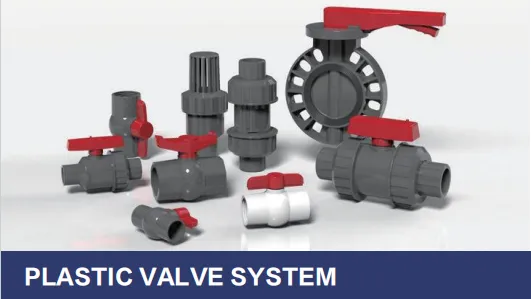
Discover the industry leaders shaping the future of corrosion-resistant fluid handling solutions worldwide
You're probably seeing plastic valves everywhere from water treatment plants to semiconductor fabrication facilities - and there's a good reason. Traditional metal valves simply can't compete when it comes to handling corrosive chemicals, maintaining purity standards, or resisting rust in harsh environments. The market has shifted dramatically toward engineered thermoplastics that outperform metal in countless applications.
Unlike metal alloys, advanced plastics laugh in the face of hydrochloric acid, chlorine solutions, and other aggressive media that would destroy metal valves within months.
For pharmaceutical and semiconductor applications where a single impurity can ruin batches worth millions, plastic valves provide uncontaminated fluid pathways.
With reduced maintenance, longer service life, and lower material costs, plastic valves deliver significant savings over their lifecycle compared to metal alternatives.
What makes this market particularly exciting is how these manufacturers continually innovate - introducing new polymer blends, smart valve systems with IoT capabilities, and environmentally sustainable production methods. The sector is anything but static, with companies racing to develop solutions for emerging industries like lithium battery production and green hydrogen.
For complex projects needing integrated architectural solutions that combine valves with complementary systems, some manufacturers now offer full fluid handling packages.
After analyzing hundreds of manufacturers worldwide, we've identified these ten companies that stand above the competition in innovation, quality, and industry impact. Each brings unique strengths to different application areas - from semiconductor manufacturing to municipal water systems.
When you absolutely need a valve solution that laughs at sulfuric acid, Plast-O-Matic should be your first call. These folks practically invented corrosion-resistant thermoplastic valves back in the 70s and haven't stopped innovating since. Their valves handle everything from pharmaceutical pure water to concentrated sodium hydroxide with equal grace.
| Valve Range | Specialty | Temperature Limit | Pressure Capacity |
|---|---|---|---|
| Solenoid Valves | Corrosive Media | 275°F (135°C) | 150 PSI |
| Ball Valves | Zero Contamination | 200°F (93°C) | 230 PSI |
Need butterfly valves the size of dinner plates? How about precision metering valves for lab applications? TVI's extensive catalogue feels like the industrial fluid control version of a candy store. What makes them special isn't just their wide product range but their practical engineering approach that emphasizes reliability in tough operating conditions.
Their true union ball valves have become the industry standard for maintenance-friendly installations where downtime means lost revenue. Field technicians love how quickly they can swap out components without dismantling entire piping sections.
If you've ever seen those spotless white valve systems in semiconductor fabs or biotech labs, chances are they came from Asahi/America. Their valves look like they belong in a spaceship and perform just as reliably in mission-critical applications where failure isn't an option. Their engineers obsess over details that others overlook - smooth internal finishes that prevent particle entrapment, self-draining designs that avoid contamination traps, and bubble-tight seals that maintain vacuum integrity.
Ever needed a valve yesterday? These folks built their reputation on having what you need when you need it. Their high-flow solenoid valves solve headaches in irrigation systems, chemical feed systems, and industrial process control applications. The beauty of their approach is how they simplify selection - with clear sizing guides and technical support that actually understands your application challenges.
When other manufacturers hesitate to tackle your bizarre chemical cocktail, KOSCN steps up. They approach valve design like chemists first and engineers second. Recently, they developed specialized PVDF valves for a lithium mining operation handling hydrofluoric acid that had eaten through Hastelloy valves in three months - their solution is going strong after two years with minimal maintenance.
For water utilities and aquacultural operations, Dayuvalves offers the perfect balance of affordability and performance. Their UPVC valves withstand decades of chlorine exposure without fading or degrading. What sets them apart is their customization flexibility - they'll tweak flange patterns, modify port sizes, or adapt actuator mounts without the usual custom tooling fees.
When space comes at a premium - in labs, mobile equipment, or compact machinery - ISM delivers solutions others can't. Their miniature pneumatic valves power medical devices, analytical instruments, and robotics with precision and reliability. Their engineers excel at simplifying complex systems, integrating valves, filters, and regulators into space-efficient packages.
For compressed air and vacuum systems, Cixi Shelily offers unbeatable value. Their nylon valves provide decades of reliable service in manufacturing environments while keeping costs down. OEMs especially appreciate their consistent quality control and willingness to support production ramp-ups without delivery hiccups.
These specialists don't just sell valves - they understand entire water purification systems inside and out. Their valves solve specific challenges in reverse osmosis systems, deionization systems, and filtration trains. They've designed clever backwash valves that prevent channeling in multimedia filters and low-shear sampling valves that deliver representative water samples without altering turbidity levels.
Where Fujian Jingteng truly shines is in elastomer innovation. While others buy off-the-shelf seals, they formulate proprietary compounds that solve specific failure modes - whether that's chlorine degradation in water valves or ethanol-induced swelling in biofuel applications. Their valves last longer simply because their materials outperform industry standards.
As industries from semiconductor manufacturing to renewable energy push technological boundaries, plastic valve manufacturers continuously raise their game. The innovations emerging today - smart valves with embedded sensors, additive-manufactured components with complex internal geometries, and sustainable biopolymer materials - will redefine what's possible in fluid handling tomorrow. These ten companies represent the vanguard of this evolution, turning industrial challenges into reliable solutions.
How do I know if a plastic valve suits my chemical application?
The compatibility depends on both the chemical media and its concentration and temperature. Most reputable manufacturers provide extensive chemical compatibility charts. When in doubt, send them a sample of your media - serious valve companies have material testing labs that can run exposure tests.
Can plastic valves handle high temperatures like metal valves?
While they have limits, advanced thermoplastics like PVDF and PEEK withstand surprisingly high temperatures - PVDF handles up to 275°F (135°C), while PEEK pushes to 480°F (250°C). For steam applications, specialized CPVC formulations perform well in temperatures that would melt standard PVC.
Do plastic valves require special installation techniques?
Avoid metal pipe wrenches that can crush plastic components. Use plastic-specific installation tools and follow manufacturer torque specs exactly - over-tightening plastic threads invites stress cracks. Support piping properly since plastic systems have greater thermal expansion than metal.
How long do plastic valves typically last compared to metal alternatives?
In corrosive environments, plastic valves often last 3-5 times longer than comparable metal valves. We've seen PVC valves in chlorinated water systems still functioning perfectly after 40 years, while brass components might fail within 5-7 years. The key is proper material selection for your specific service conditions.
Can I retrofit plastic valves into existing metal piping systems?
Absolutely - transition adapters make this straightforward. But remember: mixing metals and plastics requires careful consideration of different thermal expansion rates and electrolytic corrosion potential. Use dielectric unions to prevent galvanic corrosion at metal-to-plastic junctions.
Are plastic valves environmentally friendly?
Most thermoplastics are recyclable, and since plastic valves require less energy to manufacture than metal alternatives (especially heavy alloys), they start with a smaller carbon footprint. Leading manufacturers now offer take-back programs and use recycled materials in non-critical components.
Recommend Products












