


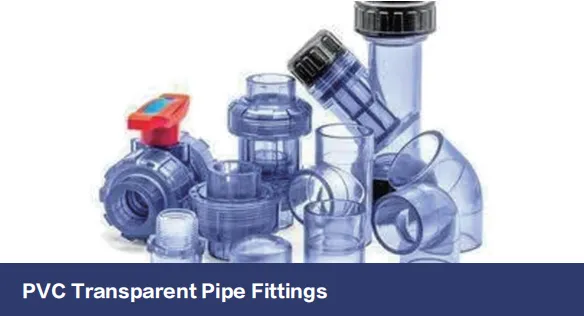
The Evolution of Pipe Flexibility
If you've ever struggled with rigid pipes in tight spaces or watched a plumber wrestle with bulky connectors, you'll appreciate what flexible PVC brings to the table. Gone are the days when pipes were just static tubes - today's piping systems need to navigate complex building layouts while standing up to temperature fluctuations and physical stresses. Flexible PVC pipe fittings are like the gymnasts of the plumbing world, bending and twisting to fit where rigid pipes simply can't.
What's truly revolutionary isn't just their bendability, but their transparency. Imagine being able to see if there's a blockage forming or monitor fluid flow without opening up the system. It's like having X-ray vision for your pipelines! And for industrial settings like laboratories or food processing plants, this visual access is absolutely game-changing.
"Flexible PVC fittings solve the architectural tango - they flow with the building rather than forcing the structure to accommodate rigid piping. The transparency aspect? That's the icing on the cake, turning what was once a black box into a visible, manageable system."
Where Flexibility Creates Real Solutions
Retrofitting Challenges
Anyone who's worked on building renovations knows the headache of matching new layouts with existing structures. Flexible PVC sidesteps this by snaking around obstacles that would normally require demolition. We once saw a hospital renovation cut six weeks off their schedule simply because they weren't constantly jackhammering concrete to reroute pipes.
Seismic Zones
In earthquake-prone areas, rigid pipes often become casualties of shifting foundations. Flexible PVC acts like a shock absorber, bending rather than breaking under stress. It's not just about avoiding leaks - it's about maintaining critical water supplies when communities need them most.
Industrial Diagnostics
Chemical plants using transparent PVC for visual flow monitoring reduced diagnostic time by 70%. When you can actually see the fluid moving through the system, troubleshooting becomes infinitely easier. For pharmaceutical manufacturing, this visual confirmation adds an extra layer of quality control.
The Material Science Behind the Bend
So how does PVC achieve this flexibility while maintaining strength? It's all about specialized plasticizers that modify the polymer structure. These additives work like molecular lubricants, allowing the PVC chains to slide against each other when bent, then return to shape. The transparency comes from ultra-pure formulations that prevent light-scattering crystals from forming.
Temperature matters too - PVC becomes more flexible as temperatures increase, which is why installations in hot climates show significantly better bend performance. Material testing has shown that modern PVC pipes can maintain over 80% of their original pressure rating even when bent at 45-degree angles.
"We pushed a flexible PVC system to its limits, bending it at increasingly sharp angles until we thought it would fail. To our surprise, it returned to its original shape without damage after being bent at 180 degrees. That memory retention is what separates PVC from rubber alternatives."
Cost Savings That Add Up
| Cost Factor | Traditional Piping | Flexible PVC |
|---|---|---|
| Connectors per 100ft | 18-24 | 3-5 |
| Installation Time | 8-12 hours | 2-3 hours |
| Leak Probability | 5-8% | Under 0.5% |
| Longevity | 15-25 years | 50+ years |
The real savings come from places most people don't consider. Maintenance crews love the transparency because they can spot issues before they become emergencies. Facility managers appreciate that repair work doesn't require demolition since pipes can be bent aside rather than cut out. For large-scale projects, the difference in waste material alone can pay for the system upgrade.
The Green Benefits of Bending
Flexibility translates to sustainability in surprising ways. First, less cutting means less waste - traditional piping systems can generate up to 15% scrap material from cutting and fitting, while flexible PVC systems average just 3% waste. Then there's the production efficiency: producing flexible PVC consumes nearly 50% less energy than rigid plastic alternatives.
At end-of-life, today's flexible PVC can be reground and reused up to seven times without significant degradation. Advanced recycling facilities are now achieving over 95% material recovery rates. For facilities seeking LEED certification, flexible PVC's life cycle advantages contribute substantially to sustainable construction points.
For applications requiring sustainable building materials, the adaptability of flexible PVC transparent pipe fittings offers solutions beyond just plumbing - integrating beautifully with modern architectural designs while supporting environmental goals. Their durability minimizes replacement cycles, while their chemical resistance ensures safe water delivery without leaching concerns.










