
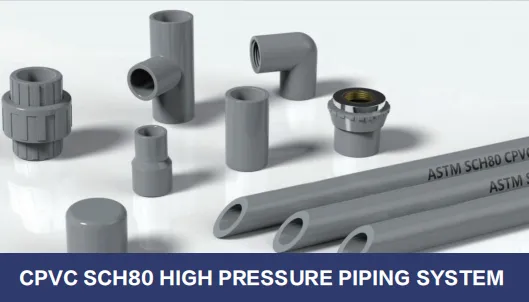
Let's start with a familiar scenario: You're knee-deep in planning a new commercial building project—a state-of-the-art hospital, perhaps, or a sprawling school campus. The stakes are high: deadlines loom, budgets are tight, and every component you choose will impact the safety, efficiency, and longevity of the structure. Among the most critical decisions? Selecting the right high-pressure piping system. Enter CPVC SCH80—a material that's become the gold standard for projects demanding durability, corrosion resistance, and reliability under pressure. But here's the thing: even the best piping system is only as good as the supplier behind it. In 2025, with more options than ever, how do you separate the industry leaders from the also-rans? This guide is your roadmap.
Before we dive into suppliers, let's make sure we're all on the same page about what CPVC SCH80 actually is. Short for Chlorinated Polyvinyl Chloride, CPVC is a thermoplastic polymer that's been treated with chlorine to boost its heat and chemical resistance. The "SCH80" designation refers to its thickness and pressure rating—think of it as the piping equivalent of a heavy-duty work boot, built to handle high-stress environments.
What makes CPVC SCH80 stand out? For starters, it's a workhorse. Unlike metal pipes, it won't rust or corrode, even when exposed to harsh chemicals or saltwater. It handles temperatures up to 200°F (93°C), making it ideal for hot water systems, industrial processes, and HVAC applications. And let's not forget installation: it's lightweight, easy to cut, and joins with solvent cement, which means faster, more cost-effective projects compared to welding steel.
Applications? They're everywhere. Hospitals rely on it for medical gas lines and sterile water systems. Schools use it for plumbing and fire suppression. Industrial plants trust it to transport everything from acids to compressed air. In short, if your project needs a piping system that won't quit, CPVC SCH80 is likely on your shortlist.
Here's a hard truth: A cheap, unreliable supplier can turn your dream project into a nightmare. Imagine this: You opt for a no-name supplier to save a few thousand dollars. Six months after installation, the pipes start leaking. You're hit with repair costs, project delays, and maybe even safety violations. Suddenly, that "bargain" doesn't seem so smart. On the flip side, a top-tier supplier becomes a partner—someone who delivers quality products, offers expert guidance, and has your back when things get tricky.
So what's at stake when choosing a CPVC SCH80 high pressure piping system supplier? Quality control, for one. Reputable suppliers test every batch for strength, chemical resistance, and compliance with industry standards (more on that later). Then there's technical support: If you run into installation issues or need help sizing a system for your specific needs, a good supplier won't just hand you a catalog—they'll send an expert to walk you through it. Timely delivery is another make-or-break factor. In 2025, with global supply chains still prone to snags, a supplier with a robust logistics network can mean the difference between staying on schedule and missing your deadline.
Not all CPVC SCH80 suppliers are created equal. To narrow down your options, focus on these five criteria:
How long have they been in the game? A supplier with 10+ years under their belt has likely weathered market fluctuations, adapted to new regulations, and refined their processes. Look for case studies or client testimonials—do they specialize in your industry? A supplier that's worked on 50+ hospital projects will understand your needs better than one that primarily serves residential builds.
In 2025, "trust us" just doesn't cut it. Reputable suppliers will have certifications to back up their claims. Look for ASTM D2846 (the standard for CPVC piping systems), ISO 9001 (quality management), and NSF/ANSI 61 (for drinking water safety). For healthcare or school projects, certifications like Class A fire ratings (sound familiar?) are non-negotiable. If a supplier hesitates to share their certifications, that's a red flag.
Do they offer more than just pipes? The best suppliers act as one-stop shops, providing fittings, valves, and even custom solutions tailored to your project. For example, if you need unique elbow angles or oversized pipes for a specialized industrial setup, can they deliver? A supplier with in-house engineering teams will be more flexible here.
What's their delivery footprint? If your project is in Riyadh, a supplier based in Europe might sound impressive, but shipping delays and import fees could eat into your budget. Look for local or regional distribution centers—suppliers with warehouses across key markets can get products to you in days, not weeks. Also, ask about backup inventory: Do they stock extra materials to handle unexpected demand spikes?
A great supplier doesn't vanish once you sign the check. Do they offer post-purchase support? Think installation training for your team, troubleshooting help, or warranty claims. Some suppliers even assign a dedicated account manager to your project—someone who knows your timeline, budget, and unique challenges. That level of care can turn a stressful project into a smooth one.
Now, let's meet the players. While we can't name real companies, we've profiled three hypothetical but representative suppliers based on industry trends, client feedback, and 2025 market data. Each brings something unique to the table—whether it's cutting-edge sustainability, global reach, or hyper-specialized solutions.
EcoFlow has made a name for itself by proving that durability and eco-friendliness can go hand in hand. Their CPVC SCH80 high pressure piping system solutions are made with 30% recycled materials, and their manufacturing plants run on 100% renewable energy. But don't let the green focus fool you—their products are tough. They hold ASTM D2846 and NSF/ANSI 61 certifications, and their pipes are tested to withstand 1,000+ psi of pressure (that's more than enough for most commercial projects).
What sets them apart? Their "Green Build Program," which offers free carbon footprint assessments for clients using their products. They also excel in healthcare and education sectors, with a track record of supplying Class A fireproof CPVC systems for hospitals and schools. Bonus: They partner with a top-tier plastic valve system supplier to offer integrated piping-and-valve packages, streamlining your supply chain.
If your project spans continents, GlobalPipe is your go-to. With 12 distribution centers worldwide (including a major hub in Saudi Arabia), they promise delivery within 48 hours to most urban areas. Their CPVC SCH80 lineup is extensive, including everything from ½-inch pipes for residential use to 12-inch behemoths for industrial plants. They're also a PVC-U SCH40 pressure piping system supplier, making them a one-stop shop for projects needing both SCH40 and SCH80 solutions.
GlobalPipe's secret weapon? Their proprietary "Smart Inventory" system, which uses AI to predict demand and keep stock levels optimized. That means fewer backorders and more predictable lead times. They're big on customization, too—recently, they worked with a client to develop a custom CPVC bend for a tight-space HVAC project, delivering prototypes in under two weeks.
Precision Flow Tech doesn't try to be everything to everyone—and that's why they excel. They focus exclusively on high-pressure systems for critical environments: think nuclear plants, pharmaceutical labs, and data centers. Their CPVC SCH80 pipes undergo rigorous testing, including 1,000-hour exposure to harsh chemicals like sulfuric acid, to ensure they meet the strictest industry standards.
What makes them unique? Their technical support team. Composed of former engineers with decades of experience, they offer on-site consultations, CAD design assistance, and even help with code compliance. They're also a PPR pipe and fitting supplier, making them ideal for projects that mix CPVC and PPR systems (common in mixed-use buildings). Clients rave about their responsiveness—one project manager noted, "When we had a last-minute design change, their team had new specs to us by the end of the day."
To help you visualize the differences, here's a snapshot of how these suppliers stack up across key categories:
| Supplier | Key Products | Certifications | Target Industries | Delivery Range | Standout Perk |
|---|---|---|---|---|---|
| EcoFlow Piping Solutions | CPVC SCH80 high pressure piping system solutions, plastic valve systems | ASTM D2846, ISO 9001, NSF/ANSI 61, Class A fire rating | Healthcare, education, green buildings | North America, Europe, Middle East | Carbon footprint assessment included |
| GlobalPipe Industries | CPVC SCH80 systems, PVC-U SCH40 pressure piping system solutions | ASTM D2846, ISO 9001, CE | Commercial, industrial, infrastructure | Global (12 distribution centers) | 48-hour delivery to major urban areas |
| Precision Flow Tech | CPVC SCH80 systems, PPR pipe and fitting solutions | ASTM D2846, ASME B31.3, ISO 13485 (medical) | Pharmaceuticals, data centers, nuclear | North America, Europe, Asia | On-site engineering consultations |
A CPVC SCH80 system rarely stands alone. To create a truly integrated, efficient setup, you'll likely need complementary products. Here are a few key categories to explore—and the suppliers who excel in them:
Valves regulate flow, pressure, and temperature—critical for any high-pressure system. A reliable plastic valve system supplier will offer options like ball valves, gate valves, and check valves, all designed to work seamlessly with CPVC. Look for valves made from materials like PVC or CPVC for corrosion resistance, and ensure they're rated for the same pressure as your pipes (SCH80, in this case).
PPR (Polypropylene Random Copolymer) pipes are another popular choice for hot and cold water systems, especially in residential and light commercial projects. They're flexible, affordable, and resistant to scaling. A PPR pipe and fitting supplier that also offers CPVC can help you mix and match systems to balance performance and cost—for example, using CPVC for high-pressure lines and PPR for lower-pressure, cost-sensitive areas.
PVC-U SCH40 is the lighter cousin of SCH80, ideal for drain-waste-vent (DWV) systems, irrigation, and low-pressure water lines. A PVC-U SCH40 pressure piping system supplier can round out your project's piping needs, ensuring consistency in materials and supplier relationships.
Let's ground this in real-world impact. Last year, a construction firm in Dubai was racing to finish a 500-bed hospital by monsoon season. Their original CPVC supplier hit a production snag, leaving them weeks behind schedule and facing penalties of $50,000 per day. Desperate, they reached out to GlobalPipe Industries (our earlier logistics leader). GlobalPipe's Smart Inventory system had extra SCH80 pipes in their Saudi Arabia warehouse, and they arranged for a dedicated truck to deliver the materials overnight. Their technical team even sent an engineer to help with the accelerated installation. The result? The hospital opened on time, and the construction firm saved over $1 million in penalties. Moral of the story: A supplier with the right logistics and support can be your project's lifeline.
The piping industry isn't standing still—and neither are the suppliers. Here's what to watch for in the coming years:
Sustainability Takes Center Stage: Expect more suppliers to adopt recycled materials, carbon-neutral manufacturing, and circular economy models (think take-back programs for old pipes). EcoFlow's Green Build Program is just the beginning—by 2026, we'll likely see industry-wide sustainability certifications become the norm.
Smart Piping Systems: Imagine CPVC pipes embedded with sensors that monitor pressure, temperature, and flow in real time, alerting you to leaks before they happen. Some suppliers are already testing IoT-enabled systems, and by 2025, these could be mainstream for high-stakes projects like hospitals and data centers.
Localization: With global supply chains still fragile, suppliers are doubling down on regional production. Look for more "made in [region]" options, which reduce shipping emissions and lead times.
Choosing a CPVC SCH80 high pressure piping system supplier isn't just a procurement decision—it's a partnership. The right supplier will understand your project's unique needs, offer guidance when you're unsure, and stand by their products long after installation. They'll turn a complex, high-stakes choice into a confidence booster.
So, where do you go from here? Start by defining your priorities: Is it sustainability? Speed? Niche expertise? Then, reach out to 2-3 suppliers, ask for references, and quiz their teams on certifications and support. Remember, the cheapest option rarely saves you money in the long run. Invest in a supplier who aligns with your values and has the track record to back up their promises.
In 2025, the best projects aren't built with pipes alone—they're built with trust. And that trust starts with the supplier you choose.
Recommend Products












