
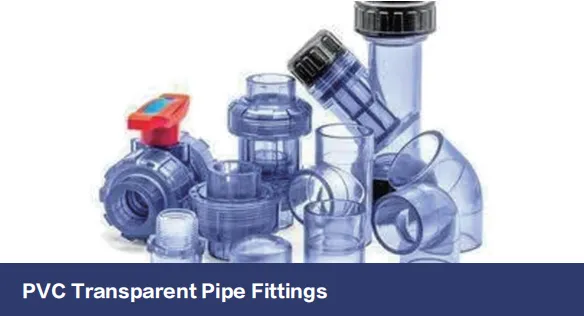
You know, when you turn on your faucet or water your garden, you probably don't think much about the clear plastic pipes making it all happen. But behind every drop of water flowing through those PVC transparent pipe fittings, there's an incredible story of precision, chemistry, and downright meticulous attention to detail. These unassuming plastic components are the unsung heroes of modern plumbing, irrigation systems, and industrial applications.
What makes them special isn't just their transparency that lets you see what's flowing inside – it's the hidden journey of quality control that transforms raw plastic into reliable, long-lasting fittings. Think about it: would you trust something carrying your drinking water if it weren't tested to the extreme? Exactly. That’s why in this deep-dive, we're unpacking the behind-the-scenes world of how PVC pipe manufacturers ensure every piece meets sky-high standards.
Transparent PVC pipes aren't just about looking cool (though let's be honest, seeing water flow through clear pipes is pretty neat). They solve real-world headaches:
But here's the catch – making PVC crystal clear is tricky. Additives must dissolve perfectly. Cooling must be ultra-even. Even a hint of contamination or imperfect mixing? You'll end up with foggy, brittle pipes instead of premium clear fittings. That’s where a rock-solid quality control system becomes non-negotiable.
You can't bake a great cake with lousy ingredients – same goes for PVC pipes. Quality starts with what goes into the mix:
Top-tier manufacturers chemically analyze every resin shipment with spectrometers – rejecting anything with off-spec density or impurities. It’s like a bouncer checking IDs before letting anyone into the factory.
Once raw materials get the green light, they enter what feels like a high-stakes kitchen:
Imagine making your morning smoothie – if you add too much banana or not enough yogurt, it tastes off. Same concept:
QC checkpoint: Lab techs run melt-flow tests on samples. If viscosity isn't spot-on? The whole batch gets rejected faster than a bad avocado.
This is where plastic melts and shapes into pipes. Crucially:
Operators watch real-time pressure readouts like hawk-eyed poker players. Any spike or dip halts production immediately. They’ll even sacrifice pipe samples, slicing them open to check for defects with magnifiers.
Freshly extruded pipes are hotter than a summer sidewalk and just as shapeless. Cooling isn't just about speed; it's about uniformity:
Fun fact: The best manufacturers use double-stage cooling. First a mist spray for gentle contact, then immersion baths. Treating pipes like fine wine – no sudden temperature shocks allowed!
Finished pipes might look flawless, but their true test is in brutal simulations:
Top factories embrace automation here. Vision systems with AI algorithms scan pipes 24/7 – spotting micro-fractures even veteran inspectors miss. Ultrasonic thickness mappers build 3D models of every fitting to flag weak spots. If you're partnering with a PVC pipe manufacturer that skimps on this step? You’re gambling with failure.
Fancy machines matter, but humans drive the system. Quality cultures show in subtle ways:
And here’s where elite players pull ahead – kaizen isn't just a buzzword. Monthly PDCA cycles (Plan-Do-Check-Act) tackle challenges like:
Imagine this: If last month’s burst-test record was 300 psi, next month’s goal becomes 310. That constant hunger for "better" makes good fittings exceptional.
Even the best systems face issues. Transparent PVC's Achilles' heels? Contamination and thermal stress:
European manufacturer, 2022. Reports of hazy pipes trace back to a failed HVAC filter in the mixing room. Microscopic dust settling onto resin created nucleation sites – like pouring soda over Mentos! Solution:
Costly? Absolutely. But recalls cost more than prevention. It cemented their slogan: "No dust. No rust. No compromise."
A humid Southeast Asian factory discovered hairline cracks after 6 months. Cause? Rapid cooling during rainy-season humidity fluctuations changed pipe crystallization. Fix:
Looking for reliable transparent fittings? Don't just fall for glossy brochures. Ask:
Trustworthy partners welcome these questions. Sketchy ones? They'll ghost you – saving you future grief.
From the careful chemistry in additives to the laser-eyed bots scanning finished pipes, PVC transparent pipe fittings embody a truth: quality isn't inspected in; it's built in at every stage. This relentless focus pays dividends beyond specifications – it breeds trust. When engineers specify see-through pipes for critical processes or families install them for drinking water, they're betting on integrity sealed into the material itself.
So next time you spot those crystal-clear conduits in a lab, factory, or home, remember: Their clarity reflects uncompromising standards, perpetual refinement, and quiet pride in getting it right. Because in pipes as in life, transparency is only valuable when what's behind it withstands scrutiny.
Recommend Products












