
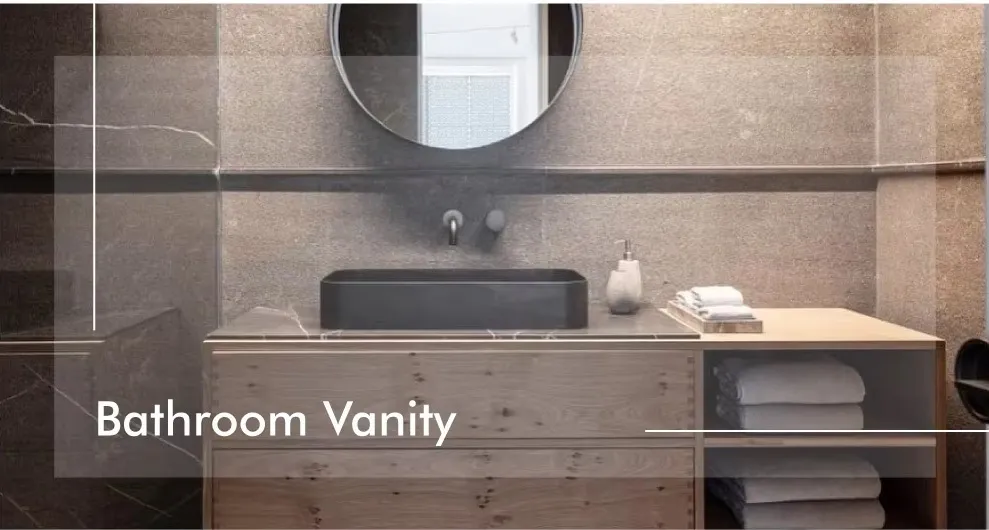
Walking through the bustling aisles of international exhibitions like KBC Shanghai and Dubai's Big 5 feels like stepping into a time machine revealing our bathrooms' future. What struck me most wasn't just the shiny surfaces or clever tech, but how vanity design is fundamentally changing our relationship with these intimate spaces. Gone are the days when bathroom cabinets were merely functional afterthoughts – they're evolving into personalized wellness sanctuaries.
At Shouya's KBC booth, I watched European designers practically drool over terracotta-textured finishes, while Middle Eastern buyers snapped photos of intelligent mirror cabinets. Meanwhile, African contractors lined up to discuss modular systems for rapid housing projects. This global mosaic reveals something profound: vanity design isn't just changing, it's fracturing into specialized streams catering to cultural needs and personal rituals.
"Eco-friendly" has become table stakes. What's truly exciting is how materials now engage our senses and emotions. At Big 5, I ran my hands across vanity surfaces made from recycled ocean plastics that felt surprisingly warm, with subtle wave-like textures. One Italian manufacturer even embedded antimicrobial stone composites with tiny heat-responsive capsules that release eucalyptus scent when touched by warm water vapor.
This tactile revolution extends to reclaimed woods with visible history – think teak salvaged from demolished Bangkok houses, complete with subtle nail hole patinas. As Marcus Thrane from Oslo Design Studio put it: "We're designing vanities that don't just minimize environmental harm, but actively improve your microclimate and mood."
Smart tech's entering its "invisible elegance" phase. The awkward tablets glued to mirrors? Gone. At KBC, Shouya demonstrated mirror cabinets where LED lighting emerged like dawn light through frosted glass, activated by motion sensors. My favorite was a floating vanity with touch-sensitive edges that controlled water temperature – no visible buttons, just walnut wood that lit gently when your hand approached.
True magic happened in water management. Several Korean companies showcased AI-powered faucets that learn your usage patterns. One system detected hard water minerals and automatically adjusted filtration while displaying real-time water quality via subtle light halos around the basin – no screens required. These aren't gadgets; they're silent guardians of your resources. For more comprehensive integrated bathroom solutions , these innovations create seamless harmony between technology and daily rituals.
The most refreshing shift? Customization shedding its luxury price tag. Turkish manufacturer Atasay displayed modular vanities with magnetic face panels – swap bamboo for metallic copper fronts seasonally. But the real game-changer came from a tiny Scandinavian booth offering open-source vanity blueprints. Download 3D-printable joints and combine with locally sourced materials? That's democratic design.
Accessibility innovations stunned me too. German company Vitra unveiled height-adjusting vanities controlled by gentle elbow taps. Their designer shared how they studied arthritis patients' movements for three years to perfect the motion sensitivity. "Good design shouldn't announce itself as 'inclusive'," she noted. "It should just work beautifully for everyone."
Minimalism's maturing beyond starkness into warmth-infused simplicity. Japanese designers led this charge with vanities featuring "breathing gaps" – intentional negative spaces around basins creating floating illusions. At Big 5, Lebanese firm Marbrum showcased marble monoliths carved with hidden towel niches that revealed themselves through shadow lines.
The real spatial wizardry happened in micro-bathrooms. Shouya's space-optimized designs included corner vanities with triangular mirrors that multiplied reflections. "It's not about making small spaces seem bigger," explained their lead designer. "It's about making them feel perfectly sufficient." This philosophy manifested in drawer systems compressing 15 functions into vertical space that once held two toothbrushes.
The exhibitions revealed fascinating regional trajectories shaping vanity design:
Rapid urbanization drives demand for modular "vanity kits" that install in hours. Water conservation tech dominates (self-recycling basins). Luxury leans toward ornate metallic inlays recalling cultural heritage.
Wellness integration reigns supreme (vitamin-infused storage, UV sanitizers). Rise of "vanity sanctuaries" with integrated seating and plant walls. Bold, colorful statements replacing all-white.
Radical transparency: visible pipework as design feature. Circular economy vanities (subscription-based upgradable components). Warm minimalism with tactile woods.
Multi-generational solutions: vanities with adjustable-height sections. Smart surfaces (displays integrated into countertops). Space-optimized shapes borrowing from origami principles.
Beyond current trends, whispers at both exhibitions hinted at revolutionary developments:
Living Materials: Bioluminescent fungi integrated into vanity surfaces for night lighting. Self-healing concrete composites that repair minor scratches when moistened.
Vanity-As-Service: Subscription models where manufacturers remotely update hardware features. Modular ecosystems supporting tech upgrades without full replacements.
Emotional AI: Systems that read stress levels through biometric handles, adjusting lighting/music. Mirrors that detect skin conditions and suggest skincare routines.
The most compelling vision came from Milanese designer Elena Rossi: "Soon we'll stop asking 'how does it look?' and start asking 'how does it make you feel?' Your vanity will become a personal wellness ritual station, adapting to your emotional state before you recognize it yourself."
Behind these beautiful innovations, production realities are shifting:
Location Matters Again: Tariff wars and shipping instability drive regional manufacturing clusters. Smart vanities for EU market now predominantly made in Portugal, while Latin America serves North America.
The Skill Shift: Traditional cabinetmakers learning mechatronics. Factories establishing "innovation garages" where engineers co-create with designers weekly rather than quarterly.
Water-Led Design: Water recycling systems dictate form factors. One Turkish manufacturer redesigned their entire vanity range around self-contained filtration – creating distinctive "water spine" silhouettes.
What emerges from these global exhibitions is clear: bathroom vanities are transitioning from utilitarian fixtures to intuitive life companions. They're becoming mirrors that reflect not just our faces, but our values about sustainability, wellness and personal identity.
The magic lies in how these innovations integrate rather than shout. The most advanced vanity at KBC wasn't the one with flashiest screen, but one blending so seamlessly into its environment that technology felt organic. As we face growing environmental pressures and societal fragmentation, these intimate spaces might just become our daily anchors – places where good design doesn't demand attention, but quietly elevates the human experience.
Walking out of the exhibition halls, I found myself dreaming not of isolated products, but of bathrooms that feel like personal wellness ecosystems. And judging from the buzzing conversations between designers from sixty countries, that future is rushing toward us faster than we imagine.
Recommend Products












