


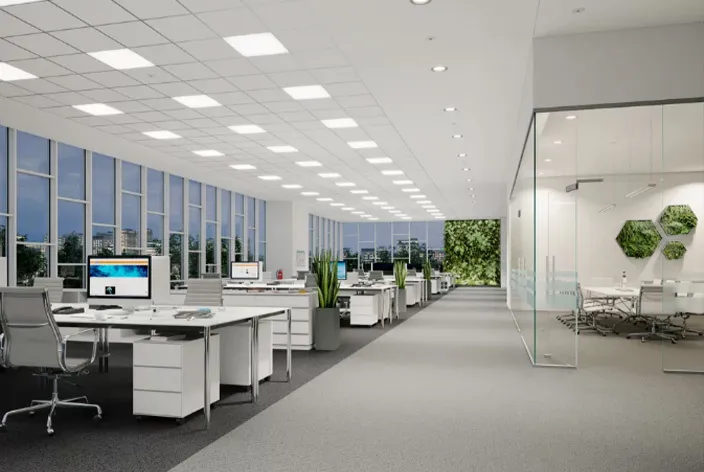
Hey there! If you're redesigning an office space or upgrading your current lighting setup, you're probably hearing everyone rave about LED panel lights. And they're right - these sleek, energy-efficient panels have become the gold standard in modern workplaces. But here's the thing: not all LED panels are created equal. Choosing the right one makes the difference between a productive, comfortable workspace and one that makes employees rub their eyes by 3 PM.
As a lighting specialist who's worked on everything from startup offices to corporate headquarters, I'll walk you through exactly what makes LED panels the smart choice and how to pick winners for your specific space. We'll cover the tech specs that matter (don't worry, I'll explain them in plain English!), bust some lighting myths, and share real-world installation insights you won't find in product manuals. By the end, you'll be equipped to make lighting decisions that boost productivity and employee well-being.
What Your Office Really Needs from Lighting
Before we dive into panel specs, let's talk fundamentals. Offices aren't warehouses or art galleries - they have unique lighting requirements:
Human-Centric Lighting
Our circadian rhythms evolved under sunlight. Cornell University research shows natural lighting reduces eye strain by 84%, while the American Academy of Sleep Medicine confirms it regulates sleep hormones. LED panels with adjustable color temperatures mimic natural light patterns.
Task-Specific Brightness
Not all work areas need equal lighting. Brainstorming spaces thrive in 300 lux, while detailed drafting tables need 500 lux. Modern LED panels offer zoned dimming capabilities missing in old fluorescent systems.
Glare Warfare
Nothing murders productivity like screen glare. Panels with UGR ratings below 19 (Unified Glare Rating) diffuse light evenly without creating painful reflections on monitors or documents.
| Office Area | Illumination (Lux) | Color Temp (K) | Recommended Fixtures |
|---|---|---|---|
| Open Workspace | 300-500 | 4000-4500 | 2'x4' Standard Panels |
| Conference Room | 300-500 | 4000-4500 | Dimmable Panels |
| Creative Studio | 500-750 | 3500-4000 | High-CRI Panels |
| Break Room | 200-300 | 3000-3500 | Color-Selectable Panels |
| Corridors | 50-100 | 3000-4000 | Low-Power Downlights |
Choosing Your Panel: More Than Just a Flat Rectangle
When you hear "LED panel," you probably picture those clean rectangles in office ceilings. But there's surprising diversity under the surface:
Edge-lit vs. Back-lit
Edge-lit (9mm Slim): LEDs placed around frame border. Ultra-sleek profile works great with modern architectural elements like sloped ceilings or curved walls.
Back-lit: LEDs distributed across backplate. Better heat dissipation prevents yellowing over time - perfect for high-up installations where maintenance is difficult.
Standard Flat Panels
The workhorses - 80% of office installations. Sizes matter:
- 1'x4': Best for corridors and narrow rooms
- 2'x2': Ideal grid replacement
- 2'x4': Most common footprint
Suspended Linear Systems
For spaces without drop ceilings. Imagine sleek light "tracks" hanging from cables. These connectable modules can form lighting patterns - waves, grids or geometric shapes that double as architectural features. When paired with complementary decorative profiles, they become integral design elements rather than mere functional lighting.
Recessed Specialty Panels
For spaces where only light should be visible:
- Downlights: Spot illumination over whiteboards
- Wall-Washers: Grazing accent lights for displays
- Directional: Focused task lighting
Emergency Backup Innovation
Panels with integrated 90-minute battery systems automatically illuminate during power failures. These aren't backup lights - they're your primary lighting doing double duty. Install these in stairwells and evacuation routes to meet safety codes.
Decoding the Tech Alphabet: What Matters Most
Ever been overwhelmed by product specs? Let me translate the critical ones:
Lumens & Lux: Brightness Reality Check
Lumens measure total light output; lux measures light hitting surfaces. For a 10'x10' room:
- 3,000+ lumens needed for 300 lux minimum
- Calculate: Lumens = Room Area (sq ft) × Target Lux × 0.0929
CCT (Color Temperature)
Measured in Kelvins (K):
- 3000K: Warm/yellow - break rooms
- 4000K: Neutral white - workstations
- 5000K: Cool/blue - detail-intensive areas
CRI (Color Rendering Index)
90+ CRI needed where color matters:
- ≤80 CRI: Fine for hallways
- 85-90 CRI: Standard work areas
- ≥95 CRI: Design studios, labs
UGR (Unified Glare Rating)
Lower = Better:
- UGR ≥ 25: Harsh glare
- UGR ≤ 19: Comfortable office space
Beyond Purchase Price: Real Cost Considerations
- Energy Efficiency: Top panels achieve 120-140 lumens/watt. Over 50,000 hours, even 10% efficiency gains save thousands
- Dimmability: Non-dim panels might need rewiring if retrofitting older installations
- Installation: Suspended panels cost less to install than recessed drop-ceiling models
Why Everyone's Switching to LEDs
The Triple Win: Energy + Cost + Environment
- 60-70% energy reduction vs fluorescents
- 50,000+ hour lifespan (5-7 years at 24/7 use)
- Zero mercury, fully recyclable components
Productivity in Numbers
- Proper lighting reduces errors by 30-60%
- Glare reduction increases on-task focus by 51%
- Adjustable temperature correlates with 18% higher productivity
Myth vs. Reality: Heat Emission
"LEDs get hot" - technically true but misleading. Unlike old bulbs radiating heat downward, LEDs disperse heat upward into ceiling spaces. The actual working space stays comfortably cool.
Creating Lighting Zones: More Science Than Art
Reception Areas
- Mix track lights with LED strips
- Brighter logo lighting (500+ lux)
- Warmer seating areas (3000K)
Workstations
- Uniform spacing with overlit task zones
- Peripheral glare-reducing diffusers
- Panel-to-workstation alignment avoids shadow zones
Conference Rooms
- Dimmable panels + spotlights
- Scene programming for presentations
- Front light for video calls
Corridors
- Motion-sensor low-power downlights
- Even 5-10 lux between panels
- Color consistency to guide movement
Retrofit Pro Tip
When replacing 2x4 fluorescent troffers, match hole dimensions. Modern LED panels use same footprints, avoiding expensive ceiling repairs.
Buying Checklist: Don't Leave Quality to Chance
Survey Your Space
Measure room dimensions and ceiling height. Note window positions and monitor layouts. Calculate panel quantity using lighting simulation tools.
Spec for Your Actual Needs
Technical Area → Requirements:
Workstations:
UGR≤19, 4000-4500K, 300-500 lux
Labs:
≥90 CRI, 5000K
Archives:
UV-free LEDs to prevent document fading
Choose Mounting Wisely
- drop Ceiling: Standard recessed panels
- Concrete Slabs: Surface-mounted options
- High Ceilings: Suspended systems
Verify Legitimacy
- UL/CUL/ETL safety certifications
- LM-80 test reports for lumen maintenance
- Warranty: Industry standard is 5 years
Your Burning Questions Answered
Q: How long until I need replacements?
Modern panels maintain 70% brightness at 50,000 hours - about 17 years at 8 hours/day. But drivers often fail first around 7-10 years. Choose panels with replaceable drivers.
Q: Can I DIY installation?
Surface-mount panels are DIY-friendly. Recessed mounting needs wiring expertise. Suspended systems require engineering for weight distribution. For commercial spaces, professional installation is recommended.
Q: What about maintenance?
LEDs outlive cleaning needs! Just dust panels annually. Top manufacturers like GRNLED offer 5-year warranties eliminating maintenance worries.
Q: How do I handle bright lights affecting monitors?
Position panels perpendicular to screens, never parallel. Choose panels with diffusers. Install monitor hoods if needed.
Q: Are panel lights really better than traditional options?
Absolutely. Compared to fluorescents, panels provide 30% more uniform light distribution while using half the energy. And unlike troffers, they eliminate dark spots between fixtures.
Wrapping It Up: Illuminate Intelligently
The transition to LED panel lighting isn't just an upgrade - it's a strategic decision impacting everything from employee health to your electricity bills. Remember:
- Design holistically: Light impacts everything from mood to error rates.
- Prioritize human needs: Glare reduction, color temperature variation, and adequate lux levels matter more than upfront savings.
- Plan for tomorrow: LED panels installed today will likely outlast your office lease.
The best lighting doesn't call attention to itself - it simply creates an environment where people can do their best work comfortably, hour after hour, year after year.










