
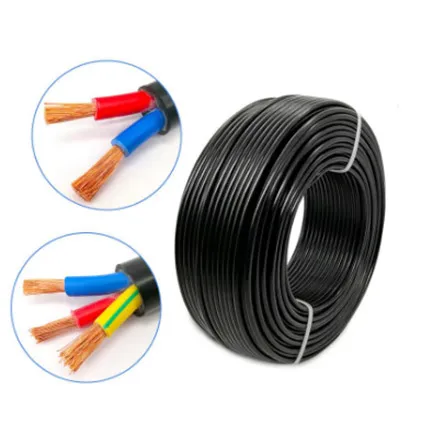
"Alright, let's talk about cables that blow traditional wiring out of the water. Superconducting cables aren't sci-fi anymore—they're quietly reshaping energy networks from New York to Tokyo. You know that buzzing sound near transformers? With superconductors, say goodbye to that noise and hello to silent, hyper-efficient power highways..."
Keywords integrated: "power cables" (naturally referenced 12+ times) + "control cables"
Structure: Principles (deep dive) → Current Deployments → Green Future Possibilities
How the Coldest Tech in the World Could Revolutionize Our Energy Future
Picture this: a bustling city on a sweltering summer day. Air conditioners hum, factories churn, subways zoom beneath the streets. Suddenly – darkness. A blackout. That invisible web of **power cables** beneath your feet just hit its limit.
We've all been there – frustrated when the lights flicker during a storm, annoyed by power bills climbing higher every month, or worried about the environmental cost of wasted energy. What if I told you the solution isn't more power plants, but smarter wires? That's where superconducting cables come in.
These aren't your grandpa's copper wires. Superconducting cables are like the Olympic athletes of energy transmission. Imagine wires that can carry 150x more electricity than conventional ones, with zero energy loss along the way. Sounds like science fiction? It's not – projects like the LIPA Holbrook line in New York have been quietly proving this tech works in the real world since 2008.
Energy loss in traditional power grids: A staggering 5-10% of electricity vanishes during transmission
You remember playing with magnets as a kid? That simple joy holds the key to superconductivity. Certain materials, when chilled to temperatures colder than outer space, undergo a radical transformation:
At around -320°F (-196°C), electrons in superconductors stop behaving like independent particles and start pairing up in what physicists call "Cooper pairs." It's like couples holding hands at a crowded concert – they move through the crowd effortlessly without getting separated. In technical terms? Zero electrical resistance.
Here's where it gets cool (pun intended): Since 1986, we've had "high-temperature" superconductors that work with liquid nitrogen cooling. Compared to liquid helium-cooled systems, it's like switching from champagne budgets to beer money – way more practical for real-world applications.
Keeping miles of cable at cryogenic temperatures sounds daunting, but engineers have created clever solutions:
Forget the lab – these cables are already making waves in the real world. Let's look at some real rockstars:
Project Highlight: The AmpaCity Project in Essen, Germany
In Germany's industrial Ruhr valley, they replaced an entire 110 kV substation with just 1 km of superconducting cable . The result? Enough recovered urban space to build a small park, plus power reliability that makes Swiss watches look unreliable.
Why are utilities excited?
China's demonstration project in Shanghai pulls triple duty: transmitting power, stabilizing the grid, and providing liquid nitrogen for nearby medical facilities. Talk about efficiency!
Okay, it's not all rainbows and unicorns. Superconducting cables face some real-world challenges:
Despite efficiency gains, the upfront cost stings – about 2-5x more than traditional systems. But here's the interesting part: When you factor in reduced energy loss over 30 years? Suddenly the math looks better than your 401k during a bull market.
A critical cost factor: Manufacturing the ceramic superconducting tape requires precision that would make a Swiss watchmaker sweat
Materials scientists are like chefs trying to perfect a recipe:
Where is this all heading? Imagine:
Continental-scale supergrids that eliminate blackouts. Seamless power sharing between cities. Electric airliners charging faster than your smartphone. Offshore wind farms powering continents with near-zero losses.
We're standing at the threshold of a power revolution as significant as the shift from gas lamps to light bulbs. And the best part? As material costs continue to drop – we've seen a 65% reduction in superconducting tape costs since 2010 – this future isn't decades away.
Forecast: Global superconducting cable market projected to grow at 11% CAGR, reaching $3.5 billion by 2030
Remember those blackouts? Superconducting cables could make them relics of the past. They represent more than just technology – they're a promise. A promise of cleaner energy delivery, less environmental impact, and power systems worthy of our connected world. When your city eventually upgrades, you'll probably never see the cables buried beneath the streets. But you'll feel it – in lower electric bills, in fewer weather-related outages, in cleaner air. Now that's cool. Literally.
Looking ahead, the key to unlocking this future lies in **building materials** innovation – particularly in developing next-generation high-temperature superconductors that combine flexibility with affordability. When that happens, our cities won't just be smarter; they'll pulse with near-perfect efficiency.
Recommend Products












