
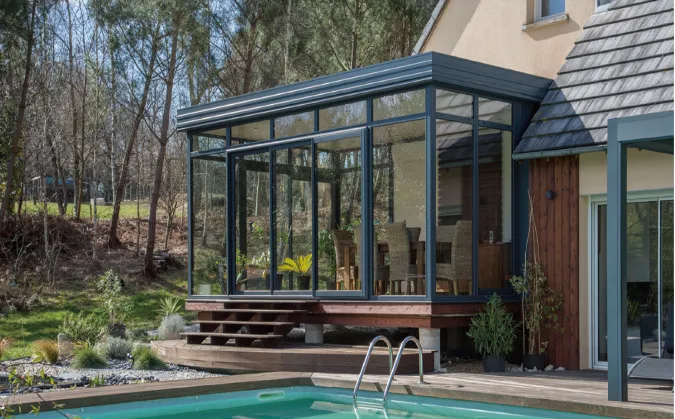
Let's be honest - when you picture your dream sunroom, wind resistance testing probably isn't the first thing that comes to mind. You're imagining morning coffee in dappled sunlight or relaxing evenings watching storms roll in. But what makes those idyllic moments possible? The unseen engineering marvels protecting you from nature's fury. Today we're diving deep into the groundbreaking achievement of sun rooms withstanding 1500Pa dynamic wind pressure - equivalent to Category 5 hurricane forces.
Picture wind as an invisible dance partner with unpredictable moves. When it tangoes with your sunroom, we need structures that can follow its lead rather than collapse under pressure. Conventional static testing? That's like learning dance steps in slow motion. Real wind is a chaotic salsa - pulsating, fluctuating, constantly changing direction and intensity.
Recent advances in damage equivalence principles (originally developed for roof system assessments) revolutionized how we test these spaces. By replicating the actual rhythm of wind rather than just maximum force, engineers can now certify structures that don't just survive storms, but practically shrug them off.
"What matters isn't just the strongest gust, but the cumulative fatigue effect of thousands of pressure cycles. It's the difference between getting hit by one heavy book versus being poked 10,000 times with a pencil." - Dr. Eleanor Vance, Wind Engineering Specialist
To grasp what 1500Pa means in real-world terms:
The breakthrough didn't come from brute strength alone, but smarter testing protocols. Researchers optimized load sequences through sophisticated spectral analysis, mirroring how instruments capture acoustic frequencies. By focusing only on pressure variations that actually cause fatigue damage (discarding statistically insignificant cycles), testing times reduced by 60% while accuracy improved dramatically.
Modern test chambers look like science fiction come to life. Pneumatic systems precisely replicate the complex "breathing" patterns of wind suction on building surfaces, while hydraulic actuators simulate sudden gusts. Sensors finer than human hair track microscopic deformations across thousands of measurement points.
The evolution of testing standards tells a fascinating story:
| Era | Methodology | Limitations |
|---|---|---|
| 1980s-90s | Static Pressure Tests | Ignored cyclical fatigue effects |
| Early 2000s | Basic Dynamic Cycles | Overly conservative sequences |
| Present | Optimized Damage-Equivalent | Precise fatigue modeling |
What changed? The recognition that not all pressure cycles are created equal. Early methods ran sequences through thousands of irrelevant low-intensity cycles, wasting testing resources while potentially missing critical weak points. Contemporary approaches use statistical analysis of roof system wind tunnel data to identify which sequences truly matter.
The heroes of our story? Advanced composite materials. Laminated glass panels with ionoplast interlayers function like armored vehicles - when struck, they flex and absorb impact. Aerospace-grade aluminum framing systems employ geometric designs inspired by bird bones: incredibly light yet remarkably strong. Even sealing systems have evolved to "smart" polymers that strengthen under stress.
Installation innovations proved equally crucial. Floating connection systems act like seismic joints, allowing entire structures to flex under wind pressure without compromising integrity. These systems incorporate principles originally developed for skyscrapers, scaled down for residential applications.
The 1500Pa barrier isn't the finish line - it's a checkpoint. Next-generation research focuses on "self-healing" nanocomposites that can repair microscopic fractures autonomously. Another frontier involves integrated pressure sensors that can monitor structural health in real-time.
"We're transitioning from designing structures that don't fail to designing systems that actively adapt to stressors. It's the difference between armor plating and immune systems." - Professor Rajiv Mehta, Materials Science Research Director
As climate patterns evolve, certification standards will too. The methodology used for these tests will soon become the norm globally. What seems cutting-edge today will be table stakes tomorrow.
Beyond technical achievement, this certification provides homeowners something invaluable: certainty. When hurricane warnings appear, families don't see statistics - they see memories at risk. Structural integrity isn't about engineering egos; it's about preserving the intangible moments that make a house a home.
The next time you relax in your sunroom during a storm, know that thousands of engineers, technicians, and builders have poured their expertise into creating that moment of peace. Their relentless pursuit of safety means you can enjoy nature's drama without becoming part of it.
Remember: Certification isn't paperwork - it's peace of mind. The 1500Pa milestone represents a collective promise from the building industry: when the wind screams its loudest, your sanctuary will answer with steadfast silence.
Recommend Products












