
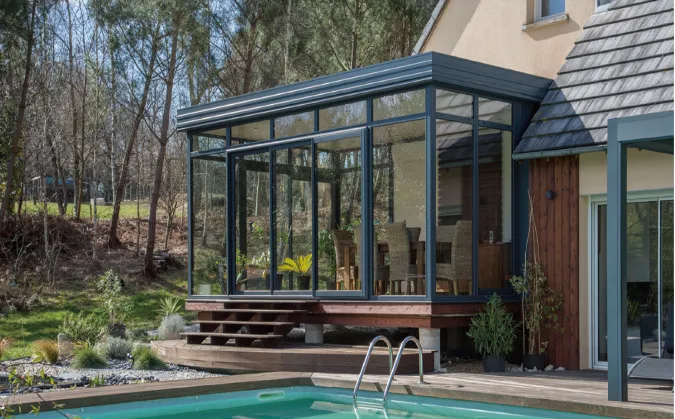
Imagine never having to squeegee those hard-to-reach sunroom windows again. Picture rainwater effortlessly washing away dirt while ultraviolet rays break down grime – all thanks to nanotechnology. Self-cleaning glass isn't science fiction; it's a reality transforming sunrooms and architectural marvels worldwide. At the heart of this revolution? Titanium dioxide nanoparticles working like microscopic janitors on your glass surfaces.
This technology particularly shines in ecological building wall panels applications. Whether for residential sunrooms or commercial atriums, the marriage of nano-science and construction creates surfaces that maintain their sparkle with minimal human intervention. The magic happens through titanium dioxide's dual-action – acting as both photocatalyst and hydrophilic agent to keep glass pristine.
When Japanese scientist Akira Fujishima first observed titanium dioxide's photocatalytic properties in 1967, he likely didn't imagine we'd one day harness it for self-cleaning sunrooms. Yet today, this humble compound achieves two critical functions simultaneously:
When UV light hits TiO 2 nanoparticles:
It's like having billions of microscopic scrub brushes activated by sunlight – no elbow grease required.
Simultaneously, another transformation occurs:
Applying these nanocoatings demands precision. For sunroom repairs or new installations, certified technicians follow this gold-standard process:
"You can't put a Rolls Royce paint job on a rusty bumper," veteran installer Marco Torres explains. "We start by:
For existing sunrooms needing repairs:
Pure titanium dioxide only works with UV light – problematic for northern climates. Advanced treatments include:
The effectiveness isn't hypothetical. At London's Bloomberg HQ:
Even underwater, these coatings shine. Norwegian researcher Naureen Akhtar proved TiO 2 -treated sensors stayed operational 400% longer in marine environments where biofouling typically cripples equipment.
University College London's breakthrough three-in-one glass showcases where the field is heading:
Vanadium dioxide nanoparticles create conical structures that trap air pockets. Raindrops roll off like mercury balls, collecting 90% more dirt than conventional surfaces.
The coating automatically adjusts: reflecting infrared during summer yet retaining heat in winter – slimming HVAC bills by 40%.
Bio-inspired structures (like moth eyes) reduce glare – no more squinting in sun-drenched reading nooks.
Like all technologies, coatings degrade. Warning signs include:
For repairs, specialists use portable CVD units to reapply targeted nanocoatings without full glass replacement. Post-repair, proper care extends lifespan:
Singapore's Solar Innovation Center is testing "regenerative coatings" where nanoparticles realign after damage. Meanwhile, Harvard experiments with graphene-doped TiO 2 demonstrate 98% efficiency even at 10° solar angles – critical for vertical glass applications.
As materials scientist Dr. Helen Cho observes: "We're moving toward holographic glass serving as solar collectors while self-cleaning. The sunroom window of tomorrow might power your home while cleaning itself."
For now, the nanotechnology revolution offers practical advantages: more time enjoying your sunroom's view and less time maintaining it. As the sun hits those titanium dioxide nanoparticles tomorrow morning, rest assured they're already hard at work – giving you one less chore in this busy world.
Recommend Products












