
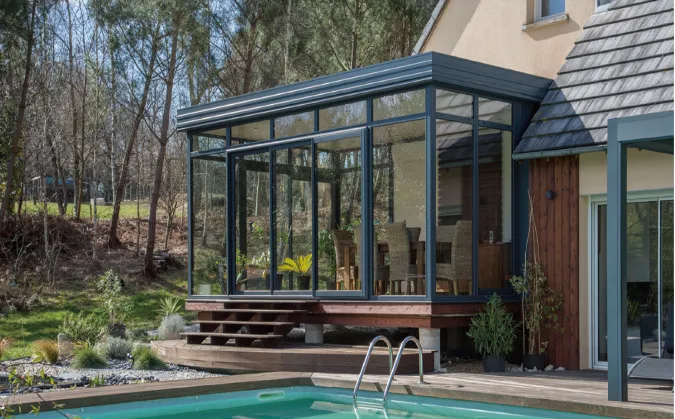
Picture your beautiful sun room during winter - snow gently accumulating on the glass roof, creating a picturesque scene. But beneath that serene image lies a structural challenge that could make or break your entire installation. Snow isn't just fluffy white stuff; it's heavy, unpredictable water weight that demands serious engineering consideration.
The European EN1991-1-3 standard gives us the playbook for handling these winter challenges. Originally developed for large-scale structures, its principles are equally crucial for sun rooms where the margin for error is slim. Whether you're a homeowner dreaming of a four-season oasis or an architect designing the next generation of solar-enhanced living spaces, understanding snow load verification isn't optional - it's essential insurance.
The current 2025 iteration of EN1991-1-3 (Eurocode 1 - Actions on structures - Part 1-3: Snow loads) packs decades of European winter experience into a comprehensive framework. Here's what makes it special:
Unlike older "one-size-fits-all" approaches, EN1991-1-3 acknowledges that snow behaves differently in the Alps versus Amsterdam. It replaces blanket assumptions with localized calculations that account for:
The latest version tightens provisions for exceptional snow events, recognizing our changing climate patterns. It explicitly excludes areas above 1,500m altitude unless specially calculated - a critical consideration for mountain cabins with sun room additions.
Specialist aspects like impact loads from sliding snow now get clearer guidance, preventing nasty surprises when snow slides off upper roofs onto sun room structures below.
Forget simplistic "pounds per square foot" rules. EN1991-1-3 introduces a sophisticated approach to modeling snow's weight:
This starting point quantifies what your region can expect:
Where:
μ
i
= Snow load shape coefficient
C
e
= Exposure coefficient
C
t
= Thermal coefficient
s
k
= Characteristic snow load on the ground
Each variable tells part of your snow story. The exposure coefficient C e adjusts for whether your sun room is shielded like a courtyard oasis or exposed like a hilltop observatory.
Here's where glass structures differ dramatically from conventional roofs. EN1991-1-3's thermal coefficient C t ranges from:
For sun rooms where solar gain creates natural heating, this coefficient becomes incredibly powerful. Properly accounting for thermal performance can reduce snow load calculations by up to 40% - a massive structural savings!
Conventional roof? Follow the charts. But sun rooms with their unique geometries demand case-by-case analysis:
EN1991-1-3 Table 7.2 provides shape coefficients for pitched roofs, but glass behaves differently than shingles. For slopes between 15°-30°:
The standard recommends applying 75% of the tabulated value to account for these realities.
Sun rooms often feature stunning curves and stepped designs. EN1991-1-3 Section 7.5 covers these complexities:
But this assumes uniform material properties. For glass structures, we must layer on:
Bringing theory to practice requires systematic verification:
Document:
EN1990:2023 §6 requires examining:
For sun rooms, the critical combination is often: Snow + Wind + Temperature Gradient
Paper calculations aren't enough. Modern verification requires FEM simulations that model:
Key outputs to examine:
Remember to account for solar panels attached to the structure - the additional weight and anchoring requirements create local loading hot spots that demand particular attention.
Meeting code is the minimum - exceptional designs build in safety margins:
Integrate features that make snow behave:
EN1991-1-3 Annex A.5 explicitly addresses climate uncertainty. For structures meant to last decades:
Navigating EN1991-1-3 for sun rooms isn't about jumping through regulatory hoops - it's about gaining true confidence that your glass sanctuary will stand strong when winter unleashes its full force. The standard gives us the tools, but the wisdom comes from understanding how each variable interacts with your unique design.
Remember these key takeaways:
With these principles in mind, you're ready to create sun rooms that deliver joy in summer and resilience in winter - truly year-round sanctuaries built on solid engineering.
Recommend Products












