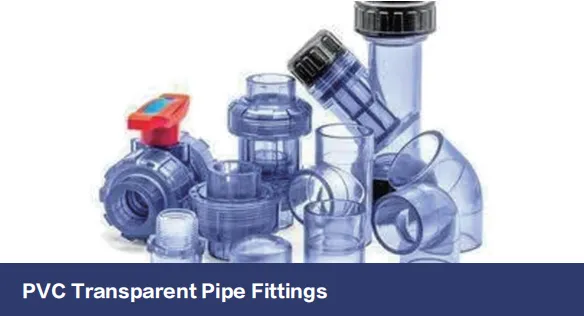
Hey there, pipe handlers and storage pros! If you're working with PVC transparent pipe fittings, you know how easily these clear plastic piping gems can get scratched, warped, or damaged. Unlike their opaque cousins, these see-through fittings show every imperfection. But relax – I've put together this comprehensive guide to help you keep them pristine from warehouse to jobsite. We'll cover everything from inspection routines to storage hacks, all while balancing professional standards with practical know-how.
As a bonus, I've pulled insights from industry manuals and added real-world tricks you won't find in official handbooks. Let's dive into protecting these essential plastic piping components – your projects (and budget) will thank you!
First things first – clear PVC isn't just regular PVC with see-through powers. That transparency comes from:
-
Ultra-smooth inner surfaces
that show every tiny scratch like a spotlight
-
Special stabilizers making them more UV-sensitive than opaque versions
-
Thinner walls in some fittings to maintain optical clarity
-
Minimal pigment additives that reduce structural reinforcement
Ever noticed how scratched clear pipes start looking cloudy? That's not just cosmetic – surface damage creates microfractures that expand under pressure. That's why these seemingly minor issues can balloon into full failures.
Before anything touches your storage racks, do the "Triple-Layer Check":
-
Visual Scan:
Hold fittings against bright light. Look for scratches, cloudiness, or stress marks. Rotate slowly – flaws hide in curved sections.
-
Surface Test:
Run a microfiber cloth (cleanroom-grade) over surfaces. If it snags, you've got invisible burrs.
-
Dimension Verification:
Use laser calipers on critical joints. Even 0.5mm warping causes leak risks later.
Critical Warning: Don't store fittings showing these flaws:
-
Hairline cracks near threaded sections
-
Discoloration at ends (indicates previous overtightening damage)
-
UV-induced yellowing (these will brittle within months)
Residual manufacturing fluids accelerate degradation. Here's your battle plan:
|
Contaminant
|
Removal Solution
|
Safety Tip
|
|
Mold release agents
|
Bio-degradable citrus cleaner
|
Never use abrasives – they scratch permanently
|
|
Cutting oils
|
Low-foam alkaline cleaner (pH 9-10)
|
Rinse 3x with distilled water to prevent stains
|
|
Dust particles
|
Electrostatic dust removal tools
|
Compressed air spreads contaminants further
|
After washing, let fittings drip-dry vertically in dust-free environments – lint-free cloths leave microfibers!
Clear PVC hates four things: Sunlight, heat, humidity, and ozone. Master these storage conditions:
-
Temperature:
Maintain 10-25°C (50-77°F). Above 30°C accelerates plasticizer migration.
-
Humidity:
Keep 40-50% RH. Lower dries fittings out, higher invites microbe growth.
-
Light Control:
Use UV-blocking films on windows and LED lighting only.
-
Air Quality:
Install ozone filters – near forklifts especially!
Forget ordinary shelves – try these advanced solutions:
The Cantilever Solution:
Custom foam-lined arms supporting fittings at 3 points:
-
Support elbows at body and both arms
-
Suspend straight pipes at 30% and 70% length points
-
Store tees horizontally with branch pointing down
Nested Storage:
For small fittings, use laser-cut EVA foam layers:
-
Layer 1: Custom cavities for each fitting shape
-
Layer 2: Perforated divider allowing air circulation
-
Layer 3: Desiccant compartment reducing humidity
-
Never use metal hooks or clamps – even coated ones eventually scratch
-
Avoid stacking fittings taller than 1 meter – bottom layers deform silently
-
Stop using stretch-wrap - creates uneven pressure points
-
Abandon PVC-solvent based adhesives in labels – they chemically attack fittings
When transferring fittings:
-
Use V-grooved conveyors with adjustable angles
-
Employ electrostatic discharge wrist straps – static attracts dust like magnets
-
Implement "Two-Person Rule" for elbows >6" diameter
-
On carts, use silicone matting with recess patterns matching fitting shapes
Traditional tie-downs damage clear PVC. Try these instead:
-
Inflatable Air Bags:
Custom-shaped pillows that expand to fill voids
-
Viscoelastic Straps:
Pressure-sensitive polymers distributing force evenly
-
Magnetic Rails:
For metal carts, using removable padded panels
For inventory staying beyond 6 months:
-
Rotation System:
Implement color-coded FIFO tagging with UV-sensitive indicators
-
Condition Monitoring:
Wireless IoT sensors tracking micro-deformations
-
Preventative Conditioning:
Quarterly light-sanding of contact points with 2000-grit foam pads
-
Anti-Static Treatment:
Monthly application of ionic surface treatments
Accidents happen! Try these rehab tricks:
-
For light scratches: Plastic polishing compounds with rotary micro-tools
-
For oxidation: Food-grade hydrogen peroxide soak (3%) followed by rinsing
-
For warping: Carefully heat with adjustable IR lamps to 60°C (140°F) then reshape
Keep these fundamentals in your daily routine:
-
Store fittings curved-side down whenever possible
-
Place heavier fittings near ground-level, lighter above
-
Maintain a 3-inch clearance between stacked materials
-
Rotate stock regularly with "first-in, first-out" approach
-
Conduct monthly condition audits with UV/blacklight inspection
Caring for PVC transparent pipe fittings doesn't require crazy investments – just smart practices. Remember that minor scratches today become critical failures tomorrow. Your transparent pipe network is the circulatory system of any fluid-handling operation. By treating fittings with the care described here, you'll extend their lifespan dramatically.
Feel free to bookmark this guide as your go-to resource. Share it with your logistics team, warehouse staff, or operations crew. Preventing damage is always cheaper than replacements! Got a tricky fitting scenario I didn't cover? Remember – thoughtful storage saves headaches.