


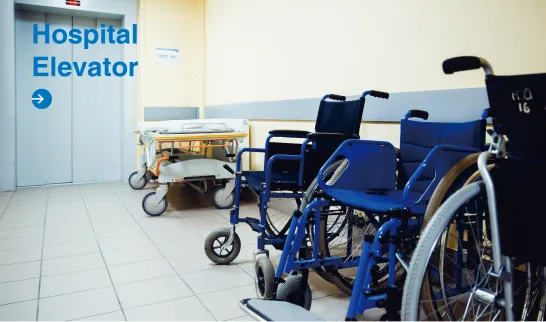
When seconds count during medical emergencies, hospital elevators become lifelines connecting critical care teams, life-saving equipment, and patients in vulnerable states. The stakes couldn't be higher, which is why specialized safety requirements for healthcare elevators go far beyond standard commercial building codes.
Beyond Standard Safety
Hospital elevators operate under constraints unknown to ordinary lifts. They routinely transport:
- Patients strapped to life support machines maintaining vital functions
- Critical care teams performing emergency procedures mid-transport
- Highly sensitive radiation equipment or medications requiring zero vibration
- Bariatric patients requiring reinforced capacities over 5,000 lbs
- Transplant organs with critical preservation timelines
A single malfunction could become catastrophic in these high-stakes scenarios. That's why global safety standards place intense focus on redundant backup systems – like dual braking mechanisms and emergency power – that activate instantly if primary systems falter.
Contamination Control
Infection prevention takes center stage in healthcare elevator regulations worldwide. International guidelines mandate:
- Non-porous, seamless materials that eliminate germ-harboring crevices
- Hygienic copper-alloy touch surfaces proven to kill microbes
- Hospital-grade UV-C sterilization systems integrated into cab ventilation
- HEPA filtration capturing 99.97% of airborne pathogens
These features are absent in standard elevators where materials prioritize aesthetics over hygiene. For vulnerable patients with compromised immune systems, this difference is life-critical.
Global Regulation Comparison
North America
ASME A17.1/CSA B44 Health Care Facilities Code demands redundant power systems capable of operating intensive care equipment for 90+ minutes. In seismic zones like California, elevators must remain operational during earthquakes up to magnitude 7.0.
European union
EN 81-70 Hospital Elevators Standard requires wider cabs (minimum 2m depth) for specialized medical transport beds. Strict noise limits protect neurological patients from auditory stress, and floor leveling must maintain exact positioning (±3mm) to prevent medical cart tipping.
China
GB/T 7588 mandates dual-layered fire protection systems where emergency power remains active during fire evacuations. Specialized dampening systems prevent imaging distortion when transporting MRI equipment.
Global Intersection
Universal requirements include antimicrobial materials, emergency communications directly to nursing stations, and dedicated elevator groups for critical departments like surgical suites and ICUs.
Life-Saving Maintenance Protocols
Global regulations enforce stricter maintenance than commercial settings:
- Redundant brake inspection every 4,000 operations vs. standard 5,000
- Emergency power systems tested bi-weekly instead of monthly
- Third-party validation of all safety certifications annually
- Priority access for certified technicians during service disruptions
Future Safety Innovations
Emerging technologies like anti-microbial nano-coatings and AI predictive maintenance systems show promise. Many medical facilities now implement modular elevator shaft designs allowing future upgrades without construction disruptions.
Manufacturers increasingly emphasize energy efficiency through regenerative drives that recapture braking energy – a crucial consideration for hospitals operating residential elevators 24/7 while maintaining strict budgets.
Conclusion
The specialized requirements woven into global hospital elevator codes reflect an uncompromising truth: These aren't passenger lifts transporting shoppers between floors – they're critical care extensions ensuring life continues when patients are at their most fragile. The industry's increasing alignment on these standards demonstrates a shared commitment to protecting patients when they're most vulnerable.










