
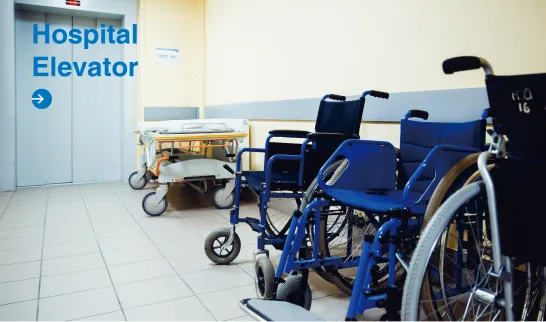
Picture this: It's 3 AM in a bustling hospital. A nurse rushes a critical patient to surgery while family members pace nervously in waiting areas. Amidst this high-stakes environment, there's one silent workhorse making everything flow smoothly – the hospital elevator. But these aren't your typical lifts. They're highly specialized systems meeting rigorous standards that go far beyond regular commercial installations.
Hospital elevators operate under unique pressures. We're talking life-and-death situations combined with constant infection risks and the need for absolute reliability. Get these installations wrong, and you're not just facing inconvenience – you're compromising patient safety and care quality. Let's explore the three pillars that make hospital elevators fundamentally different.
Hospitals are battlegrounds against infection. While everyone focuses on ORs and patient rooms, elevators quietly shuttle pathogens between floors. A Johns Hopkins study found elevator buttons carry 30x more bacteria than public toilet seats. That's why cleaning protocols aren't just maintenance – they're infection control.
"An elevator car isn't just transport – it's a vector," explains Dr. Sarah Chen, Hospital Epidemiologist. "When we transport isolation patients or chemotherapy meds, that stainless steel box becomes as clinically significant as any treatment room."
Modern solutions go far beyond the mop bucket:
Interestingly, the cleanliness standards now match pharmaceutical cleanrooms. Elevator technicians even wear bunny suits during maintenance. That's how seriously infection control teams take these spaces.
Hospitals never sleep, but patients need to. Noise pollution isn't just annoying – it slows recovery times and increases medication needs. The WHO recommends hospital noise levels below 35 dB. Achieving this near elevator shafts requires acoustic engineering worthy of concert halls.
The challenge? Modern hospitals have massive elevator banks moving constantly. Hydraulic systems generate vibration while door mechanisms create sharp percussive sounds. Solutions involve multiple layers:
For neonatal units, we install specialized acoustic mineral ceiling panels that absorb 95% of ambient sound while maintaining strict hygiene standards. This hospital-grade soundproofing solution creates near-anechoic conditions around sensitive departments.
"A cardiac patient resting near an elevator shaft isn't getting disturbed by machinery noise," explains audio engineer Miguel Torres. "That's not luck – it's physics, materials science and painstaking calibration working together."
When a trauma patient gets stuck between floors, seconds matter. That's why hospital elevator supervision goes beyond maintenance schedules to include real-time operational intelligence.
Modern systems feature multiple redundancy layers:
Most facilities now have elevator dashboards in security centers showing real-time locations and system health. During disasters, these become command centers for vertical evacuation coordination.
Meeting hospital elevator standards isn't about checking boxes. It's about embracing a fundamentally different approach where:
1.
Redundancy is sacred
: Three independent braking systems isn't overengineering – it's patient safety
2.
Materials matter microscopically
: Surfaces must survive both Ebola decontamination and decades of chemical cleaning
3.
Quiet is clinical
: Noise control directly impacts healing outcomes
4.
Design includes emotion
: Calming aesthetics reduce visitor anxiety
"People remember how they felt waiting for that elevator," notes architect Elena Morales. "Was it anxious? Calm? We design that emotional experience as carefully as the mechanical systems."
The next generation of hospital lifts is already emerging:
Modular designs
: Removable panels allowing deep cleaning without shutdowns
Air purification
: Photocatalytic oxidation systems destroying airborne pathogens
Gesture interfaces
: Touchless control for immunocompromised patients
Autonomous response
: Cars self-navigating during emergencies
Healing environments
: Circadian lighting and nature sounds enhancing wellness
These innovations remind us that hospital elevators serve a sacred function. They're not moving boxes – they're transporting hope, healing, and humanity through some of life's most vulnerable moments. And that demands extraordinary engineering.
Recommend Products












