
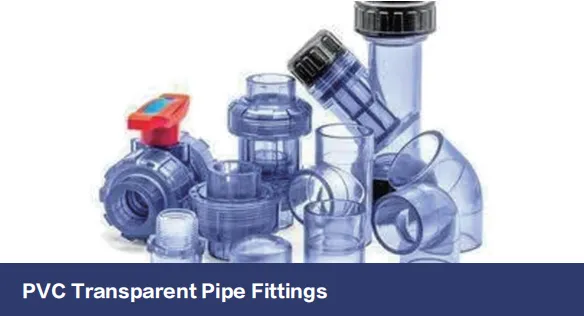
When unique challenges demand unique solutions, specialized transparent PVC fittings provide the clarity and adaptability modern engineering breakthroughs require
Picture this: a research lab where scientists track fluid dynamics in real-time. An aerospace startup prototyping a next-generation cooling system. A biotech firm developing life-saving equipment. What do they all have in common? They’re part of a quiet revolution transforming how we approach specialized industrial applications – and it all comes down to visibility.
For decades, engineers and researchers struggled with "black box" piping systems. You’d send fluid in one end and hope it came out right at the other. If something went wrong? Prepare for disassembly, diagnostic headaches, and downtime. Those days are ending thanks to one surprisingly simple innovation: transparent PVC pipe fittings .
Unlike traditional opaque materials, transparent PVC fittings serve both structural and diagnostic functions. They're like having x-ray vision for your fluid systems – letting you monitor flow patterns, detect contaminants early, and visually confirm processes without interrupting operations. That visual feedback loop? It’s priceless when you’re working on sensitive R&D projects or specialized industrial applications where every variable matters.
But here’s what really excites innovators: we’ve moved past the era of one-size-fits-all solutions. Customized small batch production means whether you need a unique elbow configuration for a micro-reactor or specialty tee fittings for a medical device prototype, manufacturers can now deliver without requiring 10,000-unit minimum orders. That’s democratizing innovation.
So what exactly can you customize? Much more than you might expect. This isn’t just about cutting tubes to different lengths – it’s about tailoring every aspect to specialized needs:
Need a 73° elbow instead of the standard 90°? A cross fitting with asymmetric port sizing? Specialized geometries that traditional suppliers would reject as "non-standard" become feasible with small batch flexibility.
Beyond standard PVC, formulations can be adjusted for enhanced chemical resistance, higher temperature tolerance, or specific optical properties. Want UV-resistant transparency for outdoor applications? That’s doable.
Custom ports for sensors, built-in sampling valves, or specialized threading – features that transform passive fittings into active diagnostic components. For research-grade projects, that integration can be the difference between a good experiment and a groundbreaking one.
"Our thermal management research hit a wall until we could visually confirm turbulent flow in custom angled fittings. The ability to order specialized configurations in batches of 50 instead of 5,000 made our project feasible."
– Dr. Elena Rodriguez, Energy Systems Research Lab
It’s tempting to think of pipe fittings as utilitarian components – until you see what visible flow enables:
Consider a biotech startup developing dialysis technology. With traditional fittings, detecting micro-bubbles in fluid lines required complex sensors. Transparent PVC turns the entire line into a visual diagnostic tool – catching issues that sensors might miss and providing intuitive visual feedback during system tuning. That transparency accelerates development cycles.
Engineering programs increasingly incorporate transparent systems to demonstrate fluid dynamics principles. Seeing laminar flow become turbulent at a fitting connection makes theoretical concepts click for students. Custom educational fittings help shape the next generation of engineers.
A team developing liquid nitrogen cooling for satellite systems struggled to detect phase change points in traditional metal fittings. Custom transparent PVC fittings with specialized borosilicate glass viewports allowed them to visually confirm phase transitions and prevent dangerous pressure buildup. The small batch capability meant they could iterate through three design revisions in six weeks – getting to market 40% faster.
How does small batch customization work in practice? It’s more straightforward than many expect:
It starts with a conversation – not a catalogue. Engineers discuss application requirements, fluid characteristics, pressure needs, and environmental factors. This consultation determines everything from material selection to optimal geometries.
Using your sketches, CAD models, or reference photos, manufacturers create digital simulations and virtual prototypes. You’ll see how fittings will perform before anything is fabricated.
Before full production, you receive functional prototypes for real-world testing. This stage catches issues before committing to batch production.
While transparent fittings have obvious utility in standard industrial applications, the most exciting innovations are happening at the intersection with residential and commercial building materials . Imagine transparent rainwater harvesting systems that double as architectural features, or visible chemical treatment lines in sustainable buildings – transparency enhances both function and form.
Where is this capability making the biggest impact? Here’s where innovators are applying custom solutions:
From pharmaceutical labs developing continuous-flow reactors to energy researchers studying geothermal fluids, custom transparent fittings provide crucial visual data for critical research. The ability to integrate sampling ports and sensor mounts makes these more than pipes – they become research tools.
Breweries monitoring yeast flow, semiconductor plants tracking ultra-pure chemicals, or food processing plants confirming sanitation. All rely on the diagnostic clarity of specialized transparent systems.
"Our microbrewery's quality consistency improved 30% after installing custom transparent fittings with integrated temperature sensors. Seeing flow patterns helped us optimize fermentation like never before."
– Michael Thorne, Artisan Brewing Co.
When developing dialysis machines, infusion pumps, or bio-reactors, engineers need to validate fluid behavior without guesswork. Custom medical-grade transparent PVC solves this while meeting strict biocompatibility standards.
What’s next for this field? The trajectory points toward increasingly intelligent integration:
The next evolution involves fittings with embedded micro-sensors for temperature, pressure, pH, and turbidity – turning passive pipes into active monitoring networks.
New polymers with tunable optical properties (like adjustable transparency) and "smart" surfaces that resist fouling while providing visual access.
Custom fittings will come with virtual models that mirror physical performance – letting engineers simulate modifications before implementing them physically.
What’s driving this transformation? Ultimately, it’s the recognition that visibility matters. In a world where innovation happens at the boundaries of disciplines, the ability to see – really see – what’s happening inside our systems accelerates discovery. Small batch customization makes that possible without requiring massive capital investment.
Transparent PVC pipe fittings have evolved from simple plumbing components to essential innovation infrastructure. By combining visual access with flexible manufacturing, they’re transforming how researchers explore, engineers build, and industries operate. The future of specialized applications isn’t just functional – it’s transparent.
Recommend Products












