
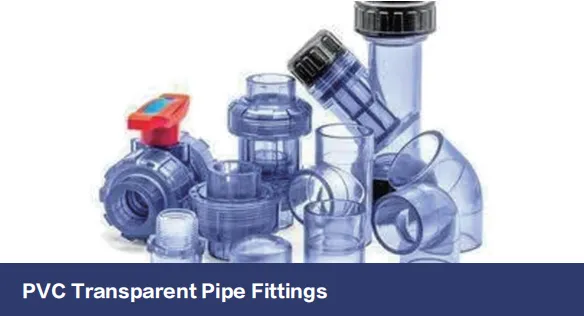
Picture this: a single speck of dust, smaller than a grain of pollen, lands on a silicon wafer during chip manufacturing. That microscopic intruder could ruin a microchip worth thousands of dollars. This is why ultra-clean environments aren’t just "nice-to-have" in semiconductors—they’re the bedrock of quality. And in these spaces, one unsung hero is PVC transparent pipe fittings. They're like the silent security guards of your smartphone's brain.
Semiconductor cleanrooms operate at ISO Class 1-4 levels—meaning fewer than 10 particles per cubic meter . Compare that to a typical office, which might have millions. If these rooms were hospitals, they’d be the ICUs. Every material used must earn its place. That’s where PVC transparent pipe fittings come in. They transport ultrapure water, chemicals, and gases without leaking contaminants, all while letting engineers visually monitor fluids.
Like highways directing cars away from accidents, laminar airflow systems sweep particles away from wafers. PVC pipes integrate seamlessly into these designs because they resist shedding particles—unlike metal alternatives that corrode and flake.
These filters trap 99.97%–99.9999% of particles. PVC fittings support this ecosystem by being non-porous. Imagine a pipe fitting made by a pipe fitting manufacturer in China; its smooth inner surface ensures nothing sticks, reducing filter load.
Static electricity attracts dust like a magnet. That’s why PVC transparency matters: engineers spot bubbles or debris instantly. Anti-static coatings are often baked into the PVC formulation—no second chances in nanoscale worlds.
Traditional metals risk leaching ions or corroding when exposed to acids in etching baths. Transparent PVC avoids this:
One fab in Taiwan cut contamination-related failures by 60% after switching from steel to PVC transparent fittings.
The next wave? Solar-powered cleanrooms and fittings embedded with IoT sensors. Imagine PVC pipes alerting you to pH imbalances before they ruin a batch—no humans needed.
In semiconductor manufacturing, every part—even a humble pipe fitting—must be mission-ready. Transparency isn’t just about seeing fluids; it’s about trust. As fabs shrink transistors and amp up production, PVC fittings evolve from bystanders to guardians of purity.
Recommend Products












