


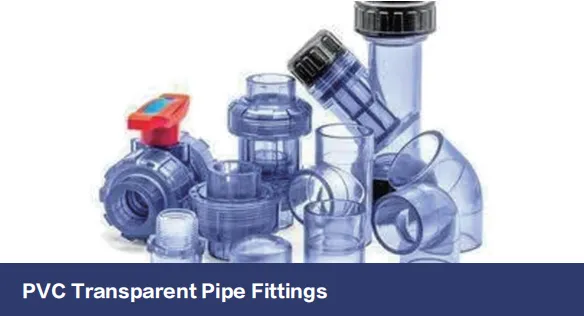
When tackling major infrastructure projects, every pipe fitting decision matters. But let's be real – selecting the right large-diameter PVC transparent pipe fittings often feels like walking through a maze blindfolded. Unlike standard opaque pipes, these clear workhorses give you X-ray vision into fluid dynamics while juggling critical performance demands. From municipal water systems to industrial processing plants, transparency isn't just a nice-to-have feature – it's your frontline diagnostic tool.
Think about it: When you can see sediment buildup or flow irregularities developing in real-time, you dodge disasters before they become budget-eating monsters. But here's the rub – not all transparent PVC fittings are created equal, especially when scaling up to 12-inch plus diameters. Over the next few sections, we'll break down exactly what separates the winners from the "should've read the specs" regrets, using real-world insights from water management pros and infrastructure veterans.
The Naked Truth About Performance
Picture this: A 16-inch wastewater bypass system fails because cloudy water hid deteriorating seals. Now imagine that scenario in a pharmaceutical plant where contamination risks translate to seven-figure recalls. That's why clarity standards aren't optional – they're your first defense layer. Premium transparent PVC maintains optical integrity even under sustained pressure cycles, avoiding the foggy degradation that plagues budget formulas.
Pressure's Silent Language
Large diameters bring unique stress patterns. As one municipal engineer put it: "Watching ripple effects through transparent sections taught us more about surge pressures than any sensor array." But that visibility means nothing if material composition can't handle the load. Dual-layer construction with reinforced molecular alignment prevents distortion under load – critical when monitoring turbulent flow in stormwater applications.
Chemical Blind Spots
Remember that industrial installation using "clear" connectors that yellowed within six months? Oxidation resistance matters double when you're eyeballing fluid purity. UV-stabilized formulations with advanced co-polymers preserve clarity despite chlorine exposure or pH swings – something standard PVC resins sacrifice for cost savings.
Where Theory Meets Trenches
All specs look perfect on paper. Then comes installation day, and suddenly those elegant connector diagrams turn into real-world puzzles. Through countless jobsite interviews, three pain points emerge:
Gasket Roulette
Ever play connector compatibility bingo? Mismatched gaskets leak microscopic air bubbles that ruin your visual monitoring. Premium systems like those using bottle-tight removable seals eliminate this guesswork, but verify torque specs align with transparent sections' stress thresholds.
Thermal Ballet
PVC's expansion rate seems trivial until a 14-inch fitting cracks after sunset temperature drops. Transparent formulations often differ structurally, requiring revised gap calculations during joining. As one pipeline veteran noted: "Those extra millimeters matter when morning dew hits."
Bulletproof Connections
"See-through" shouldn't mean "break-through." Reinforced socket designs with graduated wall thickness prevent cracking at stress points – a non-negotiable when transparent fittings interface with heavy valves.
Your Eyes Don't Lie
During a drought response in Texas, municipal crews spotted sediment islands forming through transparent junctions before sensors registered flow changes. That visual advantage translates to:
- Clog forecasting - Spot bridging material before full blockages
- Corrosion mapping - Visually track scaling patterns impossible to detect otherwise
- Seal diagnostics - Identify micro-bubbles at connection points indicating seal fatigue
But maintaining this advantage demands deliberate specification choices. Optical-grade cleaning coatings that resist mineral deposits? Non-yellowing additives validated for 25+ year UV exposure? These aren't luxuries – they're what separates a temporary fix from infrastructure that outlives its planners.
Transparency Beyond Literal Meanings
Here's where many engineers get tripped up: Clarity isn't just about material composition. True transparency emerges from:
Process Visibility
Beyond leak detection, observing flow characteristics informs future system designs
Maintenance Certainty
Reducing inspection guesswork = slashing operational downtime
Chemical Interaction Tracking
Watching precipitation patterns reveals incompatible fluid combinations
An agricultural project using transparent pvc pipe connectors in irrigation pivots demonstrated this perfectly: Observing turbulent flow at junctions led to redesigned manifolds that dropped pump energy costs by 18%.
The 'No Regrets' Specification Checklist
Based on cross-referenced project post-mortems and manufacturer data, always verify:
That last point deserves a war story: When a hurricane flooded a Florida wastewater plant, crews modified transparent junctions in the field because the system allowed mechanical cuts without optical distortion. Days later, the same feature helped locate trapped debris causing backup risks.
The Real Math Behind Costs
Upgrading to optical-grade PVC fittings adds 15-30% upfront. Now flip the perspective:
Reactive Approach
$38K average inspection camera deployment per incident
14 days production loss for major pipe excavation
$120K+ environmental fines for undetected leaks
Transparent Advantage
87% faster contamination identification
Predictive maintenance instead of emergency shutdowns
Flow optimization cutting pumping costs
As a project lead on Denver's water renewal initiative told us: "We justify the premium by what we don't spend downstream." Their transparent junction monitoring caught a hairline fracture in Week 3 – a defect that would've cost $1.2M in emergency repairs just 6 months later.
Where Material Science Is Headed
Get ready for game-changers already in pipeline R&D:
Smart Transparency
Self-reporting fittings using micro-engraved patterns that distort at specific pressure thresholds – giving visual and digital alerts
Nano-Coatings
Permanent hydrophilic layers preventing biofilm adhesion without impacting optics
Thermochromic Formulations
Visual temperature mapping via color-shifting additives – no embedded sensors required
What remains unchanged? The core principle: Seeing translates to knowing . And in large-scale engineering, what you don't know carries massive costs.
The Last Word from Site Veterans
After dozens of interviews, one refrain emerges: "Quit thinking about transparent fittings as passive parts. They're your most observant crew members."
That mindset shift pays dividends across project lifecycles. During commissioning, they validate flow assumptions. At operations phase, they replace guesswork with certainty. And during system upgrades, they reveal interactions no digital twin predicted.
"We've had flow meters lie. SCADA systems miss gradual changes. But our transparent junctions? They don't filter reality."
– Chief Engineer, Great Lakes Water AuthoritySo yes – pore over those ASTM certifications and pressure curves. But never forget what you're really buying: Unfiltered visibility into your system's truth. That insight justifies every specification debate.










