


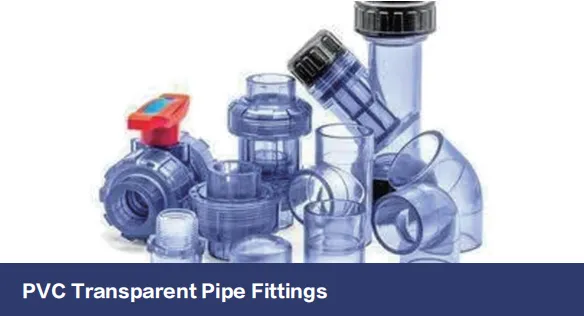
Ever wondered why some plumbing projects outlast others by decades while some fail catastrophically within months? The secret often lies in the supplier's quality control . If you're using transparent PVC pipe fittings in medical labs, chemical plants, or food processing units, a single defective connector could compromise entire systems. Just last year, a pharmaceutical company recalled $2M worth of products due to leached chemicals from substandard PVC fittings – a nightmare scenario that proper evaluation could have prevented.
Why You Can't Skip This Evaluation Process
The Transparency Paradox
Clear PVC seems like it'd reveal all flaws, right? Ironically, visual clarity actually hides crystalline imperfections and micro-stresses that opaque pipes make obvious. Transparent pipes demand special lighting techniques and viewing angles to catch what your eyes normally miss.
Material Migration Risk
Unlike white pipes where pigment stabilizes the material, transparent PVC relies solely on chemical stabilizers that can leach into fluids over time. One factory inspection revealed fittings bleeding plasticizers into purified water systems – undetectable without chemical testing.
The UV Vulnerability
Natural light turns standard PVC yellow and brittle. Quality transparent formulations should contain UV inhibitors, but suppliers often cheap out here. We'll show how to check formulations without lab equipment – crucial for outdoor installations.
Pro Tip: Always request batch-specific material certificates. One supplier's "same formula" between batches varied 23% in stabilizer content – enough to fail NSF certification.
The 360° Evaluation Framework
Visual Inspection Protocol
Forget glancing at fittings under warehouse lights. Set up polarized light sources at 15° angles to reveal stress patterns. Check for:
- Weld line irregularities at joints
- Sink marks around threaded sections
- Cloudiness gradients indicating uneven cooling
Precision Measurement Tactics
Tolerance issues cause more failures than material defects:
- Measure ID/OD at 5 points using laser micrometers
- Check ovality by rotating fittings 90° between measurements
- Verify threading depth matches ASME B1.20.1 standards
Material Integrity Verification
Critical tests for clear PVC:
- Acetone wipe test: discoloration indicates plasticizer migration
- Cold impact test at -10°C to check brittleness threshold
- Spectrophotometer verification of UV inhibitor levels
| Test Parameter | Acceptable Range | Premium Grade | Industrial Grade |
|---|---|---|---|
| Transmission Clarity | ≥88% visible light | 92-95% | 85-88% |
| Haze Measurement | <3% | 0.8-1.2% | 2-2.8% |
| Tensile Strength | ≥50 MPa | 55-62 MPa | 50-52 MPa |
| Chemical Stability | No swelling in 24h | No change after 72h | Marginal swelling |
Certification and Standards Deep Dive
"Our pipes meet standards" means nothing without specification sheets. A supplier claiming NSF-61 compliance actually had fittings suitable only for cold water applications while marketing them for hot oil transfer. Always verify:
NSF/ANSI 61
Essential for potable water systems. Demand Section 9 test reports showing actual contaminant levels rather than pass/fail certificates.
ASTM D1784
Classifies PVC compounds by temperature/pressure ratings. Check if the fitting's ASTM code matches its claimed application limitations.
FDA CFR 21
Mandatory for food/beverage applications. Verify registration numbers in the FDA database – one "certified" supplier wasn't actually registered!
Simulation-Based Performance Validation
Lab tests can't replicate decade-long stress. Advanced suppliers now provide FEA (Finite Element Analysis) simulations showing:
- Stress distribution under max pressure loads
- Thermal expansion/contraction patterns
- Flow-induced vibration resistance
Field Verification Trick: Install sample fittings in parallel to main systems with pressure loggers. Cheaper than catastrophic failure and generates real-world validation data.
When selecting transparent PVC pipe fittings suppliers, prioritize those providing visual flow pipeline fittings as this demonstrates their commitment to manufacturing transparency beyond mere material clarity – revealing how products will actually behave in your specific application environment.
Comprehensive Quality Assurance Checklist
Incoming Material Review
- Verify PVC resin K-values (should be 58-60 for transparent formulations)
- Check CoA for UV stabilizer content (minimum 1.5% Tinuvin P)
- Confirm phthalate-free plasticizer certifications
Process Validation
- Audit extrusion temperature profiles (±2°C control required)
- Verify mold venting systems prevent burning/stress
- Check drying procedures – residual moisture causes bubbles
Traceability Systems
- Batch numbering engraved on fittings (not just packaging)
- Full material genealogy documentation
- Real-time SPC control charts access
Implementation Strategy: Start with small validation batches using our checklist. One water treatment plant reduced fitting replacements by 78% after implementing these protocols, saving $145K/year in maintenance.
Operational Integration Protocol
| Phase | Key Actions | Success Metrics |
|---|---|---|
| Supplier Qualification |
On-site audits with our checklist
Benchmark against 3 competitors |
Score ≥85% on audit
Critical item zero tolerance |
| Incoming Quality Control |
First article inspection per AS9102
Random sampling per AQL Level II |
Defects ≤0.65%
100% cert documentation |
| Installation & Monitoring |
Pressure decay testing post-install
Photographic documentation |
Zero leaks at 1.5x operating pressure
Annual inspection reports |
Transparent PVC fittings offer unprecedented visibility into flow dynamics – a game-changer for chemical processing and laboratory applications. By implementing this comprehensive evaluation framework, you transform from passive consumer to informed partner in quality creation. When you can verify material origins, scrutinize production discipline, and validate performance predictions, your fittings won't just connect pipes – they'll connect your operation to decades of trouble-free service.










