
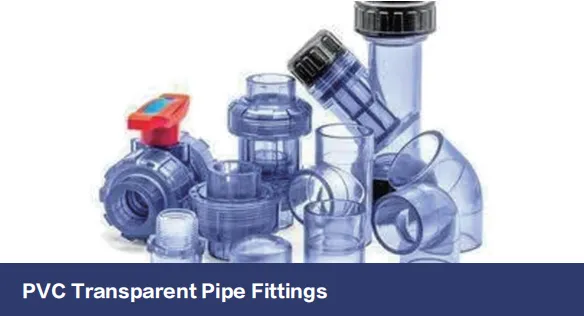
Getting transparent PVC pipe fittings ready for production isn't just about mixing materials and cranking up machines—it's like preparing for a high-stakes symphony where every instrument needs perfect tuning. When clients ask for customized fittings, whether it's for a lab setup, aquarium system, or industrial application, the journey from blueprint to batch production has a crucial pitstop: sample confirmation. And skipping this step? That's like baking a wedding cake without tasting the batter first.
Imagine investing in thousands of custom fittings only to discover they fog up under specific temperatures or develop stress cracks after installation. Sample confirmation is your insurance against expensive do-overs and disappointed clients. It's where you transform technical drawings into tangible reality to catch potential hiccups before they snowball into production disasters. This phase is especially critical for transparent fittings because clarity isn't just aesthetic—it directly impacts functional inspection in medical, chemical, or food-grade applications where seeing flow matters.
Custom PVC starts with cocktail-hour chemistry. Every formulation tweak influences transparency, flexibility, and crucially, durability. Here's what goes behind the scenes:
Think of this as your base band:
For a brewery client wanting transparent fittings for acid-cleaning cycles, we took a different path: swapped standard plasticizers for alkyl sulfonic ester types. Why? Because they withstand lactic acid baths that would haze ordinary formulations. Sample testing wasn't just about appearance—we simulated 200 clean cycles to ensure zero fogging or brittleness. This tweak added 17% to material costs but saved thousands in replacement costs.
Once formulation's locked in, it's time to translate specs into machine settings. Transparent PVC demands precision temperature choreography:
Think about melting chocolate—too hot, it scorches; too cool, it's lumpy. PVC behaves similarly:
For specialized fittings like transparent T-junctions, calibration gets trickier. We once spent three days adjusting cooling bath flow rates to prevent differential shrinkage—where one arm of the T cooled faster, warping the geometry. Solution? Install directional nozzles targeting thicker sections.
Molds aren't just negative spaces—they're narrative tools shaping how PVC cools and flows:
Before signing off on sample molds, we run micro-batches of 100 fittings under fluctuating conditions: cycle temperatures ±10°C, pressure spikes, restart after pause. Why? Because production realities aren't lab-perfect. This exposes "first-shot" defects that appear only after tool heat-soak or intermittent cooling glitches.
Approving samples isn't desk work—it's detective work. Here's how we interrogate fittings:
| Test | Method | Acceptance Criteria |
|---|---|---|
| Hydrostatic Burst | ASTM D1599 | ≥2x working pressure |
| Impact Resistance | ASTM D2444 | Zero cracks at 23°C with 1kg weight |
| Chemical Resistance | Immersion per ASTM D543 | <5% weight change, no haze |
A pro tip: Always test assembled systems, not just individual components. We recall a winery project where fittings passed individually but leaked at joints due to minor diameter deviations that only appeared under union compression.
Finally, sample confirmation is only as good as its paper trail:
One golden lesson? Photograph everything. For complex custom junctions, we shoot macro shots from multiple angles and seal samples in dated acrylic blocks—perfect for settling "it didn't look like this yesterday" disagreements.
Never underestimate subjective expectations. What engineers call "acceptable haze" might look like fog to designers. We use client feedback sessions with mood lighting to demonstrate clarity—a fitting submerged in water with backlighting often proves "good enough" better than a spec sheet. Similarly, for textured clear fittings, 3D-printed prototypes help clients visualize final aesthetics before compounding.
While rigorous, this process actually reduces production delays. Common pitfalls caught during sample validation:
Ultimately, sample confirmation transforms PVC formulation from a "chemistry experiment" into a reliable production blueprint. It balances science with real-world performance, ensuring that when you hit 'start' on that production run, you're not crossing fingers—you're confirming expectations.
Recommend Products












