
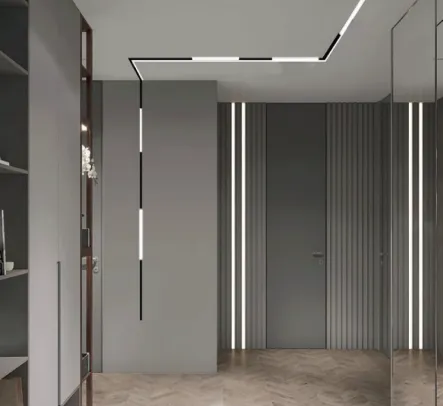
Picture this: You're walking into your living room after a long day. Instead of a harsh overhead glare hitting your tired eyes, you're greeted by a warm, inviting glow that seems to dance around the room. It illuminates just where you need it - your favorite reading chair, that special artwork on the wall, the side table where you place your evening tea. This isn't magic; it's the elegant science of no-main-light design.
For decades, we've been conditioned to think of lighting as a simple necessity - something that needs to be "bright enough." But that single chandelier or central ceiling light that once defined our spaces now feels about as sophisticated as using a sledgehammer to crack a walnut. The truth is, our lighting needs are as varied as our moods throughout the day. We require bright, focused light for reading in the evening, but soft ambient lighting for relaxation. The solution? A layered lighting system that replaces that single central source with a constellation of purpose-driven fixtures.
No-main-light design isn't about having less light—it's about having the right light, in the right places, at the right intensity. It's a fundamental shift from thinking "How bright is this space?" to "How can lighting enhance this experience?"
Imagine your space as a theatre production. Instead of flooding the entire stage with uniform brightness (like that single ceiling fixture), you create scenes. Spotlights highlight architectural details or artwork. Wash lighting creates mood and atmosphere. Task lighting ensures activities can be performed comfortably. The magnetic track lights, downlights, and light strips are your versatile actors that help create this layered lighting system.
Traditional lighting dumps uniform light everywhere regardless of actual needs. No-main-light design puts illumination exactly where it matters - your reading nook, kitchen counter, dressing area. It's efficient, elegant, and eliminates wasted light energy.
Central lighting often forces you to look directly at bright light sources. Distributed lighting with magnetic track lights and well-shielded downlights creates comfortable illumination without the eyestrain and shadows.
With customizable layers of light, you can completely transform a space's atmosphere. Dinner parties get bright and energetic; evening relaxation turns soft and intimate. Your space evolves with your life.
Thoughtfully layered lighting makes colors pop, textures come alive, and spaces feel larger and more inviting. It creates moments of visual delight that positively impact mood and well-being.
Magnetic track lighting offers unparalleled adaptability. As your needs change, you can rearrange fixtures without rewiring. Add, remove, or redirect spotlights to follow your life's evolution.
The real magic happens when you realize lighting isn't just about seeing—it's about feeling. When done right, lighting evokes emotions. The soft glow from under-cabinet lights while preparing dinner creates calm. The focused beam on your reading chair signals cozy comfort. Accent lighting on bookshelves suggests intellectual richness. Distributed lighting tells a story about how you live.
Think of magnetic track lighting as your home's adjustable spotlight system. Instead of being stuck with fixed lighting positions, magnetic tracks let you place, move, or swap fixtures without rewiring. Need to highlight a new painting? Slide the spotlight over. Cooking more often? Add a task light above the counter. This flexibility makes it ideal for spaces that evolve.
Downlights are the quiet heroes of no-main-light schemes. Well-placed recessed lights with anti-glare baffles create a comfortable base layer of illumination without calling attention to themselves. Modern ultra-slim designs with precision optics disappear almost completely into ceilings while providing beautiful, even light distribution.
Strategic placement matters: Space downlights about 1.2-1.5m apart in living areas and hallways. For accent lighting, position them closer to walls to create beautiful grazing effects on textures. Combine with dimmers and you have an invisible foundation that supports all other lighting layers.
Light strips are the magicians of mood lighting. Hidden inside coves, under cabinets, or behind furniture, they create soft, glowing pockets of light that seem to float. Modern LED strips offer incredible versatility—adjustable brightness, tunable white light, and even color options. But perhaps their greatest strength is how they transform architectural features into illuminated artwork.
Consider how they enhance spaces:
Effective no-main-light design requires thoughtful planning tailored to each room's purpose:
The lighting trinity becomes truly magical with smart controls. Modern systems allow for:
The greatest risk in lighting design? Losing sight of simplicity amidst possibilities. Overloading a space with too many fixtures creates visual chaos and wastes energy. Remember: Start with essentials first, then layer in decorative accents.
Other common challenges and solutions:
Solution: Stick to one temperature per space. No blending warm and cool whites! Choose 2700-3000K for bedrooms, 3000-3500K for living areas, and 4000K for task areas.
Solution: Plan transformer placement during design—ceiling bulkheads, closet tops, or access panels. Calculate your total wattage and allow at least 20% buffer capacity.
Solution: Calculate requirements properly: 100-200 lux for general living, 300-500 lux for kitchen tasks, 50-100 lux for mood lighting. Use an online lighting calculator.
Solution: Specify high-quality fixtures with accessible drivers and easily replaceable LEDs. Avoid cheap LED strips that degrade quickly.
As we move beyond the era of single-source illumination, the combination of magnetic track lights, downlights, and light strips represents the new standard in residential lighting. This layered lighting approach offers unparalleled flexibility, mood-setting capability, and visual comfort that traditional systems can't match.
Remember, lighting isn't just functional infrastructure—it's an essential element of interior character. The play of light and shadow defines
Recommend Products












