
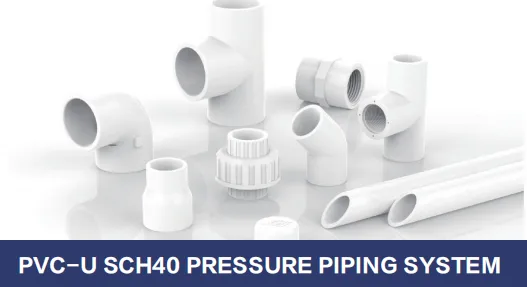
Beneath the floors of our homes, behind the walls of hospitals, and along the streets of our cities, there's an unsung network that keeps life flowing smoothly: piping systems. These silent workhorses carry water to our taps, distribute fluids in industrial plants, and ensure clean irrigation for farms. But not all pipes are created equal. When projects demand reliability under pressure—whether it's a high-rise apartment's water supply or a school's drinking water line—one material stands out: PVC-U SCH40. In this guide, we'll dive into the technical heart of this essential building component, exploring its specs, the standards that govern it, and why choosing the right PVC-U SCH40 pressure piping system supplier matters just as much as the material itself.
Let's start with the basics. PVC-U, or unplasticized polyvinyl chloride, is a rigid, durable plastic polymer. Unlike its flexible cousin (PVC), PVC-U skips the plasticizers, making it stiffer and more resistant to pressure and heat. The "SCH40" designation refers to its "schedule"—a standard that defines wall thickness, and thus, pressure-bearing capacity. Think of SCH40 as the "workhorse" grade: thick enough to handle moderate to high pressure, yet lightweight enough to simplify installation.
Manufactured through a process of extrusion, PVC-U SCH40 pipes are formed by melting PVC resin with stabilizers, impact modifiers, and pigments, then forcing the mixture through a die to create seamless, uniform tubes. The result? A pipe that balances strength, affordability, and versatility—qualities that have made it a staple for residential building materials supplier and commercial projects alike.
When engineers, contractors, or even homeowners evaluate piping, they're looking for hard data. Here's a breakdown of the key technical specs that define PVC-U SCH40:
| Specification | Details | Why It Matters |
|---|---|---|
| Dimensions | Available in diameters from ½" to 24" (common sizes: 1", 2", 4"); standard lengths of 10ft or 20ft; wall thickness varies by diameter (e.g., 1" pipe has ~0.133" wall thickness). | Ensures compatibility with existing systems and meets flow rate requirements. |
| Pressure Rating | Typically 160 psi at 73°F (23°C); decreases with temperature (e.g., 112 psi at 100°F/38°C). | Determines if the pipe can handle the system's operating pressure without bursting. |
| Chemical Resistance | Resistant to acids, alkalis, salts, and most organic solvents (except strong oxidizers like concentrated sulfuric acid). | Crucial for industrial applications or areas with aggressive water chemistry. |
| Temperature Range | Operates safely between 33°F (1°C) and 140°F (60°C); prolonged exposure above 140°F may weaken the material. | Defines suitable use cases (e.g., cold water supply vs. hot water lines, where PPR might be preferred—more on that later). |
| Weight | Lightweight: A 10ft length of 2" SCH40 pipe weighs ~3.6 lbs, compared to ~28 lbs for a steel pipe of the same size. | Eases transportation, reduces labor costs, and minimizes structural load on buildings. |
| Fire Performance | Self-extinguishing; does not support combustion once the flame source is removed. | Enhances safety in commercial spaces like hospitals and schools, aligning with building codes. |
These specs aren't arbitrary. They're the result of rigorous testing, ensuring that a 2" SCH40 pipe from one pipes fittings supplier performs consistently with another—provided both adhere to industry standards.
Imagine buying a pipe labeled "SCH40" only to find its wall thickness is thinner than advertised—that's where standards come in. Global organizations like ASTM International and DIN set benchmarks to ensure uniformity, safety, and reliability. For PVC-U SCH40, two standards reign supreme:
Published by ASTM International, D1785 is the most widely recognized standard for PVC-U pressure pipes. It specifies everything from dimensional tolerances (how much a pipe's diameter can vary) to mechanical properties like tensile strength and impact resistance. For example, under D1785, a SCH40 pipe must withstand a "notch impact test" at 0°F (-18°C) without cracking—a critical check for cold-weather regions.
Compliance with D1785 isn't optional for reputable suppliers. When evaluating a PVC-U SCH40 pressure piping system supplier , ask for D1785 certification; it's proof the product has passed third-party testing for pressure, durability, and safety.
In Europe and parts of Asia, DIN 8062 takes the lead. Similar to ASTM, it outlines dimensions, pressure ratings, and testing methods, but with slight variations in sizing (metric vs. imperial) and pressure classes. For example, DIN 8062 defines "PN" (pressure nominal) ratings, where PN10 pipes correspond roughly to SCH40 in pressure capacity. This standard is especially relevant for projects in regions like Saudi Arabia, where saudi arabia building materials supplier often source materials compliant with both local and international norms.
ISO 1452-2 (international), BS EN 1452-2 (British), and AS/NZS 1477 (Australian) also govern PVC-U piping, each with nuanced requirements for local conditions. The takeaway? A quality pipe should meet at least one of these standards—non-compliant products risk leaks, bursts, or premature failure.
PVC-U SCH40 isn't a one-trick pony. Its balance of pressure resistance and affordability makes it ideal for a range of uses:
From single-family homes to apartment complexes, SCH40 pipes deliver cold water to kitchens, bathrooms, and gardens. Their smooth inner surface minimizes friction, reducing energy use for pumps, while their corrosion resistance ensures decades of rust-free service—no small feat for a residential building materials supplier aiming to build trust with homeowners.
Hospitals, schools, and office towers demand reliable piping. SCH40's fire resistance and low maintenance align with strict building codes, while its lightweight design cuts installation time in multi-story projects. Even in specialized spaces like labs or cafeterias, where chemical exposure is possible, SCH40's chemical resistance (to most cleaning agents, for example) keeps systems intact.
Beyond buildings, SCH40 serves municipal water distribution, irrigation systems, and industrial process lines (for non-corrosive fluids like coolants or water-based solutions). Municipal engineers favor it for its long lifespan (50+ years with proper installation) and low lifecycle cost, while farmers appreciate its resistance to soil chemicals and easy buried installation.
With options like PPR, copper, and even other PVC types (like DWV), why choose SCH40? Let's stack it up against common alternatives:
PVC DWV (Drain, Waste, Vent) is another PVC variant, but it's designed for gravity-fed systems like sinks or showers—not pressure. DWV pipes have thinner walls (SCH20 or lower) and lower pressure ratings, making them unsuitable for water supply. A PVC DWV pipe supplier will emphasize drainage performance, while SCH40 suppliers focus on pressure endurance—two distinct roles.
PPR (polypropylene random copolymer) is a popular choice for hot water systems, thanks to its heat resistance (up to 200°F/93°C). But for cold water pressure applications, SCH40 often wins on cost and availability. A PPR pipe and fitting supplier might pitch PPR for radiant heating, but for a school's drinking water line, SCH40's lower price and proven track record make it the pragmatic pick.
Copper is durable but heavy, expensive, and prone to corrosion in acidic water. SCH40, by contrast, weighs 70% less than copper, costs a fraction, and resists rust—no wonder commercial building materials supplier increasingly opt for PVC-U in large-scale projects.
A pipe is only as good as the company that makes it. Here's how to spot a reliable PVC-U SCH40 pressure piping system supplier :
Ask for ASTM D1785, ISO 9001 (quality management), and local certifications (e.g., SASO for Saudi Arabia). These documents prove the supplier adheres to global quality standards.
Pipes alone aren't enough—you need fittings (elbows, tees, valves) to complete the system. Opt for suppliers who also act as a pipes fittings supplier ; matching pipes and fittings from the same manufacturer ensures compatibility and reduces leak risks.
Inquire about in-house testing: Do they check each batch for wall thickness? Conduct pressure tests? A supplier that invests in quality control shows they care about your project's success.
Even the best products need guidance. Look for suppliers who offer technical support—help with sizing, installation tips, or troubleshooting. A supplier that takes time to understand your project (residential vs. industrial) is a partner, not just a vendor.
Even top-tier SCH40 pipe can fail if installed poorly. Here are key best practices:
Maintenance is minimal but critical: Inspect for leaks annually, avoid exposing pipes to direct sunlight (UV rays degrade PVC over time), and never use harsh chemicals (like drain cleaners) that exceed the pipe's chemical resistance limits. With care, SCH40 systems can outlast the buildings they serve.
Let's bring this to life with a real-world example. In Riyadh, Saudi Arabia, a construction firm recently built a 500-unit residential complex. For the water supply system, they chose PVC-U SCH40 pipes from a local saudi arabia building materials supplier certified to ASTM D1785. The decision boiled down to three factors: cost (30% cheaper than copper), speed of installation (lightweight pipes reduced labor time by 25%), and durability (the supplier guaranteed 50-year performance). Today, two years post-construction, the complex reports zero leaks or pressure issues—a testament to SCH40's reliability when paired with quality materials and skilled installation.
PVC-U SCH40 pressure piping isn't just a product—it's a promise. A promise of consistent pressure, long life, and peace of mind for homeowners, engineers, and communities. Its technical specs—from wall thickness to pressure ratings—are the blueprints of that promise, while standards like ASTM D1785 ensure it's kept. And when paired with a trusted PVC-U SCH40 pressure piping system supplier —one that prioritizes certifications, quality, and support—SCH40 becomes more than a pipe: it's the backbone of projects that stand the test of time.
So the next time you turn on a tap or walk into a hospital, take a moment to appreciate the SCH40 pipes working behind the scenes. They may be out of sight, but their impact? Undeniably visible.
Recommend Products












